第21集:马来亚民族解放同盟(解盟):地下生命线与国际反帝战线(1949–1969)
Episode 21: The Malayan National Liberation League (MNLL): Clandestine Lifelines and the International Anti-Imperialist Front (1949–1969)
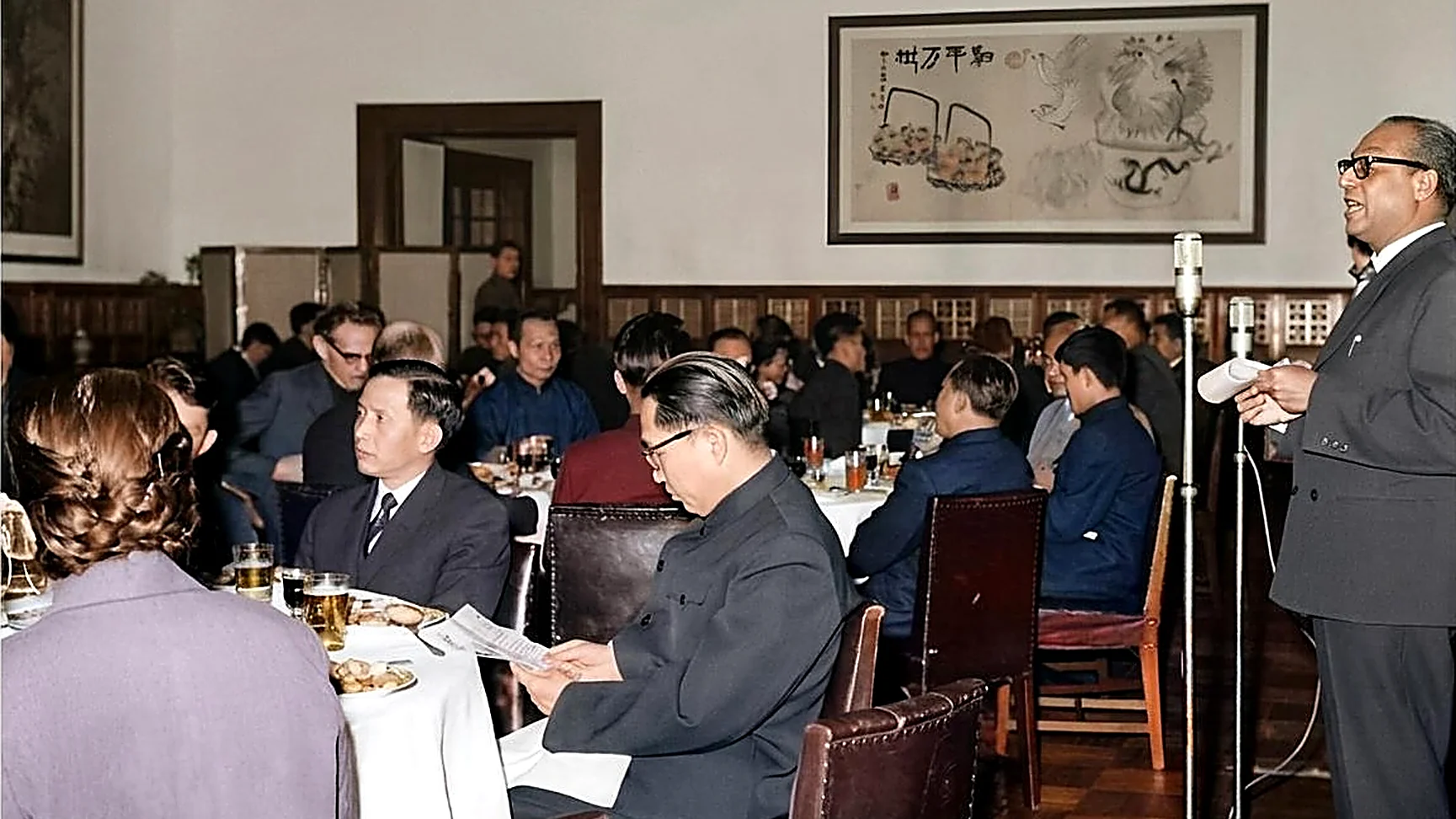
1949年2月1日,在紧急状态白色恐怖的高潮中,马共中央将全马各州地下进步组织整编为统一的秘密群众统战机构:马来亚民族解放同盟(简称“解盟”/ MNLL)。解盟在严酷的军事管制与新村铁丝网下建立起毛细血管般的“民运”生命线,保障了民族解放军长期的后勤物资补给与情报传递。进入1960年代,解盟相继在雅加达与北京建立海外常驻代表团,冲破外交封锁,登上亚非团结与国际反帝舞台;在经历印尼“九三〇政变”血火考验后,代表团核心成员最终于1969年调赴湖南参与创建“马来亚革命之声广播电台”,在现代马来亚反帝民族解放运动史上书写了不可磨灭的统战与外交篇章。
On February 1, 1949, amidst the height of Emergency martial law, the CPM Central Committee consolidated regional underground groups into a unified clandestine mass organization: the Malayan National Liberation League (MNLL). Operating under barbed-wire internment and brutal counter-insurgency, the MNLL forged capillary 'Min Yuen' supply lines providing medical aid, food, and intelligence for the MNLA. During the 1960s, the League established overseas missions in Jakarta and Beijing, breaking diplomatic isolation across the Afro-Asian anti-imperialist stage. Surviving the violent aftermath of the 1965 Indonesian coup, the League's leadership transitioned in 1969 to help establish the Voice of the Malayan Revolution (VMR) radio, cementing an enduring legacy of multi-ethnic solidarity, clandestine resistance, and international diplomacy.
第一章:统一战线的烽火前驱:从“荣誉红白旗”到1949年解盟的诞生
Chapter 1: Vanguard of the United Front — From 'Sang Saka Malaya' to the Birth of the MNLL
第二次世界大战日本战败投降后,重返马来半岛的英国殖民统治者企图强推带有浓厚殖民统制色彩的‘马来亚联邦’(Malayan Union)宪制方案,激起了全马各族民众空前强烈的反对浪潮。在激荡的反殖民启蒙中,全马进步政治力量与群众团体迅速集结,形成了现代马来亚历史上第一个跨越族群与阶层的反帝民主统一战线:‘人民力量中心-全马联合行动委员会’(PUTERA-AMCJA)。
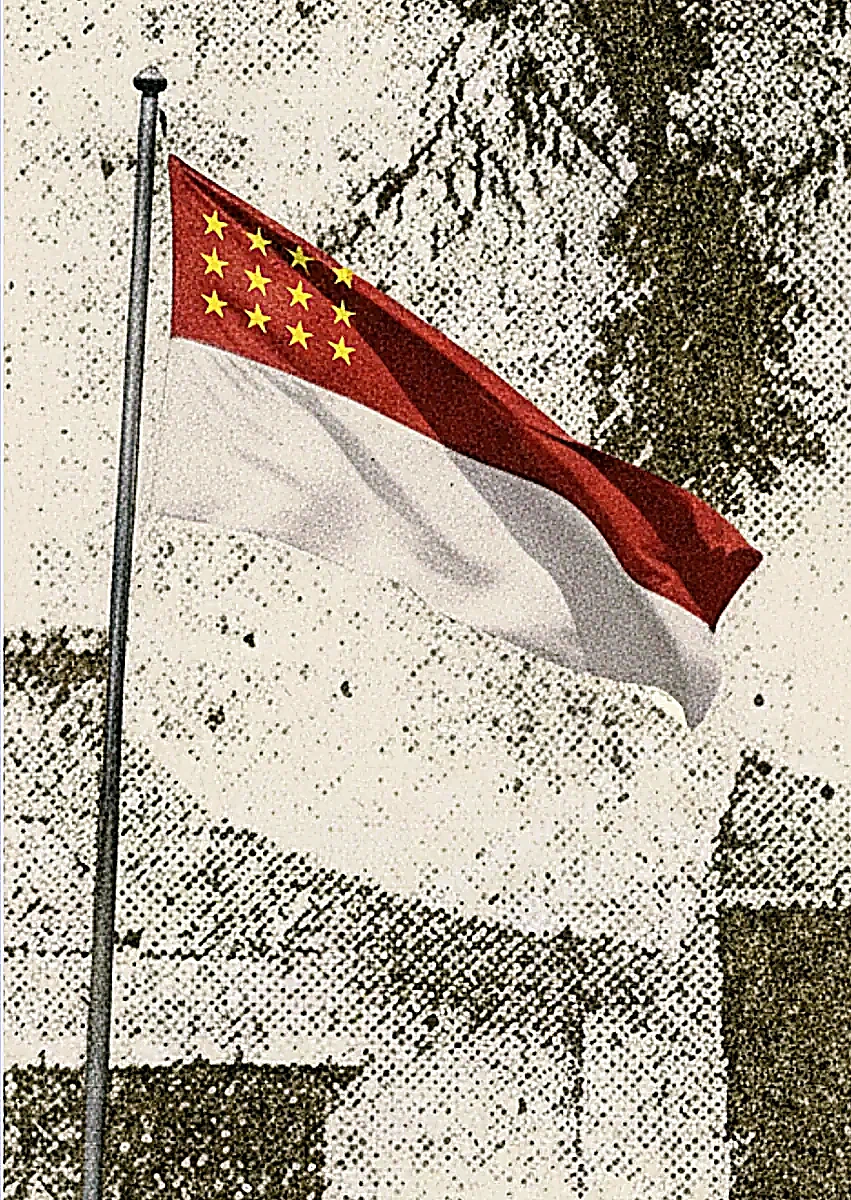
作为这一民主阵营的重要推动力量,由战后知识分子和爱国青年创办的新加坡最早政党之一:马来亚民主同盟(Malayan Democratic Union,简称‘马盟’/ MDU),与布哈努丁博士领导的马来民族党(PKMM)并肩作战。1947年11月11日,马盟在新加坡总部庄严升起了‘荣誉红白旗’(Sang Saka Malaya)。在马来古典语汇中,‘Sang’意为神圣,‘Saka’意为图腾旗帜,这面象征着古老马来群岛反帝尊严的红白旗帜,公开向国际社会表达了各族先驱对建立一个包含新加坡在内、完整统一且独立自主的现代马来亚共和国的坚定愿景。
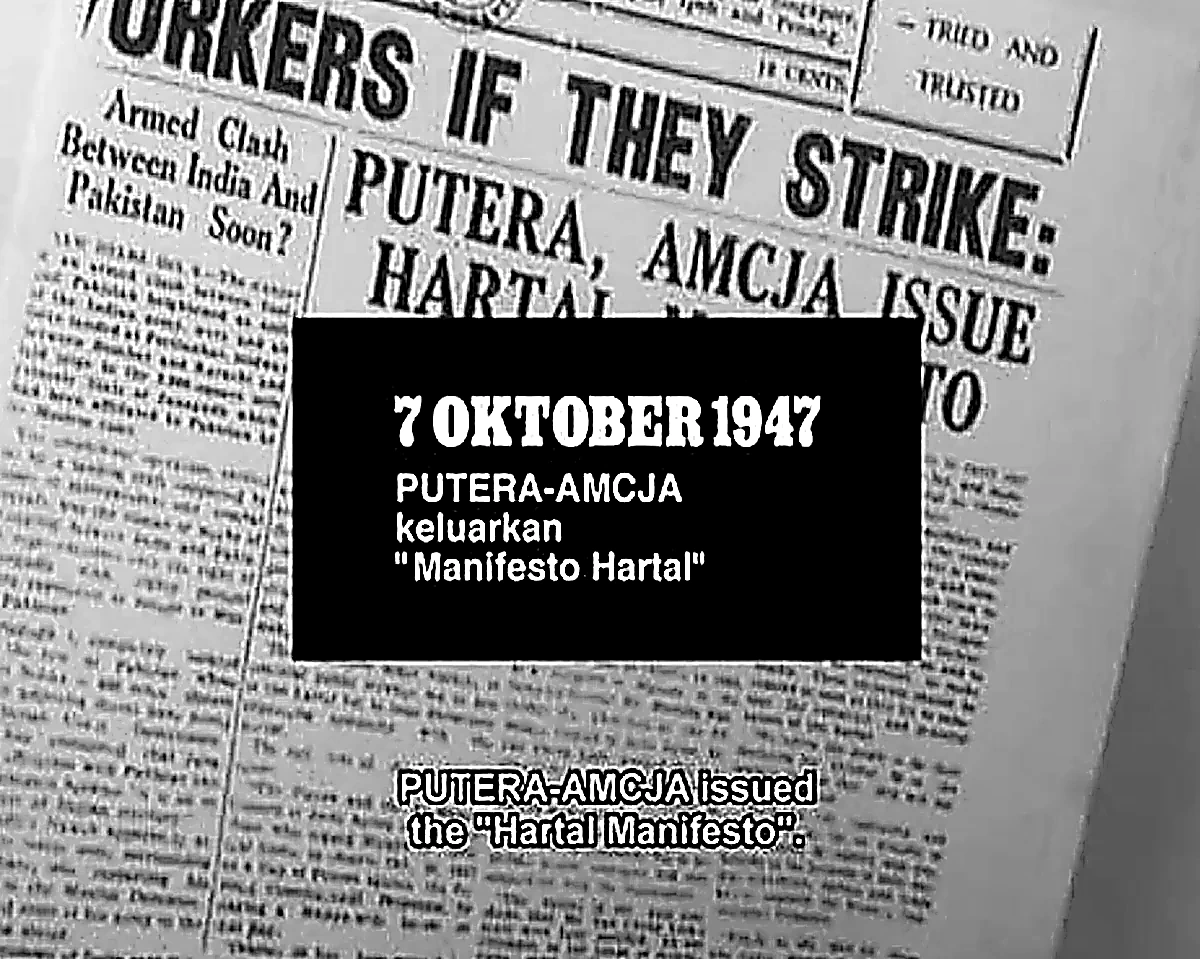
1947年,PUTERA-AMCJA 联盟正式颁布了由各族人民民主商榷铸就的《人民宪章草案》(People's Constitutional Proposals),并于同年10月20日发动了席卷全半岛与新加坡的‘全马大罢市’(Hartal)。面对这一空前强大的宪政民意,大英帝国不仅拒绝接受和平宪政改革,反而在1948年6月20日借故全面颁布‘紧急状态法令’,动用军警特务暴力查封所有公开进步政党与工会,逮捕、拘禁与驱逐了成千上万名反帝骨干。宪政和平道路被殖民国家机器彻底斩断。
在严酷的白色恐怖下,被取缔的进步力量并未瓦解,而是迅速转入地下。在新加坡、霹雳、吉打与槟城,爱国志士重组为‘抗英同盟’(Anti-British League,简称 ABL);在柔佛与雪兰莪,地下网络则以‘马来亚独立同盟’的名义继续坚持斗争。1949年2月1日,为了适应全面武装斗争与反抗殖民暴政的需要,马共中央果断将各地分散的地下秘密团体统一整编为高度严密的全国性革命统一战线组织:马来亚民族解放同盟(Malayan National Liberation League,简称‘解盟’/ MNLL)。解盟的诞生,标志着全马反帝武装抵抗拥有了最广泛的民间同盟者与坚实的政治后盾和后勤保障。
Following Japan's surrender in World War II, the returning British colonial authorities sought to enforce the authoritarian 'Malayan Union' constitutional scheme, triggering an unprecedented wave of anti-colonial resistance across the peninsula and Singapore. Amidst this democratic awakening, progressive political forces coalesced into the first comprehensive multi-ethnic united front in modern Malayan history: PUTERA-AMCJA (Pusat Tenaga Rakyat and All-Malaya Council of Joint Action).
As a pivotal component of this democratic alliance, the Malayan Democratic Union (MDU)—one of Singapore's earliest post-war parties founded by patriotic intellectuals—collaborated closely with the Malay Nationalist Party (PKMM) led by Dr. Burhanuddin al-Helmy. On November 11, 1947, the MDU hoisted the 'Sang Saka Malaya' (The Sacred Banner of Malaya) flag at its Singapore headquarters. Deriving from classical Austronesian terms where 'Sang' signifies sacred honor and 'Saka' denotes a sovereign emblem, the banner publicly demonstrated the vision of an independent, unified nation encompassing both Malaya and Singapore.
In 1947, PUTERA-AMCJA formulated the historic 'People's Constitutional Proposals' and executed the peninsula-wide Hartal (general strike) on October 20. Confronted with this organized civic movement, British imperialism rejected peaceful constitutional evolution. On June 20, 1948, Whitehall declared the Emergency, deploying paramilitary forces to proscribe progressive parties, unions, and associations, detaining, torturing, and deporting thousands of activists. The path of peaceful constitutional agitation was violently suppressed.
Under intense martial surveillance, outlawed activists transitioned into clandestine networks. In Singapore, Perak, Kedah, and Penang, they operated under the banner of the Anti-British League (ABL); in Johor and Selangor, they mobilized as the Malayan Independence League. On February 1, 1949, the CPM Central Committee consolidated these decentralized networks into a single, disciplined revolutionary united front: the Malayan National Liberation League (MNLL). The formation of the MNLL established an indispensable clandestine mass foundation and political rear guard for the Malayan National Liberation Army (MNLA).
第二次世界大战日本战败投降后,重返马来半岛的英国殖民统治者企图强推带有浓厚殖民统制色彩的‘马来亚联邦’(Malayan Union)宪制方案,激起了全马各族民众空前强烈的反对浪潮。在激荡的反殖民启蒙中,全马进步政治力量与群众团体迅速集结,形成了现代马来亚历史上第一个跨越族群与阶层的反帝民主统一战线:‘人民力量中心-全马联合行动委员会’(PUTERA-AMCJA)。
作为这一民主阵营的重要推动力量,由战后知识分子和爱国青年创办的新加坡最早政党之一:马来亚民主同盟(Malayan Democratic Union,简称‘马盟’/ MDU),与布哈努丁博士领导的马来民族党(PKMM)并肩作战。1947年11月11日,马盟在新加坡总部庄严升起了‘荣誉红白旗’(Sang Saka Malaya)。在马来古典语汇中,‘Sang’意为神圣,‘Saka’意为图腾旗帜,这面象征着古老马来群岛反帝尊严的红白旗帜,公开向国际社会表达了各族先驱对建立一个包含新加坡在内、完整统一且独立自主的现代马来亚共和国的坚定愿景。
Following Japan's surrender in World War II, the returning British colonial authorities sought to enforce the authoritarian 'Malayan Union' constitutional scheme, triggering an unprecedented wave of anti-colonial resistance across the peninsula and Singapore. Amidst this democratic awakening, progressive political forces coalesced into the first comprehensive multi-ethnic united front in modern Malayan history: PUTERA-AMCJA (Pusat Tenaga Rakyat and All-Malaya Council of Joint Action).
As a pivotal component of this democratic alliance, the Malayan Democratic Union (MDU)—one of Singapore's earliest post-war parties founded by patriotic intellectuals—collaborated closely with the Malay Nationalist Party (PKMM) led by Dr. Burhanuddin al-Helmy. On November 11, 1947, the MDU hoisted the 'Sang Saka Malaya' (The Sacred Banner of Malaya) flag at its Singapore headquarters. Deriving from classical Austronesian terms where 'Sang' signifies sacred honor and 'Saka' denotes a sovereign emblem, the banner publicly demonstrated the vision of an independent, unified nation encompassing both Malaya and Singapore.
1947年,PUTERA-AMCJA 联盟正式颁布了由各族人民民主商榷铸就的《人民宪章草案》(People's Constitutional Proposals),并于同年10月20日发动了席卷全半岛与新加坡的‘全马大罢市’(Hartal)。面对这一空前强大的宪政民意,大英帝国不仅拒绝接受和平宪政改革,反而在1948年6月20日借故全面颁布‘紧急状态法令’,动用军警特务暴力查封所有公开进步政党与工会,逮捕、拘禁与驱逐了成千上万名反帝骨干。宪政和平道路被殖民国家机器彻底斩断。
In 1947, PUTERA-AMCJA formulated the historic 'People's Constitutional Proposals' and executed the peninsula-wide Hartal (general strike) on October 20. Confronted with this organized civic movement, British imperialism rejected peaceful constitutional evolution. On June 20, 1948, Whitehall declared the Emergency, deploying paramilitary forces to proscribe progressive parties, unions, and associations, detaining, torturing, and deporting thousands of activists. The path of peaceful constitutional agitation was violently suppressed.
在严酷的白色恐怖下,被取缔的进步力量并未瓦解,而是迅速转入地下。在新加坡、霹雳、吉打与槟城,爱国志士重组为‘抗英同盟’(Anti-British League,简称 ABL);在柔佛与雪兰莪,地下网络则以‘马来亚独立同盟’的名义继续坚持斗争。1949年2月1日,为了适应全面武装斗争与反抗殖民暴政的需要,马共中央果断将各地分散的地下秘密团体统一整编为高度严密的全国性革命统一战线组织:马来亚民族解放同盟(Malayan National Liberation League,简称‘解盟’/ MNLL)。解盟的诞生,标志着全马反帝武装抵抗拥有了最广泛的民间同盟者与坚实的政治后盾和后勤保障。
Under intense martial surveillance, outlawed activists transitioned into clandestine networks. In Singapore, Perak, Kedah, and Penang, they operated under the banner of the Anti-British League (ABL); in Johor and Selangor, they mobilized as the Malayan Independence League. On February 1, 1949, the CPM Central Committee consolidated these decentralized networks into a single, disciplined revolutionary united front: the Malayan National Liberation League (MNLL). The formation of the MNLL established an indispensable clandestine mass foundation and political rear guard for the Malayan National Liberation Army (MNLA).
第二章:反殖纲领与时代宣言:《解盟宣言》对新殖民主义秩序的深刻剖析
Chapter 2: The Anti-Colonial Manifesto — The MNLL's Critique of the Neo-Colonial Order
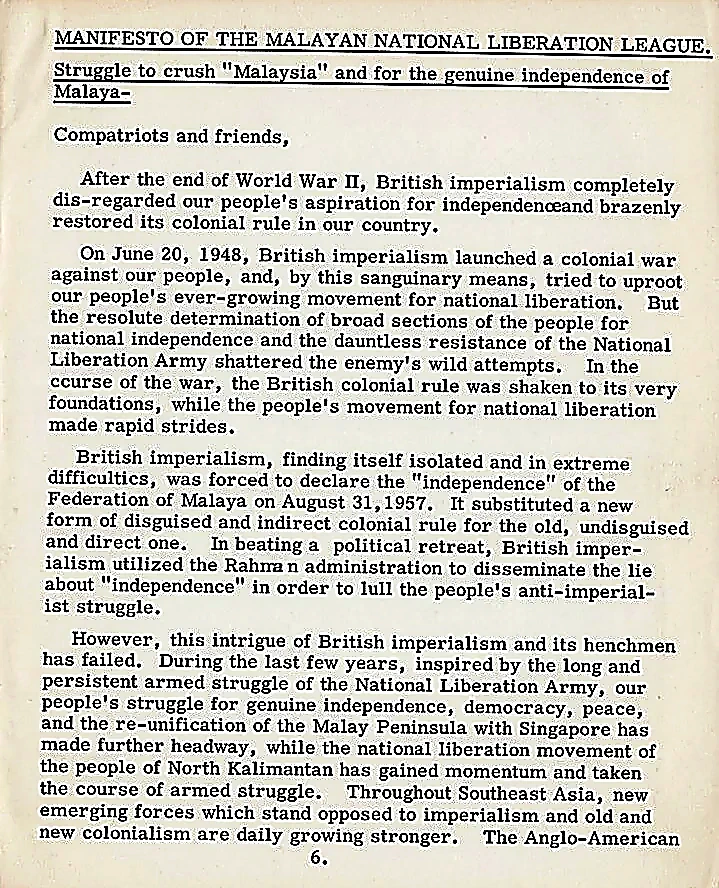
作为团结马来半岛与新加坡各阶层的秘密政治先锋,解盟不仅承担着极为沉重的地下后勤重任,更在反帝思想战线上发挥了深刻的政治引领作用。解盟正式发布的历史文献《解盟宣言:粉碎“马来西亚”,争取马来亚真正独立》(Manifesto of the Malayan National Liberation League),对战后帝国主义统治形式的蜕变作出了极具洞察力的唯物史观剖析。
《解盟宣言》明确指出:二战结束后,大英帝国无视马来亚人民对民族独立的迫切呼声,强行复辟殖民统治;1948年6月20日英国发动殖民战争,妄图以血腥镇压扼杀民族解放运动。然而,民族解放军在热带丛林中的坚决抵抗与广大人民群众的不屈支持,动摇了殖民统治的根基,令伦敦在财政赤字与军事僵局中深陷孤立。正是在这一沉重代价逼迫下,英国殖民者才不得不在1957年8月31日宣布马来亚联合邦‘独立’,以此换取间接的新殖民主义统治,保障英国垄断资本与军事基地在东南亚的长久存续。
针对1963年英美帝国主义主导炮制的“马来西亚”新殖民主义计划,解盟在1965年3月15日发表的宣言中予以了严肃的政治批判。宣言揭露这一强行合并工程实质上是将北加里曼丹人民与新加坡捆绑进受冷战同盟保护的新殖民主义架构之中,背离了民族自决权准则。解盟向全马各族同胞郑重宣告:人民必须团结一致,反抗政治压迫,争取真正的国家完全独立、各民族平等、社会正义与人的基本尊严,并为马来半岛与新加坡在平等自主基础上的重新统一而奋斗。
这份纲领性宣言体现了解盟作为现代反殖统一战线组织的政治与理论成熟度。它不仅超越了狭隘的种族主义分化图谋,将斗争焦点锁定在宗主国政治经济特权与军事基地霸权之上,更在冷战白热化阶段确立了马来亚人民争取真正独立、反干涉的国际道义合法性。
As a clandestine vanguard uniting diverse strata across Malaya and Singapore, the MNLL functioned not only as an operational artery but also as a primary political compass. The league's foundational manifesto—*Manifesto of the Malayan National Liberation League: Struggle to Crush 'Malaysia' and for the Genuine Independence of Malaya*—presented an incisive materialist critique of the post-war imperialist transition.
The Manifesto expounded that following World War II, British imperialism brazenly disregarded popular aspirations for self-determination. When the colonial war of June 20, 1948 failed to extinguish popular resistance due to the tenacity of the MNLA and the endurance of rural communities, Whitehall was forced to recalculate. Confronted with fiscal exhaustion and military stalemate, London conceded formal independence to the Federation of Malaya on August 31, 1957, substituting direct colonial governance with indirect neo-colonial hegemony to safeguard British economic concessions and military enclaves.
Regarding the 1963 formation of the Federation of Malaysia, the MNLL mounted a rigorous political critique, identifying the project as an Anglo-American neo-colonial contraption engineered to circumvent genuine self-determination in North Kalimantan and Singapore. The Manifesto called for broad popular solidarity to resist oppression, establish genuine independence, guarantee ethnic parity and human dignity, and work toward the sovereign reunification of the Malayan Peninsula and Singapore.
This seminal manifesto demonstrated the ideological maturity of the MNLL. By piercing through divide-and-rule racialist narratives and focusing on foreign monopolistic control and military pacts, it consolidated the historical and moral legitimacy of the Malayan national liberation struggle on the international plane.
作为团结马来半岛与新加坡各阶层的秘密政治先锋,解盟不仅承担着极为沉重的地下后勤重任,更在反帝思想战线上发挥了深刻的政治引领作用。解盟正式发布的历史文献《解盟宣言:粉碎“马来西亚”,争取马来亚真正独立》(Manifesto of the Malayan National Liberation League),对战后帝国主义统治形式的蜕变作出了极具洞察力的唯物史观剖析。
《解盟宣言》明确指出:二战结束后,大英帝国无视马来亚人民对民族独立的迫切呼声,强行复辟殖民统治;1948年6月20日英国发动殖民战争,妄图以血腥镇压扼杀民族解放运动。然而,民族解放军在热带丛林中的坚决抵抗与广大人民群众的不屈支持,动摇了殖民统治的根基,令伦敦在财政赤字与军事僵局中深陷孤立。正是在这一沉重代价逼迫下,英国殖民者才不得不在1957年8月31日宣布马来亚联合邦‘独立’,以此换取间接的新殖民主义统治,保障英国垄断资本与军事基地在东南亚的长久存续。
As a clandestine vanguard uniting diverse strata across Malaya and Singapore, the MNLL functioned not only as an operational artery but also as a primary political compass. The league's foundational manifesto—*Manifesto of the Malayan National Liberation League: Struggle to Crush 'Malaysia' and for the Genuine Independence of Malaya*—presented an incisive materialist critique of the post-war imperialist transition.
The Manifesto expounded that following World War II, British imperialism brazenly disregarded popular aspirations for self-determination. When the colonial war of June 20, 1948 failed to extinguish popular resistance due to the tenacity of the MNLA and the endurance of rural communities, Whitehall was forced to recalculate. Confronted with fiscal exhaustion and military stalemate, London conceded formal independence to the Federation of Malaya on August 31, 1957, substituting direct colonial governance with indirect neo-colonial hegemony to safeguard British economic concessions and military enclaves.
针对1963年英美帝国主义主导炮制的“马来西亚”新殖民主义计划,解盟在1965年3月15日发表的宣言中予以了严肃的政治批判。宣言揭露这一强行合并工程实质上是将北加里曼丹人民与新加坡捆绑进受冷战同盟保护的新殖民主义架构之中,背离了民族自决权准则。解盟向全马各族同胞郑重宣告:人民必须团结一致,反抗政治压迫,争取真正的国家完全独立、各民族平等、社会正义与人的基本尊严,并为马来半岛与新加坡在平等自主基础上的重新统一而奋斗。
这份纲领性宣言体现了解盟作为现代反殖统一战线组织的政治与理论成熟度。它不仅超越了狭隘的种族主义分化图谋,将斗争焦点锁定在宗主国政治经济特权与军事基地霸权之上,更在冷战白热化阶段确立了马来亚人民争取真正独立、反干涉的国际道义合法性。
Regarding the 1963 formation of the Federation of Malaysia, the MNLL mounted a rigorous political critique, identifying the project as an Anglo-American neo-colonial contraption engineered to circumvent genuine self-determination in North Kalimantan and Singapore. The Manifesto called for broad popular solidarity to resist oppression, establish genuine independence, guarantee ethnic parity and human dignity, and work toward the sovereign reunification of the Malayan Peninsula and Singapore.
This seminal manifesto demonstrated the ideological maturity of the MNLL. By piercing through divide-and-rule racialist narratives and focusing on foreign monopolistic control and military pacts, it consolidated the historical and moral legitimacy of the Malayan national liberation struggle on the international plane.
第三章:毛细血管般的隐蔽战线:民运网络、秘密印刷所与森林生命线
Chapter 3: The Capillary Underground — Min Yuen Networks, Clandestine Presses, and Border Lifelines
在英帝国军警布下的天罗地网与‘布里格斯计划’集中营(新村)的高墙铁丝网下,解盟建立起了一套扎根基层的隐蔽毛细血管网络:‘民运’组织(Min Yuen,负责保障部队补给与情报的后勤部、传递情报的交通组,需要时也参加战斗)。他们生活在敌人的眼皮底下,表面上是胶工、菜农、码头苦力、华校教师、报社排字工甚至殖民政府的低级雇员,但在暗夜中,他们是马共和民族解放军不可动摇的情报耳目与物资后盾。
每一个解盟支部都奉行严密的‘单线联系’纪律。交通员们冒着被处以绞刑的极刑危险,将一袋袋大米、一瓶瓶奎宁药品、电池与布匹,巧妙地藏在双层底胶桶、自行车大梁或空心木料中,突破英军在村口的搜身哨卡,在预定时间送达雨林边缘的‘死信箱’与‘秘密接头点’。正是靠着解盟民运工作者建立的隐蔽补给线,转战深山的游击健儿们才得以在长达数年的严酷封锁与飞机轰炸下维持长期抵抗。
除了后勤生命线,解盟还是穿透殖民者新闻封锁的思想阵地。在吉隆坡的贫民窟、新加坡惹兰勿刹的秘密阁楼、怡保后巷的印刷作坊里,解盟地下工作者用简陋的铁笔与蜡纸油印机,通宵达旦地刻印《自由报》、《战友报》、《人民呼声报》等地下刊物。这些油印传单与报纸被秘密散发到各大工矿、种植园与大中学校,向各民族劳苦大众阐明战后经济掠夺与政治戒严的真相。
解盟的隐蔽战线更是一场惊心动魄的情报博弈。殖民地警方政治部(Special Branch)竭尽全力试图渗透解盟,但解盟依靠严谨的群众纪律与底层社会的掩护,多次在英军发动大规模清剿前向深山根据地送出预警,使军警重兵合围屡屡扑空。大批解盟工作者在不幸被捕后经受了严刑逼供,却始终恪守组织秘密,用坚忍的牺牲维系了全马地下抗英网络的生存。
Encircled by extensive colonial security networks and the barbed-wire fences of the Briggs Plan 'New Villages,' the MNLL established a capillary grassroots system: the Min Yuen (logistics, intelligence, and courier network). Operating directly under colonial surveillance as rubber tappers, vegetable growers, wharf dockers, vernacular schoolteachers, and low-ranking municipal clerks, they provided essential intelligence, supplies, and communications to the MNLA.
Every MNLL cell adhered to strict unilateral contact protocols. Couriers risked summary execution under martial regulations to transport rice, quinine, dry batteries, and cotton cloth through military checkpoints, concealing cargo within false-bottomed latex buckets, hollowed bicycle tubing, and lumber shipments to reach forest drop-boxes and rendezvous points. These clandestine conduits enabled guerrilla forces to endure protracted counter-insurgency sweeps in the mountainous interior.
Beyond logistics, the MNLL countered stringent press censorship through underground printshops. In hidden attics in Kuala Lumpur, Singapore, and Ipoh, clandestine cadres operated manual mimeograph presses to publish illegal news bulletins such as *Zhan You Bao* (Comrades-in-Arms), *Worker-Peasant News*, and *Red Star*. Circulated covertly among plantation workers and students, these bulletins countered colonial state narratives.
The underground struggle involved intense counter-intelligence work. Despite infiltration campaigns directed by the colonial Special Branch, the MNLL's organic mass ties enabled it to transmit early warnings of military sweeps, neutralizing encirclement operations. Captured couriers and organizers withstood interrogation and torture, protecting the clandestine network through collective discipline.
在英帝国军警布下的天罗地网与‘布里格斯计划’集中营(新村)的高墙铁丝网下,解盟建立起了一套扎根基层的隐蔽毛细血管网络:‘民运’组织(Min Yuen,负责保障部队补给与情报的后勤部、传递情报的交通组,需要时也参加战斗)。他们生活在敌人的眼皮底下,表面上是胶工、菜农、码头苦力、华校教师、报社排字工甚至殖民政府的低级雇员,但在暗夜中,他们是马共和民族解放军不可动摇的情报耳目与物资后盾。
每一个解盟支部都奉行严密的‘单线联系’纪律。交通员们冒着被处以绞刑的极刑危险,将一袋袋大米、一瓶瓶奎宁药品、电池与布匹,巧妙地藏在双层底胶桶、自行车大梁或空心木料中,突破英军在村口的搜身哨卡,在预定时间送达雨林边缘的‘死信箱’与‘秘密接头点’。正是靠着解盟民运工作者建立的隐蔽补给线,转战深山的游击健儿们才得以在长达数年的严酷封锁与飞机轰炸下维持长期抵抗。
Encircled by extensive colonial security networks and the barbed-wire fences of the Briggs Plan 'New Villages,' the MNLL established a capillary grassroots system: the Min Yuen (logistics, intelligence, and courier network). Operating directly under colonial surveillance as rubber tappers, vegetable growers, wharf dockers, vernacular schoolteachers, and low-ranking municipal clerks, they provided essential intelligence, supplies, and communications to the MNLA.
Every MNLL cell adhered to strict unilateral contact protocols. Couriers risked summary execution under martial regulations to transport rice, quinine, dry batteries, and cotton cloth through military checkpoints, concealing cargo within false-bottomed latex buckets, hollowed bicycle tubing, and lumber shipments to reach forest drop-boxes and rendezvous points. These clandestine conduits enabled guerrilla forces to endure protracted counter-insurgency sweeps in the mountainous interior.
除了后勤生命线,解盟还是穿透殖民者新闻封锁的思想阵地。在吉隆坡的贫民窟、新加坡惹兰勿刹的秘密阁楼、怡保后巷的印刷作坊里,解盟地下工作者用简陋的铁笔与蜡纸油印机,通宵达旦地刻印《自由报》、《战友报》、《人民呼声报》等地下刊物。这些油印传单与报纸被秘密散发到各大工矿、种植园与大中学校,向各民族劳苦大众阐明战后经济掠夺与政治戒严的真相。
解盟的隐蔽战线更是一场惊心动魄的情报博弈。殖民地警方政治部(Special Branch)竭尽全力试图渗透解盟,但解盟依靠严谨的群众纪律与底层社会的掩护,多次在英军发动大规模清剿前向深山根据地送出预警,使军警重兵合围屡屡扑空。大批解盟工作者在不幸被捕后经受了严刑逼供,却始终恪守组织秘密,用坚忍的牺牲维系了全马地下抗英网络的生存。
Beyond logistics, the MNLL countered stringent press censorship through underground printshops. In hidden attics in Kuala Lumpur, Singapore, and Ipoh, clandestine cadres operated manual mimeograph presses to publish illegal news bulletins such as *Zhan You Bao* (Comrades-in-Arms), *Worker-Peasant News*, and *Red Star*. Circulated covertly among plantation workers and students, these bulletins countered colonial state narratives.
The underground struggle involved intense counter-intelligence work. Despite infiltration campaigns directed by the colonial Special Branch, the MNLL's organic mass ties enabled it to transmit early warnings of military sweeps, neutralizing encirclement operations. Captured couriers and organizers withstood interrogation and torture, protecting the clandestine network through collective discipline.
第四章:走向万隆精神的外交突围:雅加达代表团与亚非反帝大联合(1965)
Chapter 4: The Diplomatic Breakthrough — The Jakarta Mission and Afro-Asian Solidarity (1965)
进入1960年代中期,随着国际冷战与非殖民化浪潮的风起云涌,解盟迎来了从单纯地下抗争走向国际外交舞台的历史性飞跃。在印尼总统苏加诺倡导‘新兴力量同盟’(NEFOS)以及激烈对抗新殖民主义产物‘马来西亚’的特定地缘背景下,解盟受命开拓海外正式外交据点。
1965年6月2日,马来亚民族解放同盟首个驻国外正式代表团在印尼首都雅加达隆重宣布成立。代表团由四位资深革命家组成:团长易卜拉欣·穆罕默德(Ibrahim Mohamad)、副团长余柱业(Eu Chooi Yip)、秘书阿杜拉·苏丁(Abdullah Sudin)与团员沙姆西亚·法克赫(Shamsiah Fakeh)。该代表团不仅获得了印尼苏加诺政府的正式外交承认,更在雅加达市中心设立了官方办事处,成为马来亚反殖力量在海外最重要的合法政治窗口。
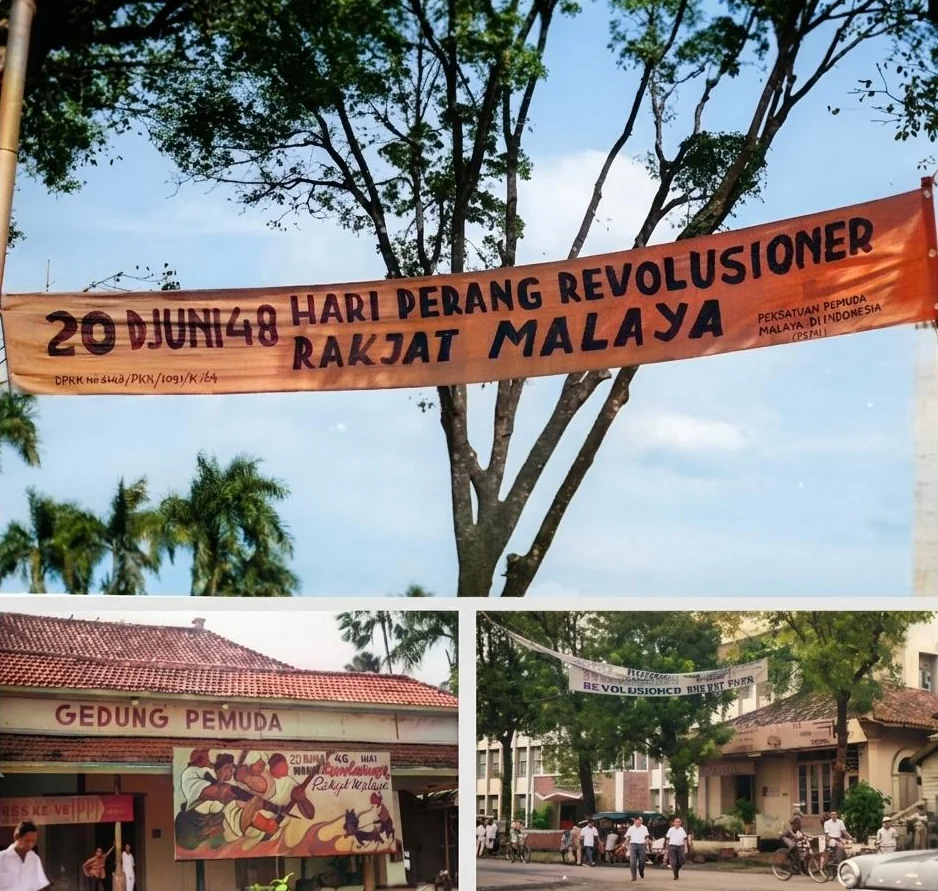
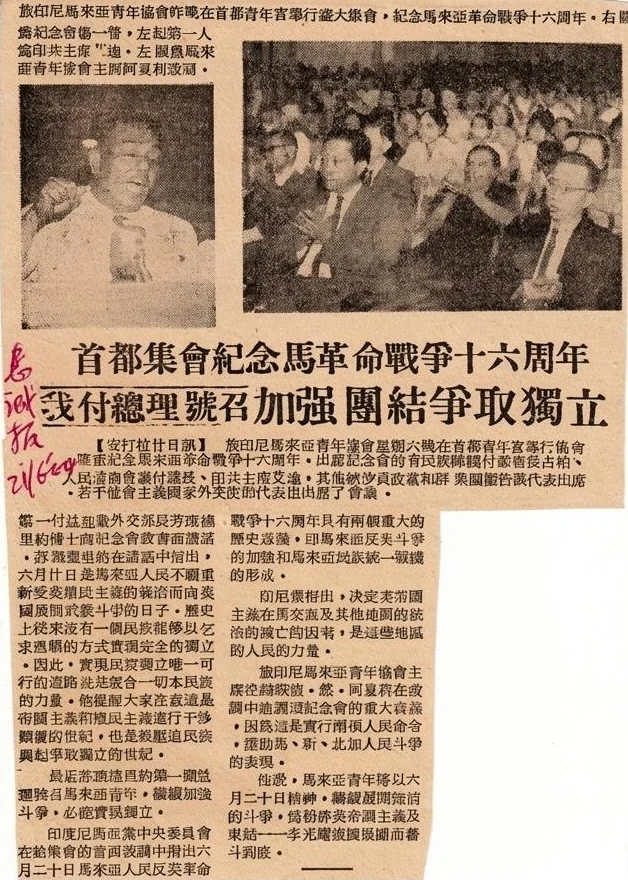
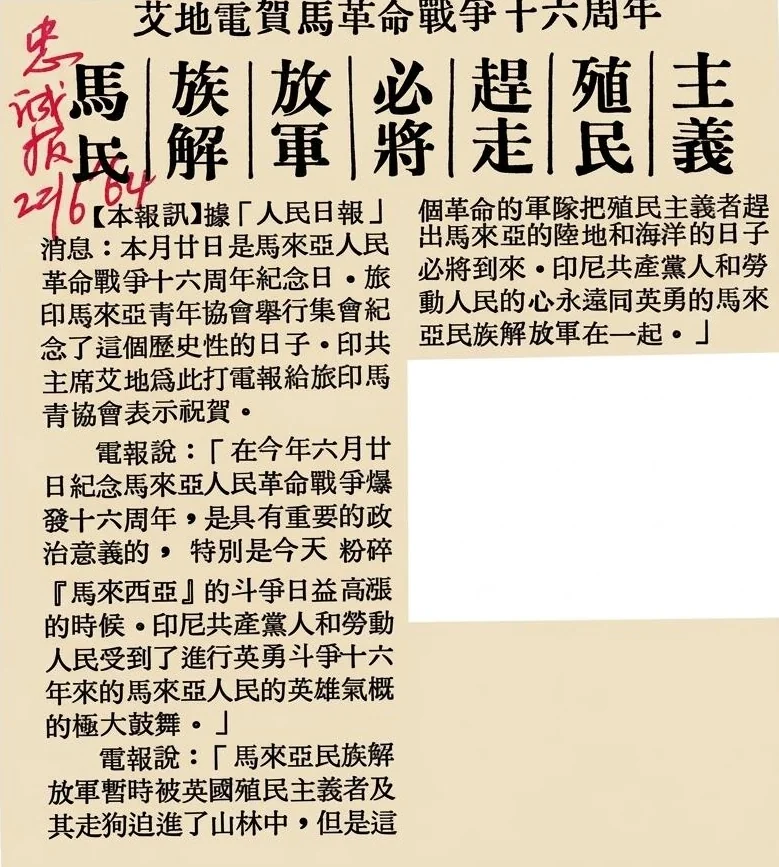
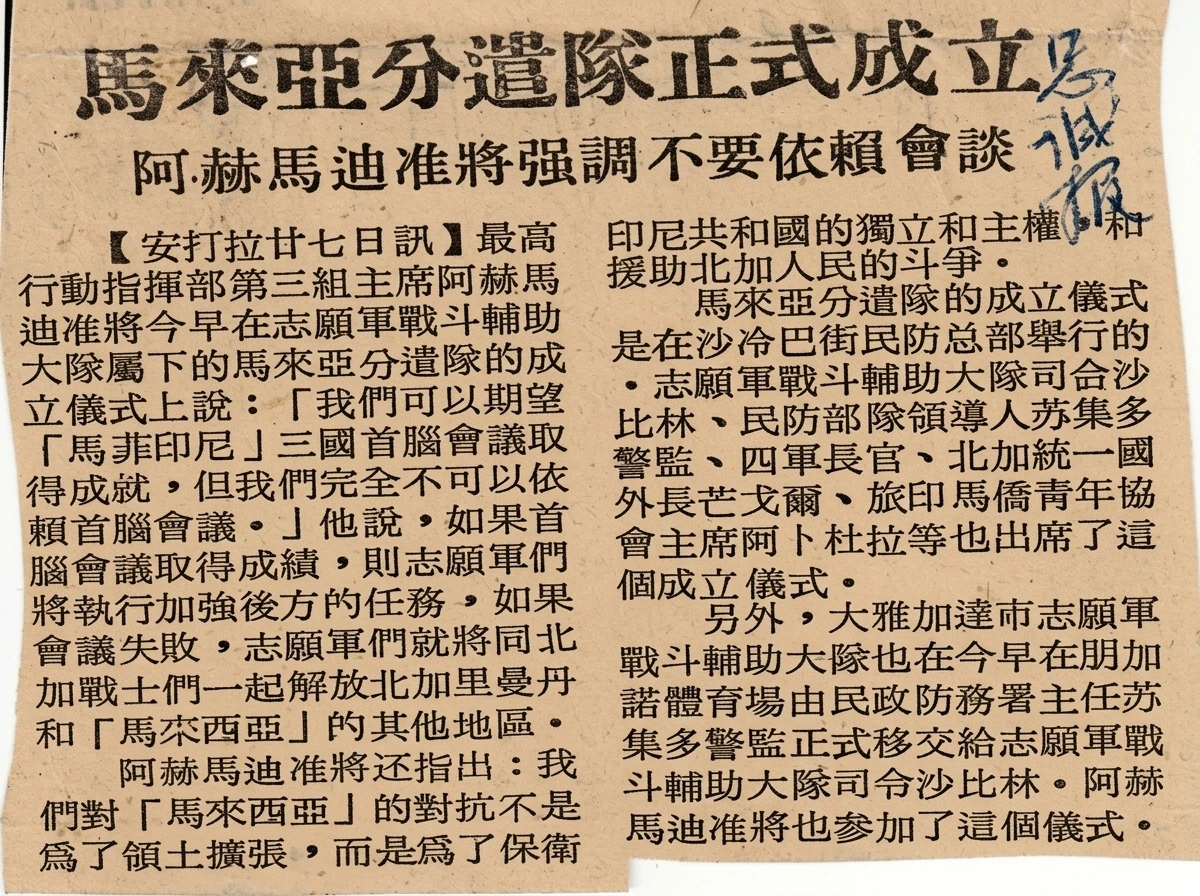
解盟雅加达代表团迅速成为亚非拉反帝团结运动中高度活跃的力量。早在代表团正式设立前的1964年6月20日,旅印马来亚青年协会(PPMI)便在雅加达青年大厦(Gedung Pemuda)举行隆重集会,纪念马来亚抗英民族解放战争十六周年。印尼共产党(PKI)中央主席艾地(D.N. Aidit)发表热烈演说并致电崇高敬意,印尼最高行动指挥部更动员组建了支援马来亚人民斗争的“马来亚志愿分遣队”(Detasemen Malaya)。1965年间,解盟代表团先后赴加纳温尼巴出席第四届亚非人民团结大会,远赴芬兰赫尔辛基出席世界和平大会,赴东京参加第十一届禁止原子弹氢弹世界大会,并在雅加达出席反对外国军事基地国际会议。1965年6月20日,代表团联合亚非新闻工作者协会等进步团体再次举行盛大集会,热烈庆祝全马抗英民族解放战争十七周年。
1965年9月29日,解盟雅加达代表团促成了海外反帝阵营的深度整合,联合‘马来亚独立运动’(GKM)与“旅印马来亚青年协会”(PPMI)成立争取马来亚真正独立的联合协调机构。解盟在雅加达的外交实践,成功打破了英美殖民阵营对全马解放斗争的信息封锁,将马来亚反帝问题提升至万隆精神与第三世界民族解放的全球政治高度。
In the mid-1960s, amidst the high tide of Afro-Asian non-alignment and Third World decolonization, the MNLL made a strategic transition from domestic underground operations to international diplomatic engagement. Within the geopolitical framework of Sukarno's 'New Emerging Forces' (NEFOS) and the Confrontation against the newly minted 'Malaysia', the League sought to establish formal external missions.
On June 2, 1965, the MNLL's first overseas delegation was inaugurated in Jakarta with formal recognition from the Indonesian government. The mission comprised four veteran leaders: Head of Delegation Ibrahim Mohamad, Deputy Head Eu Chooi Yip, Secretary Abdullah Sudin, and Committee Member Shamsiah Fakeh (former leader of AWAS). The mission established a permanent liaison office, serving as the CPM's external diplomatic window.
The MNLL Jakarta Mission swiftly emerged as a vigorous force in the Afro-Asian anti-imperialist solidarity movement. Even prior to the official inauguration of the mission, on June 20, 1964, the Malayan Youth Association in Indonesia (PPMI) held a massive commemorative rally outside Gedung Pemuda in Jakarta to mark the 16th anniversary of the Malayan National Liberation War. PKI Central Committee Chairman D.N. Aidit delivered an impassioned address and sent formal solidarity telegrams saluting the MNLA, while the Indonesian Supreme Operational Command (KOTI) mobilized the volunteer "Malaya Detachment" (Detasemen Malaya). Following the mission's formal establishment in 1965, its delegates attended the 4th Afro-Asian Peoples' Solidarity Conference in Winneba (Ghana), the World Peace Congress in Helsinki, the 11th World Conference against Atomic and Hydrogen Bombs in Tokyo, and the International Conference against Foreign Military Bases in Jakarta, followed by a grand rally on June 20, 1965 commemorating the 17th anniversary of the liberation war.
On September 29, 1965, the MNLL convened a broader alliance in Jakarta, establishing a joint coordinating organ alongside the Malayan Independence Movement (GKM) and the Malayan Youth Association in Indonesia (P2MI). These activities broke the diplomatic blockade imposed by Anglo-American interests, situating Malaya's decolonization firmly within the Bandung anti-imperialist framework.
进入1960年代中期,随着国际冷战与非殖民化浪潮的风起云涌,解盟迎来了从单纯地下抗争走向国际外交舞台的历史性飞跃。在印尼总统苏加诺倡导‘新兴力量同盟’(NEFOS)以及激烈对抗新殖民主义产物‘马来西亚’的特定地缘背景下,解盟受命开拓海外正式外交据点。
1965年6月2日,马来亚民族解放同盟首个驻国外正式代表团在印尼首都雅加达隆重宣布成立。代表团由四位资深革命家组成:团长易卜拉欣·穆罕默德(Ibrahim Mohamad)、副团长余柱业(Eu Chooi Yip)、秘书阿杜拉·苏丁(Abdullah Sudin)与团员沙姆西亚·法克赫(Shamsiah Fakeh)。该代表团不仅获得了印尼苏加诺政府的正式外交承认,更在雅加达市中心设立了官方办事处,成为马来亚反殖力量在海外最重要的合法政治窗口。
In the mid-1960s, amidst the high tide of Afro-Asian non-alignment and Third World decolonization, the MNLL made a strategic transition from domestic underground operations to international diplomatic engagement. Within the geopolitical framework of Sukarno's 'New Emerging Forces' (NEFOS) and the Confrontation against the newly minted 'Malaysia', the League sought to establish formal external missions.
On June 2, 1965, the MNLL's first overseas delegation was inaugurated in Jakarta with formal recognition from the Indonesian government. The mission comprised four veteran leaders: Head of Delegation Ibrahim Mohamad, Deputy Head Eu Chooi Yip, Secretary Abdullah Sudin, and Committee Member Shamsiah Fakeh (former leader of AWAS). The mission established a permanent liaison office, serving as the CPM's external diplomatic window.
解盟雅加达代表团迅速成为亚非拉反帝团结运动中高度活跃的力量。早在代表团正式设立前的1964年6月20日,旅印马来亚青年协会(PPMI)便在雅加达青年大厦(Gedung Pemuda)举行隆重集会,纪念马来亚抗英民族解放战争十六周年。印尼共产党(PKI)中央主席艾地(D.N. Aidit)发表热烈演说并致电崇高敬意,印尼最高行动指挥部更动员组建了支援马来亚人民斗争的“马来亚志愿分遣队”(Detasemen Malaya)。1965年间,解盟代表团先后赴加纳温尼巴出席第四届亚非人民团结大会,远赴芬兰赫尔辛基出席世界和平大会,赴东京参加第十一届禁止原子弹氢弹世界大会,并在雅加达出席反对外国军事基地国际会议。1965年6月20日,代表团联合亚非新闻工作者协会等进步团体再次举行盛大集会,热烈庆祝全马抗英民族解放战争十七周年。
1965年9月29日,解盟雅加达代表团促成了海外反帝阵营的深度整合,联合‘马来亚独立运动’(GKM)与“旅印马来亚青年协会”(PPMI)成立争取马来亚真正独立的联合协调机构。解盟在雅加达的外交实践,成功打破了英美殖民阵营对全马解放斗争的信息封锁,将马来亚反帝问题提升至万隆精神与第三世界民族解放的全球政治高度。
The MNLL Jakarta Mission swiftly emerged as a vigorous force in the Afro-Asian anti-imperialist solidarity movement. Even prior to the official inauguration of the mission, on June 20, 1964, the Malayan Youth Association in Indonesia (PPMI) held a massive commemorative rally outside Gedung Pemuda in Jakarta to mark the 16th anniversary of the Malayan National Liberation War. PKI Central Committee Chairman D.N. Aidit delivered an impassioned address and sent formal solidarity telegrams saluting the MNLA, while the Indonesian Supreme Operational Command (KOTI) mobilized the volunteer "Malaya Detachment" (Detasemen Malaya). Following the mission's formal establishment in 1965, its delegates attended the 4th Afro-Asian Peoples' Solidarity Conference in Winneba (Ghana), the World Peace Congress in Helsinki, the 11th World Conference against Atomic and Hydrogen Bombs in Tokyo, and the International Conference against Foreign Military Bases in Jakarta, followed by a grand rally on June 20, 1965 commemorating the 17th anniversary of the liberation war.
On September 29, 1965, the MNLL convened a broader alliance in Jakarta, establishing a joint coordinating organ alongside the Malayan Independence Movement (GKM) and the Malayan Youth Association in Indonesia (P2MI). These activities broke the diplomatic blockade imposed by Anglo-American interests, situating Malaya's decolonization firmly within the Bandung anti-imperialist framework.
第五章:风云突变与国际营救:印尼“九三〇”政变、雅加达铁窗与转道抵京(1965–1966)
Chapter 5: Tempest and Rescue — The 1965 Indonesian Coup, Imprisonment, and the Journey to Beijing
正当解盟在东南亚的外交战线迅速打开局面之际,一场突如其来的地缘风暴骤然降临。1965年10月1日,印尼爆发震惊世界的‘九三〇事件’。以苏哈托为首的陆军右翼将领发动军事政变,迅速架空苏加诺总统,并在全国范围内掀起了针对印尼共产党(PKI)、左翼进步社团与华人社区的血腥大清洗与残酷屠杀,数十万无辜民众惨遭残害,印尼进步政局发生根本性逆转。
在这场右翼白色恐怖狂潮中,合法设立于雅加达的解盟代表处随即沦为军方重点打击目标。1965年11月17日夜,全副武装的印尼陆军特种部队突袭搜查了解盟办事处,强行拘捕了易卜拉欣·穆罕默德、余柱业、阿杜拉·苏丁与沙姆西亚·法克赫等四位代表团主要负责人。在长达整整一年的非法监禁中,四位反殖先驱被关押在阴暗严密的军管监狱中,经历了高压审讯与生命威胁,但他们始终严守革命气节,拒绝在政治原则上作任何妥协。
解盟代表团遭难的消息迅速震动了国际社会。在马共中央与中国驻印尼外交机构的强力斡旋下,亚非拉多个友好国家政要、国际民主法律家协会及全球正义团体迅速掀起了跨国抗议与营救浪潮。中国外交部向印尼军政当局提出严正交涉,指责其公然撕毁外交承认、严重践踏国际法基本准则与人道主义准则,要求必须无条件保障解盟人员的安全并立即恢复其完全人身自由。
面对强大的国际道义压力与坚如磐石的法理交涉,印尼军方当局被迫于1966年11月撤销对四名解盟代表的非法扣押,将其驱逐出境。在国际友好通道与中方的周密安排下,易卜拉欣、余柱业、阿杜拉·苏丁与沙姆西亚·法克赫四位反殖先驱克服重重险阻,几经辗转于1967年1月安全抵达中国北京,不仅保存了解盟驻外领导核心,更为海外外交力量的整合奠定了关键基石。
Just as the MNLL's external diplomacy was expanding, a severe geopolitical tempest erupted. On October 1, 1965, the 'September 30 Movement' unfolded in Indonesia. Right-wing army generals led by Suharto orchestrated a coup d'état, sidelining President Sukarno and unleashing a catastrophic purge against the Indonesian Communist Party (PKI), left-wing associations, and ethnic Chinese communities, fundamentally transforming Indonesian politics.
Under this violent military crackdown, the MNLL mission in Jakarta became an immediate target. On the night of November 17, 1965, Indonesian army units raided the league's premises, arresting Ibrahim Mohamad, Eu Chooi Yip, Abdullah Sudin, and Shamsiah Fakeh. Detained without trial for an entire year in military detention facilities, the four comrades endured coercive interrogations while maintaining organizational integrity and refusing political capitulation.
The detention of the Malayan envoys elicited immediate international condemnation. Mobilized by the CPM Central Committee and supported by Chinese diplomatic channels, progressive organizations, Afro-Asian solidarity bodies, and the International Association of Democratic Lawyers launched a worldwide campaign. The Chinese government lodged formal diplomatic protests against the Indonesian military junta, demanding the immediate release and safe passage of the accredited representatives.
Compelled by persistent international diplomatic pressure, the Indonesian military was forced to release the four detainees in November 1966. Assisted through discreet diplomatic routes, Ibrahim Mohamad, Eu Chooi Yip, Abdullah Sudin, and Shamsiah Fakeh traversed regional checkpoints, arriving safely in Beijing in January 1967. Their survival preserved the veteran leadership of the overseas mission and prepared the ground for the consolidation of the League's international headquarters.
正当解盟在东南亚的外交战线迅速打开局面之际,一场突如其来的地缘风暴骤然降临。1965年10月1日,印尼爆发震惊世界的‘九三〇事件’。以苏哈托为首的陆军右翼将领发动军事政变,迅速架空苏加诺总统,并在全国范围内掀起了针对印尼共产党(PKI)、左翼进步社团与华人社区的血腥大清洗与残酷屠杀,数十万无辜民众惨遭残害,印尼进步政局发生根本性逆转。
在这场右翼白色恐怖狂潮中,合法设立于雅加达的解盟代表处随即沦为军方重点打击目标。1965年11月17日夜,全副武装的印尼陆军特种部队突袭搜查了解盟办事处,强行拘捕了易卜拉欣·穆罕默德、余柱业、阿杜拉·苏丁与沙姆西亚·法克赫等四位代表团主要负责人。在长达整整一年的非法监禁中,四位反殖先驱被关押在阴暗严密的军管监狱中,经历了高压审讯与生命威胁,但他们始终严守革命气节,拒绝在政治原则上作任何妥协。
Just as the MNLL's external diplomacy was expanding, a severe geopolitical tempest erupted. On October 1, 1965, the 'September 30 Movement' unfolded in Indonesia. Right-wing army generals led by Suharto orchestrated a coup d'état, sidelining President Sukarno and unleashing a catastrophic purge against the Indonesian Communist Party (PKI), left-wing associations, and ethnic Chinese communities, fundamentally transforming Indonesian politics.
Under this violent military crackdown, the MNLL mission in Jakarta became an immediate target. On the night of November 17, 1965, Indonesian army units raided the league's premises, arresting Ibrahim Mohamad, Eu Chooi Yip, Abdullah Sudin, and Shamsiah Fakeh. Detained without trial for an entire year in military detention facilities, the four comrades endured coercive interrogations while maintaining organizational integrity and refusing political capitulation.
解盟代表团遭难的消息迅速震动了国际社会。在马共中央与中国驻印尼外交机构的强力斡旋下,亚非拉多个友好国家政要、国际民主法律家协会及全球正义团体迅速掀起了跨国抗议与营救浪潮。中国外交部向印尼军政当局提出严正交涉,指责其公然撕毁外交承认、严重践踏国际法基本准则与人道主义准则,要求必须无条件保障解盟人员的安全并立即恢复其完全人身自由。
面对强大的国际道义压力与坚如磐石的法理交涉,印尼军方当局被迫于1966年11月撤销对四名解盟代表的非法扣押,将其驱逐出境。在国际友好通道与中方的周密安排下,易卜拉欣、余柱业、阿杜拉·苏丁与沙姆西亚·法克赫四位反殖先驱克服重重险阻,几经辗转于1967年1月安全抵达中国北京,不仅保存了解盟驻外领导核心,更为海外外交力量的整合奠定了关键基石。
The detention of the Malayan envoys elicited immediate international condemnation. Mobilized by the CPM Central Committee and supported by Chinese diplomatic channels, progressive organizations, Afro-Asian solidarity bodies, and the International Association of Democratic Lawyers launched a worldwide campaign. The Chinese government lodged formal diplomatic protests against the Indonesian military junta, demanding the immediate release and safe passage of the accredited representatives.
Compelled by persistent international diplomatic pressure, the Indonesian military was forced to release the four detainees in November 1966. Assisted through discreet diplomatic routes, Ibrahim Mohamad, Eu Chooi Yip, Abdullah Sudin, and Shamsiah Fakeh traversed regional checkpoints, arriving safely in Beijing in January 1967. Their survival preserved the veteran leadership of the overseas mission and prepared the ground for the consolidation of the League's international headquarters.
第六章:北京前哨与电波破晓:驻京代表团、毛泽东接见与革命之声广播电台的诞生(1966–1969)
Chapter 6: The Beijing Outpost — The Delegation, Mao's Audience, and the Inception of the VMR (1966–1969)
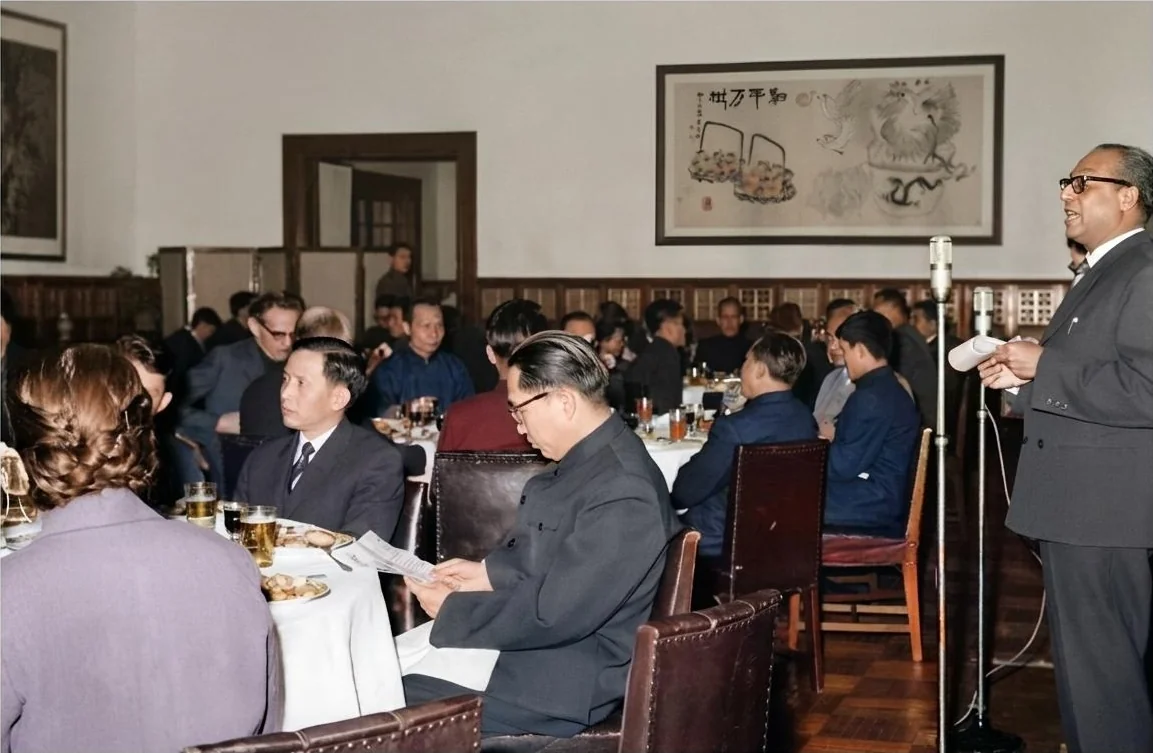
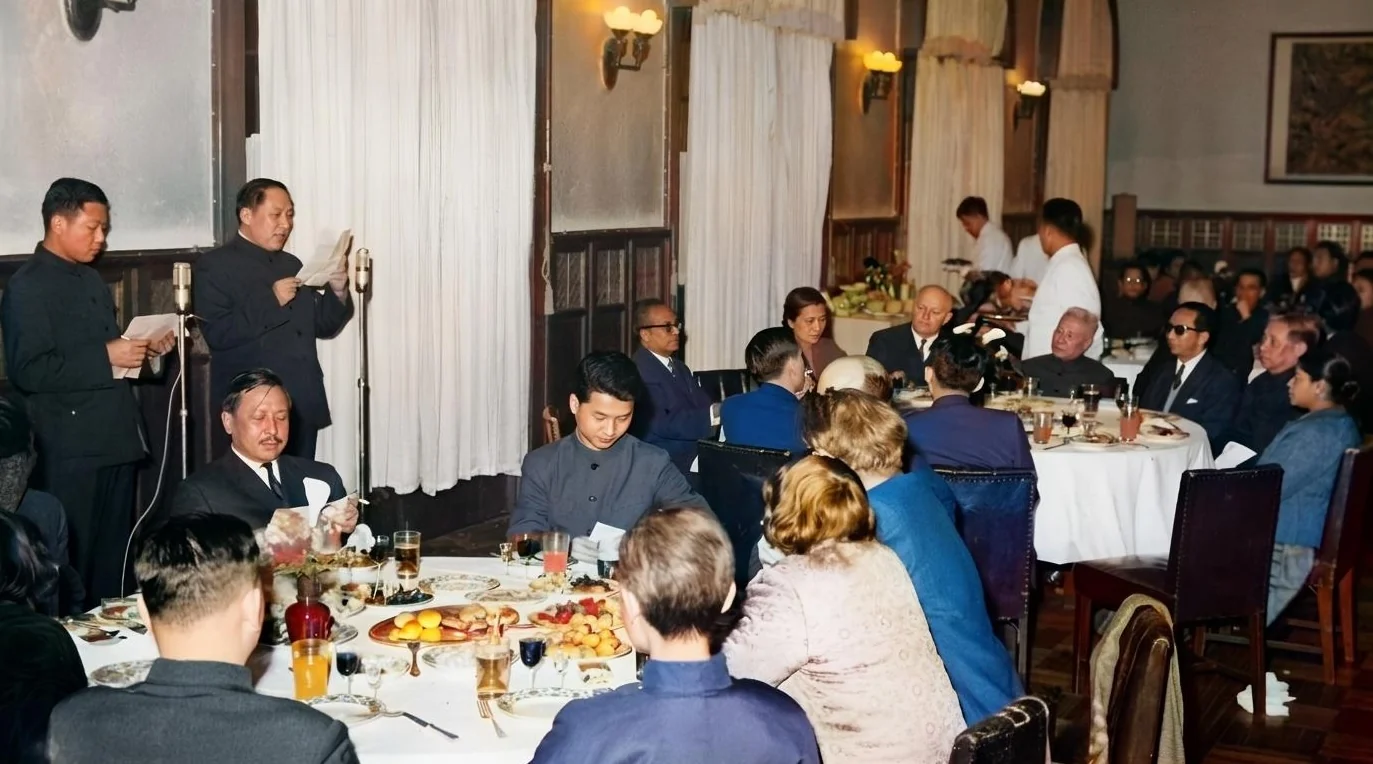
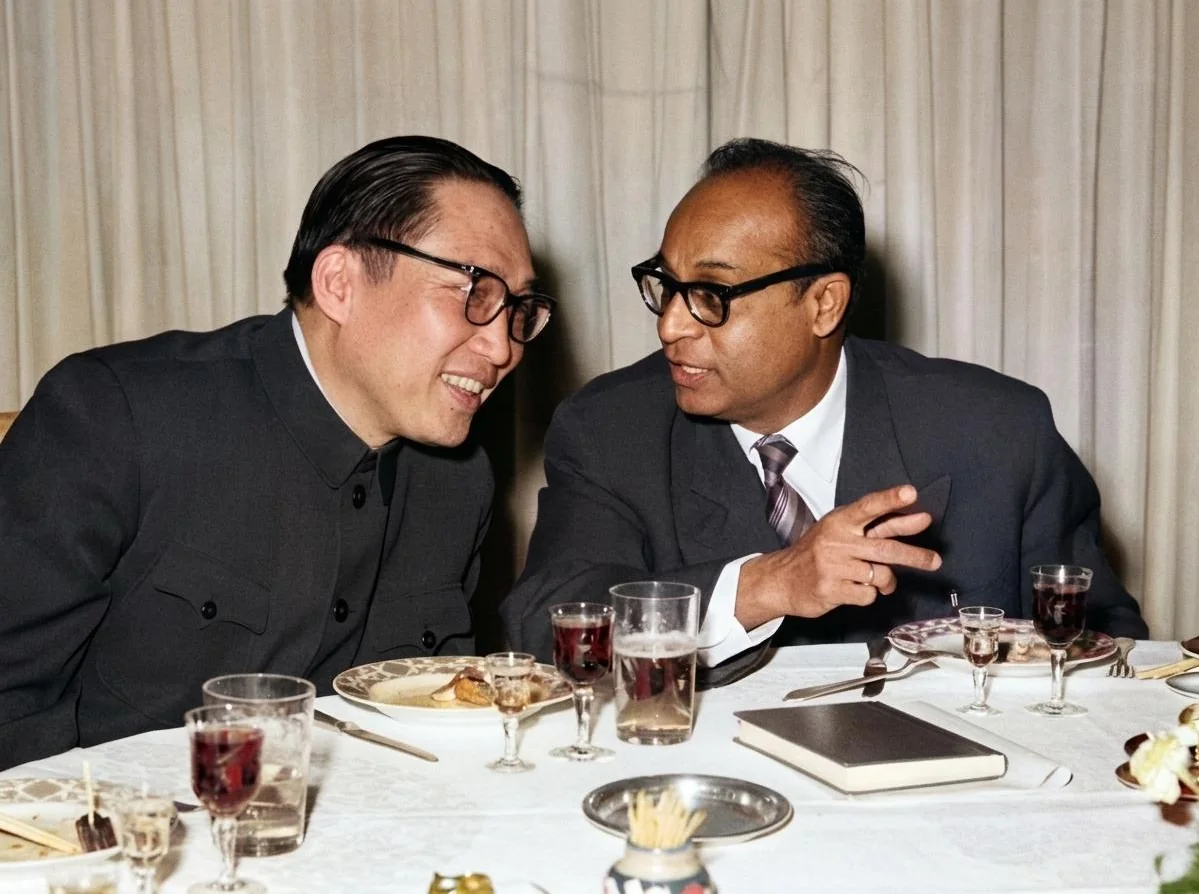
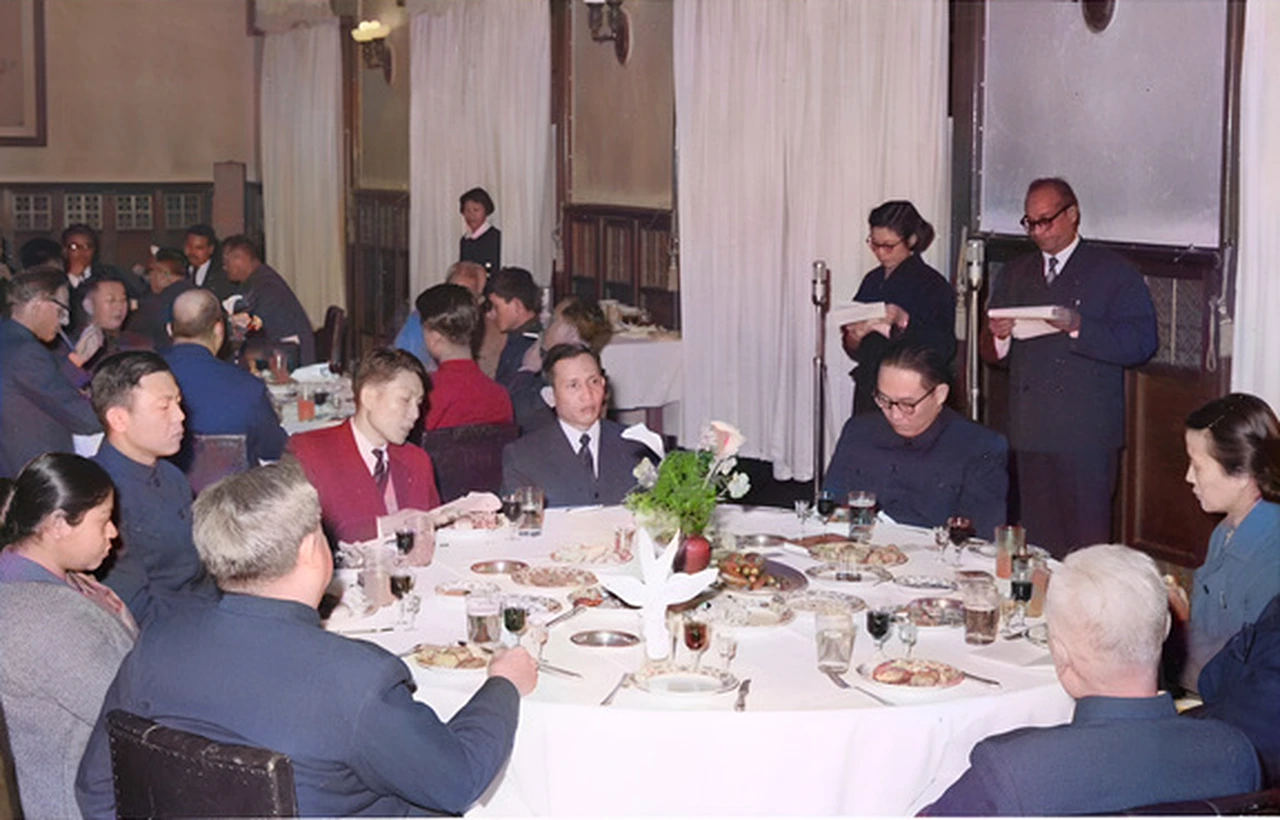
在雅加达局势突变的同时,马共中央审时度势,开辟了更为广阔的国际外交枢纽。1966年1月12日,马来亚民族解放同盟第二个驻国外代表团在中华人民共和国首都北京正式宣告成立。代表团团长由杰出的印度裔反殖知识分子、前新加坡教师工会创办人之一 P.V. 沙尔玛(P.V. Sharma)担任,团员包括陈承禄(又名陈星)、莎拉达·沙尔玛(Sharada Sharma),翻译由刘英芳担任。
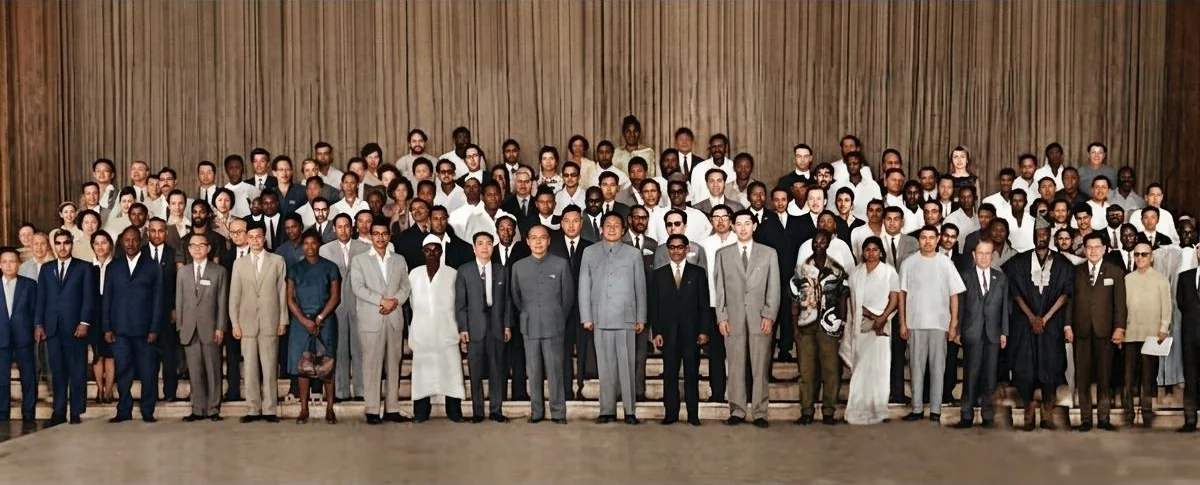
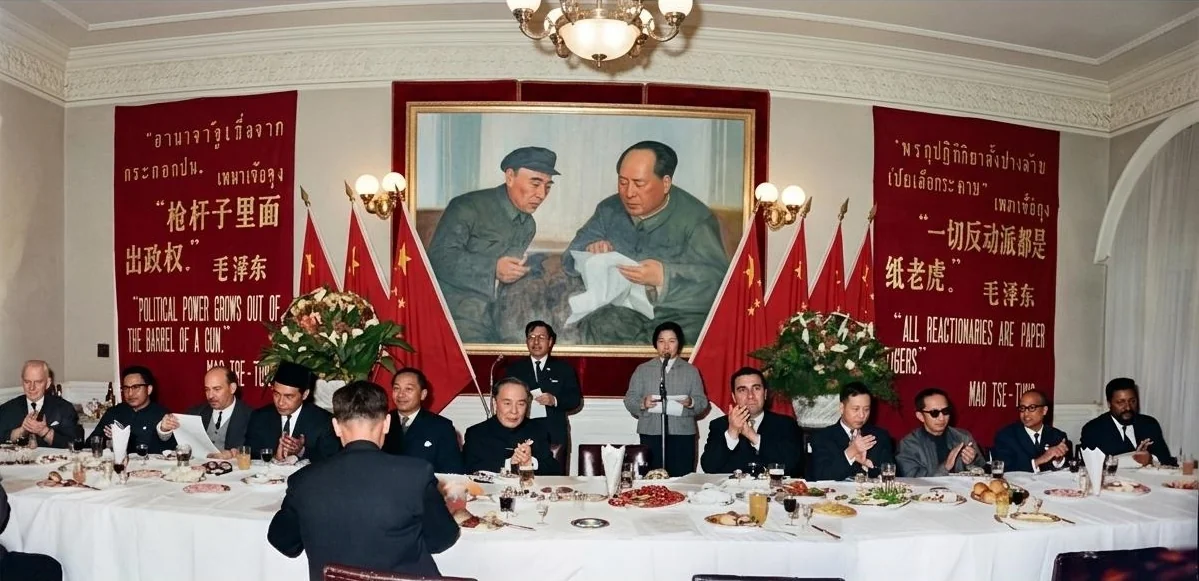
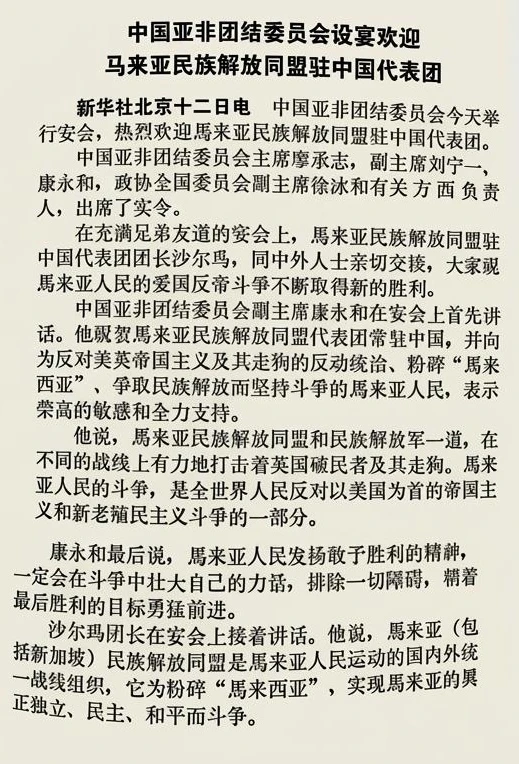
1966年1月12日晚,中国亚非团结委员会在北京举行隆重盛大的国宴招待会,热烈祝贺解盟驻中国代表团正式成立。中国亚非团结委员会主席廖承志、副主席刘宁一、康永和以及有关方面负责人悉数出席。次日(1966年1月13日),中共中央机关报《人民日报》在头版刊发通栏电讯报道。宴会上,越南南方民族解放阵线、巴勒斯坦解放组织(PLO)、老挝爱国阵线、泰国爱国阵线以及美、日、澳、新西兰等十余国驻京外交使节与和平人士共同出席,使解盟驻京代表团成为了举世瞩目的国际反帝外交平台。
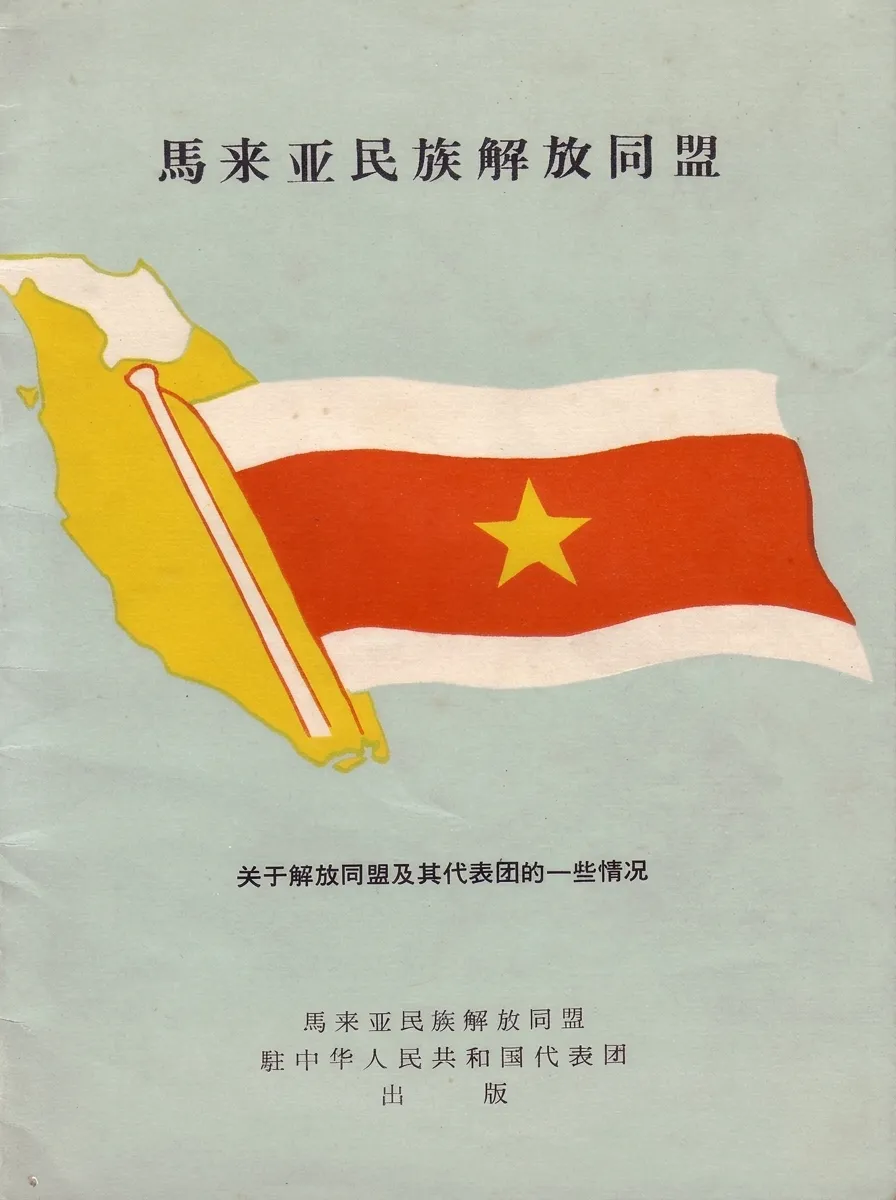
代表团在北京设立了常驻办事处,定期出版并向各国驻华使团、中国对外联络机构及国际和平人士发行官方英文机关刊物《马来亚公报》(Malaya Bulletin),同时编印出版中文专册《马来亚民族解放同盟:关于解放同盟及其代表团的一些情况》等历史文献。该刊物封面以金色马来半岛与新加坡版图为底,上方猎猎飘扬着嵌有金色五角星的红白两色解盟盟旗,系统阐述了解盟自1949年建盟以来的反殖政治纲领、地下抗争历程以及驻外代表团的外交使命,广泛传播马来亚民族自决的正义立场。
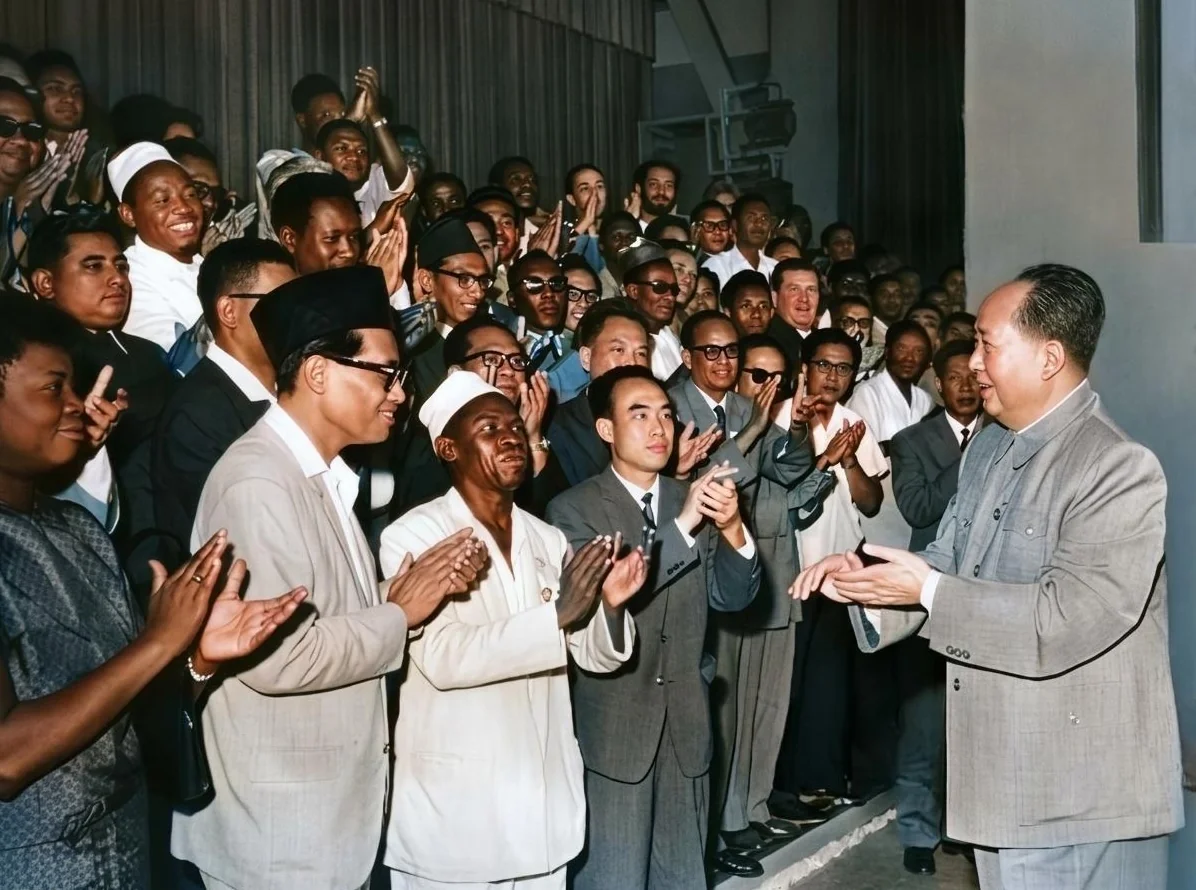
1966年7月17日,P.V. 沙尔玛作为解盟代表团团长,在京出席亚非作家紧急会议,并与北加里曼丹共产党主席文铭权等国际代表同席。会议期间,中共中央主席毛泽东在湖北武汉亲切接见了沙尔玛与全体与会代表,给予了马来亚人民反帝民族解放斗争以崇高的道义支持与深切关怀。
1967年1月,经国际营救获释的印尼代表团成员抵京会师,驻京代表团实现了力量大整合:余柱业出任副团长,阿杜拉·苏丁出任秘书。同年2月1日,代表团在北京隆重举行庆祝解盟建盟十八周年大型中外招待会,廖承志、丁西林等中方领导人亲临祝贺。1969年8月,随着国际斗争重心由常规外交宣传向空中电波阵地转移,P.V. 沙尔玛、余柱业、阿杜拉·苏丁等代表团核心骨干圆满完成外交使命,由北京调赴湖南益阳,参与筹建二十世纪东南亚革命史上最具传奇色彩的空中堡垒:‘马来亚革命之声广播电台’(Voice of the Malayan Revolution, VMR)。解盟二十载的风雨兼程,从隐蔽后勤与交通战线到跨国讲坛,为全马人民反殖抗争谱写了兼具历史厚度与国际声望的光辉篇章。
剥离冷战意识形态的话语迷雾,置于战后全球非殖民化浪潮的历史坐标之中,解盟二十载的风雨实践,绝非一段尘封孤立的历史陈迹,而是深刻参与塑造了现代马来亚乃至东南亚政治结构的先驱性力量。
它的历史穿透力,首先在于以无懈可击的历史事实,彻底粉碎了殖民当局与右翼统治集团精心建构的“族群隔阂天然论”。从战后《人民宪章草案》的政治构想,到解盟领导层中巫、华、印各族先驱生死与共的铁血纽带,跨族群的阶级团结与平权建国方案,早在此方土地获得形式独立之前便已具备成熟的实践形态。这一铁铸的事实证明:族群政治并非不可逾越的本土宿命,而是殖民分治与冷战霸权人为规训的产物。
同样,解盟文献对“恩赐独立”与新殖民依附体制的尖锐剖析,亦构成这片土地上最具锋芒的去殖民思想遗产。它早于同时代绝大多数从政者指出:防务协定下的主权残缺、《内部安全法》(ISA)对公民权利的长期绞杀,乃至对原宗主国经济命脉的深度依附,使1957年的政权移交始终带有妥协性与不彻底性的历史局限。而解盟在半岛与北加里曼丹、新加坡之间维系的地下脉动,更是对冷战人为割裂地缘有机体的永恒历史抗辩。
当历史的帷幕缓缓垂下,解盟在暗夜中所践行的,不仅是一场反帝斗争,更是一种对“人民国家”最初形态的悲壮探索。各族先驱在至暗时刻所留下的组织记忆与反殖求索,至今依然是这片土地冲破历史迷雾、叩问何为真正国家主权与社会正义时,无法绕行、亦不容抹煞的沉重基石。
Amidst the upheavals in Jakarta, the CPM Central Committee calibrated its diplomatic strategy by inaugurating a pivotal northern diplomatic mission. On January 12, 1966, the MNLL's second overseas delegation was officially established in Beijing, People's Republic of China. The mission was headed by P.V. Sharma, a distinguished ethnic Indian intellectual and founding leader of the Singapore Teachers' Union, alongside delegates Chen Chenglu (Chen Xing) and Sharada Sharma, with Liu Yingfang serving as interpreter.
On January 12, 1966, the Chinese Afro-Asian Solidarity Committee hosted an official state banquet in Beijing to welcome the delegation, attended by Chairman Liao Chengzhi, Vice-Chairmen Liu Ningyi and Kang Yonghe. On January 13, the *People's Daily* featured front-page coverage of the inaugural reception. Representatives from the National Liberation Front of South Vietnam (NLF), Palestine Liberation Organization (PLO), the Neo Lao Hak Sat, and foreign diplomats from across Asia, Africa, and the West attended, consolidating the Beijing mission as a prominent diplomatic outpost.
Establishing a permanent office in Beijing, the mission published its official English-language organ, the *Malaya Bulletin*, alongside Chinese-language documentary monographs such as *The Malayan National Liberation League: Some Facts About the Liberation League and Its Mission*, circulating communiqués and literature to Chinese foreign-relations bodies, diplomatic missions in Beijing, and international peace activists. Emblazoned with the golden map of the Malayan Peninsula and Singapore beneath the red-and-white starred banner of the MNLL, these publications systematically expounded the League's anti-colonial program, clandestine struggle since 1949, and diplomatic mandate for national self-determination.
On July 17, 1966, P.V. Sharma attended the Afro-Asian Writers Emergency Meeting in Beijing alongside North Kalimantan Communist Party Chairman Wen Mingquan, subsequently meeting Chinese Communist Party Chairman Mao Zedong during an official audience in Wuhan, Hubei, which extended strong moral and internationalist support to the Malayan people's anti-imperialist liberation struggle.
In January 1967, following their extraction from Indonesia, Eu Chooi Yip and Abdullah Sudin joined the Beijing mission as Deputy Head and Secretary, respectively. On February 1, 1967, the mission hosted a state reception celebrating the 18th anniversary of the League's founding, attended by Liao Chengzhi and Ding Xilin. In August 1969, as the strategic priority transitioned toward clandestine radio transmission, P.V. Sharma, Eu Chooi Yip, and Abdullah Sudin concluded their diplomatic tenure in Beijing and relocated to Yiyang, Hunan, to establish the Voice of the Malayan Revolution (VMR). The League's twenty-year trajectory—from grassroots rural couriers to diplomatic missions—established an indelible legacy in Malaya's anti-colonial history.
Stripped of Cold War ideological mystification and situated within the global tide of post-war decolonization, the two decades of the MNLL's tempestuous practice were by no means an obsolete, isolated historical relic, but a pioneering force that deeply shaped the political architecture of modern Malaya and Southeast Asia.
Its historical penetration lies first in completely dismantling the 'natural communal discord' myth meticulously engineered by colonial authorities and right-wing ruling elites. From the political vision of the 1947 People's Constitutional Proposals to the unbreakable bond uniting Malay, Chinese, and Indian pioneers in the League's leadership, cross-ethnic class solidarity and egalitarian state-building had already attained a mature practice on this soil long before formal independence was proclaimed. This cast-iron reality demonstrates that communal politics is not an insurmountable native fate, but the historical byproduct of colonial divide-and-rule and Cold War disciplinary regimes.
Equally, the League's piercing critique of 'benevolent independence' and neo-colonial dependency structures represents the sharpest anti-colonial intellectual heritage in modern Malayan history. Long before mainstream politicians recognized it, the League warned that compromised sovereignty under defense agreements, the systematic repression of civil liberties via the Internal Security Act (ISA), and structural economic subservience to the former colonial power bequeathed severe historical constraints upon the 1957 transfer of power. Furthermore, the underground lifeline maintained by the League across the peninsula, Northern Kalimantan, and Singapore stands as an enduring historical protest against the artificial geopolitical partition imposed by Cold War containment.
As the curtain of history falls, what the League pursued through the darkness was not merely an anti-imperialist campaign, but a heroic, tragic exploration into the nascent form of a true 'People's Republic.' The organizational memory and anti-colonial quest forged by multi-ethnic pioneers in their darkest hour remain an indelible, unyielding bedrock whenever this nation seeks to pierce historical illusions and interrogate genuine sovereignty and social justice.
在雅加达局势突变的同时,马共中央审时度势,开辟了更为广阔的国际外交枢纽。1966年1月12日,马来亚民族解放同盟第二个驻国外代表团在中华人民共和国首都北京正式宣告成立。代表团团长由杰出的印度裔反殖知识分子、前新加坡教师工会创办人之一 P.V. 沙尔玛(P.V. Sharma)担任,团员包括陈承禄(又名陈星)、莎拉达·沙尔玛(Sharada Sharma),翻译由刘英芳担任。
1966年1月12日晚,中国亚非团结委员会在北京举行隆重盛大的国宴招待会,热烈祝贺解盟驻中国代表团正式成立。中国亚非团结委员会主席廖承志、副主席刘宁一、康永和以及有关方面负责人悉数出席。次日(1966年1月13日),中共中央机关报《人民日报》在头版刊发通栏电讯报道。宴会上,越南南方民族解放阵线、巴勒斯坦解放组织(PLO)、老挝爱国阵线、泰国爱国阵线以及美、日、澳、新西兰等十余国驻京外交使节与和平人士共同出席,使解盟驻京代表团成为了举世瞩目的国际反帝外交平台。
Amidst the upheavals in Jakarta, the CPM Central Committee calibrated its diplomatic strategy by inaugurating a pivotal northern diplomatic mission. On January 12, 1966, the MNLL's second overseas delegation was officially established in Beijing, People's Republic of China. The mission was headed by P.V. Sharma, a distinguished ethnic Indian intellectual and founding leader of the Singapore Teachers' Union, alongside delegates Chen Chenglu (Chen Xing) and Sharada Sharma, with Liu Yingfang serving as interpreter.
On January 12, 1966, the Chinese Afro-Asian Solidarity Committee hosted an official state banquet in Beijing to welcome the delegation, attended by Chairman Liao Chengzhi, Vice-Chairmen Liu Ningyi and Kang Yonghe. On January 13, the *People's Daily* featured front-page coverage of the inaugural reception. Representatives from the National Liberation Front of South Vietnam (NLF), Palestine Liberation Organization (PLO), the Neo Lao Hak Sat, and foreign diplomats from across Asia, Africa, and the West attended, consolidating the Beijing mission as a prominent diplomatic outpost.
代表团在北京设立了常驻办事处,定期出版并向各国驻华使团、中国对外联络机构及国际和平人士发行官方英文机关刊物《马来亚公报》(Malaya Bulletin),同时编印出版中文专册《马来亚民族解放同盟:关于解放同盟及其代表团的一些情况》等历史文献。该刊物封面以金色马来半岛与新加坡版图为底,上方猎猎飘扬着嵌有金色五角星的红白两色解盟盟旗,系统阐述了解盟自1949年建盟以来的反殖政治纲领、地下抗争历程以及驻外代表团的外交使命,广泛传播马来亚民族自决的正义立场。
Establishing a permanent office in Beijing, the mission published its official English-language organ, the *Malaya Bulletin*, alongside Chinese-language documentary monographs such as *The Malayan National Liberation League: Some Facts About the Liberation League and Its Mission*, circulating communiqués and literature to Chinese foreign-relations bodies, diplomatic missions in Beijing, and international peace activists. Emblazoned with the golden map of the Malayan Peninsula and Singapore beneath the red-and-white starred banner of the MNLL, these publications systematically expounded the League's anti-colonial program, clandestine struggle since 1949, and diplomatic mandate for national self-determination.
1966年7月17日,P.V. 沙尔玛作为解盟代表团团长,在京出席亚非作家紧急会议,并与北加里曼丹共产党主席文铭权等国际代表同席。会议期间,中共中央主席毛泽东在湖北武汉亲切接见了沙尔玛与全体与会代表,给予了马来亚人民反帝民族解放斗争以崇高的道义支持与深切关怀。
On July 17, 1966, P.V. Sharma attended the Afro-Asian Writers Emergency Meeting in Beijing alongside North Kalimantan Communist Party Chairman Wen Mingquan, subsequently meeting Chinese Communist Party Chairman Mao Zedong during an official audience in Wuhan, Hubei, which extended strong moral and internationalist support to the Malayan people's anti-imperialist liberation struggle.
1967年1月,经国际营救获释的印尼代表团成员抵京会师,驻京代表团实现了力量大整合:余柱业出任副团长,阿杜拉·苏丁出任秘书。同年2月1日,代表团在北京隆重举行庆祝解盟建盟十八周年大型中外招待会,廖承志、丁西林等中方领导人亲临祝贺。1969年8月,随着国际斗争重心由常规外交宣传向空中电波阵地转移,P.V. 沙尔玛、余柱业、阿杜拉·苏丁等代表团核心骨干圆满完成外交使命,由北京调赴湖南益阳,参与筹建二十世纪东南亚革命史上最具传奇色彩的空中堡垒:‘马来亚革命之声广播电台’(Voice of the Malayan Revolution, VMR)。解盟二十载的风雨兼程,从隐蔽后勤与交通战线到跨国讲坛,为全马人民反殖抗争谱写了兼具历史厚度与国际声望的光辉篇章。
In January 1967, following their extraction from Indonesia, Eu Chooi Yip and Abdullah Sudin joined the Beijing mission as Deputy Head and Secretary, respectively. On February 1, 1967, the mission hosted a state reception celebrating the 18th anniversary of the League's founding, attended by Liao Chengzhi and Ding Xilin. In August 1969, as the strategic priority transitioned toward clandestine radio transmission, P.V. Sharma, Eu Chooi Yip, and Abdullah Sudin concluded their diplomatic tenure in Beijing and relocated to Yiyang, Hunan, to establish the Voice of the Malayan Revolution (VMR). The League's twenty-year trajectory—from grassroots rural couriers to diplomatic missions—established an indelible legacy in Malaya's anti-colonial history.
剥离冷战意识形态的话语迷雾,置于战后全球非殖民化浪潮的历史坐标之中,解盟二十载的风雨实践,绝非一段尘封孤立的历史陈迹,而是深刻参与塑造了现代马来亚乃至东南亚政治结构的先驱性力量。
它的历史穿透力,首先在于以无懈可击的历史事实,彻底粉碎了殖民当局与右翼统治集团精心建构的“族群隔阂天然论”。从战后《人民宪章草案》的政治构想,到解盟领导层中巫、华、印各族先驱生死与共的铁血纽带,跨族群的阶级团结与平权建国方案,早在此方土地获得形式独立之前便已具备成熟的实践形态。这一铁铸的事实证明:族群政治并非不可逾越的本土宿命,而是殖民分治与冷战霸权人为规训的产物。
同样,解盟文献对“恩赐独立”与新殖民依附体制的尖锐剖析,亦构成这片土地上最具锋芒的去殖民思想遗产。它早于同时代绝大多数从政者指出:防务协定下的主权残缺、《内部安全法》(ISA)对公民权利的长期绞杀,乃至对原宗主国经济命脉的深度依附,使1957年的政权移交始终带有妥协性与不彻底性的历史局限。而解盟在半岛与北加里曼丹、新加坡之间维系的地下脉动,更是对冷战人为割裂地缘有机体的永恒历史抗辩。
当历史的帷幕缓缓垂下,解盟在暗夜中所践行的,不仅是一场反帝斗争,更是一种对“人民国家”最初形态的悲壮探索。各族先驱在至暗时刻所留下的组织记忆与反殖求索,至今依然是这片土地冲破历史迷雾、叩问何为真正国家主权与社会正义时,无法绕行、亦不容抹煞的沉重基石。
Stripped of Cold War ideological mystification and situated within the global tide of post-war decolonization, the two decades of the MNLL's tempestuous practice were by no means an obsolete, isolated historical relic, but a pioneering force that deeply shaped the political architecture of modern Malaya and Southeast Asia.
Its historical penetration lies first in completely dismantling the 'natural communal discord' myth meticulously engineered by colonial authorities and right-wing ruling elites. From the political vision of the 1947 People's Constitutional Proposals to the unbreakable bond uniting Malay, Chinese, and Indian pioneers in the League's leadership, cross-ethnic class solidarity and egalitarian state-building had already attained a mature practice on this soil long before formal independence was proclaimed. This cast-iron reality demonstrates that communal politics is not an insurmountable native fate, but the historical byproduct of colonial divide-and-rule and Cold War disciplinary regimes.
Equally, the League's piercing critique of 'benevolent independence' and neo-colonial dependency structures represents the sharpest anti-colonial intellectual heritage in modern Malayan history. Long before mainstream politicians recognized it, the League warned that compromised sovereignty under defense agreements, the systematic repression of civil liberties via the Internal Security Act (ISA), and structural economic subservience to the former colonial power bequeathed severe historical constraints upon the 1957 transfer of power. Furthermore, the underground lifeline maintained by the League across the peninsula, Northern Kalimantan, and Singapore stands as an enduring historical protest against the artificial geopolitical partition imposed by Cold War containment.
As the curtain of history falls, what the League pursued through the darkness was not merely an anti-imperialist campaign, but a heroic, tragic exploration into the nascent form of a true 'People's Republic.' The organizational memory and anti-colonial quest forged by multi-ethnic pioneers in their darkest hour remain an indelible, unyielding bedrock whenever this nation seeks to pierce historical illusions and interrogate genuine sovereignty and social justice.
一切旨在将各种族人民割裂开来、挑起种族对立的政策,都是殖民统治者维系其特权的卑劣伎俩。全马各族人民必须在平等、民主与人的基本尊严基础上紧密团结,为摆脱任何形式的新老殖民主义依附、建立一个真正完全独立自主的祖国而共同奋斗。All policies engineered to divide the people and incite racial discord are the despicable stratagems of colonial rulers to preserve their monopolistic privileges. The people of all nationalities across Malaya must unite in solidarity on the bedrock of equality, democracy, and basic human dignity, to break free from all forms of neo-colonial subjugation and strive collectively for a genuinely independent and sovereign homeland.— 《马来亚民族解放同盟宣言》 | Manifesto of the Malayan National Liberation League