第28集:风雷激荡同盟曲:马共、共产国际与国际兄弟党的战斗情谊(1930年-1980年代)
Episode 28: Thunderous Symphonies of Solidarity: The CPM, the Comintern, and Fraternal Parties (1930–1980s)
无产阶级国际主义,是二十世纪被压迫民族反抗帝国主义霸权与殖民奴役最崇高、最震撼的历史旗帜。自1930年4月30日胡志明(阮爱国)代表共产国际远东局亲临指导马共成立大会起,马来亚共产党便与世界无产阶级革命力量和东南亚各民族解放运动紧密交织在一起。在长达半个多世纪的风雷激荡中,无论是抗日战争时期南洋华人社团与马共工运网络密切协同支持南侨机工奔赴中国滇缅公路,还是战后面对大英帝国紧急状态暴力清剿时中国共产党提供的落脚点、干部培养与湖南益阳“691工程”《马来亚革命之声》电台基地;无论是毛泽东主席多次在北京亲切接见陈平、李安东等领导人,还是1962年陈平在越南河内主持高层政治局常委会议确立战略转折;无论是马共代表远赴欧洲出席阿尔巴尼亚劳动党六大、霍查亲切会见,还是在泰南莽莽丛林中与泰国共产党建立长达四十年患难与共的人员补给生命通道,乃至1980年马共建党五十周年时中共、泰共、缅共、菲共、印尼共与北加共发来的珍贵贺电全宗,无不雄辩地证明:马共领导的反帝反殖武装斗争,绝非孤立的丛林战火,而是二十世纪亚洲民族解放与世界社会主义运动不可分割的英雄篇章。这一段以鲜血和信仰浇筑的国际主义情谊,筑起了现代东南亚反殖历史上不可磨灭的世纪丰碑。
Proletarian internationalism stood as the supreme standard under which oppressed nations resisted imperialist hegemony and colonial enslavement throughout the twentieth century. From the very inception of the Malayan Communist Party on April 30, 1930—attended and guided by Ho Chi Minh (Nguyen Ai Quoc) on behalf of the Comintern Far Eastern Bureau—the CPM's struggle was inextricably linked with the global socialist movement and the anti-colonial vanguard across Southeast Asia. Spanning over half a century of revolutionary turbulence, this solidarity manifested across every front: from the mobilization of the Nanyang Transport Corps along the Burma Road during the Anti-Japanese War, to the safe haven, cadre education, and Hunan-based 'Project 691' broadcast infrastructure provided by the Chinese Communist Party; from Chairman Mao Zedong's historic meetings with Secretary-General Chin Peng to the pivotal 1962 Politburo conference convened in Hanoi; from the CPM's presence at the 6th Congress of the Party of Labour of Albania to the four-decade logistical lifeline shared with the Communist Party of Thailand, culminating in the historic 50th Anniversary congratulatory telegrams from fraternal parties across Asia in 1980. The CPM's armed struggle was never an isolated jungle rebellion, but a vital, heroic component of the global anti-imperialist tide.
第一章:星火播撒与自主成熟:共产国际远东局指导建党与1943年第三国际解散谈话(1930–1943)
Chapter 1: Sowing the Sparks and Maturing in Self-Reliance: Comintern Guidance at the CPM's Founding and the 1943 Talk on the Dissolution of the Comintern (1930–1943)
1930年4月30日,在森美兰瓜拉庇劳附近一座隐秘的橡胶园工寮内,具有划时代历史意义的马来亚共产党成立大会秘密召开。这一历史事件的诞生,直接得益于共产国际(第三国际,Comintern)远东局的统筹运筹与直接指导。当时,化名“阮爱国”的杰出越南革命领袖、共产国际远东局全权特派代表胡志明亲临大会,主持了建党的核心议程。
胡志明以极其深邃的无产阶级国际主义视野,指导大会通过了马共首部革命纲领。纲领明确宣告:马共不仅是工人阶级的先锋队,更是全马各民族劳苦大众推翻大英帝国殖民枷锁、争取民族自决独立的坚强领导核心。胡志明的亲临指导,标志着马来亚革命从此摆脱了早期分散盲动的萌芽状态,正式融入列宁开创的世界无产阶级反帝民族解放革命的宏伟激流之中。敌伪殖民史书妄图把马共诬蔑为“狭隘孤立的海外侨民组织”,然而历史档案以如铁事实昭告天下:马共从其诞生之日起,就是肩负马来亚各民族彻底解放神圣使命、具备崇高无产阶级国际主义基因的正义政党!
1943年5月15日,共产国际执行委员会主席团作出历史性决定,宣布解散共产国际(第三国际),以适应世界反法西斯战争的新格局与各国革命力量独立自主发展的需要。令人惊叹的是,在日军铁蹄封锁马来半岛的严酷敌后环境下,仅相隔三周后的1943年6月8日,马共中央代表便在《四三年雪州六月谈话》中向地方党组织准确传达了《B. 第三国际解散的三个原因》,并精辟批注道:“第三国际已经完成了它的历史使命,共产主义脱离不了民族问题。”这一珍贵手抄文献雄辩地证明,马共在历经十余年革命洗礼后,已从早期依托共产国际指导的支部形态,彻底成长为深深扎根马来亚本土各民族解放事业、能够在复杂环境下独立创造革命策略的成熟马克思列宁主义政党。
On April 30, 1930, inside a modest rubber plantation workers' hut near Kuala Pilah, Negeri Sembilan, the inaugural congress of the Malayan Communist Party convened in secret. The birth of this historic party was directed by the Far Eastern Bureau of the Communist International. Ho Chi Minh, operating under the pseudonym Nguyen Ai Quoc as the plenipotentiary representative of the Comintern, attended and presided over the founding proceedings.
With visionary internationalist perspective, Ho Chi Minh steered the adoption of the CPM's foundational manifesto, which proclaimed the party as the vanguard of Malaya's multi-ethnic working masses fighting to overthrow British colonial hegemony. Ho's direct sponsorship situated the Malayan anti-colonial movement firmly within the global tide of anti-imperialist national liberation, obliterating colonial narratives that sought to dismiss the movement as an isolated or alien conspiracy.
On May 15, 1943, the Presidium of the Executive Committee of the Communist International adopted the historic decision to dissolve the Comintern, adapting to the global anti-fascist war and the need for national communist parties to chart independent paths suited to their own conditions. Remarkable for a party operating under total Japanese military blockade, just three weeks later on June 8, 1943, a CPM Central Committee representative delivered the "June 1943 Selangor Talk," systematically explaining the "Three Reasons for the Dissolution of the Third International" and inscribing the incisive annotation: "The Third International has fulfilled its historical mission; Communism cannot be divorced from the national question." This primary manuscript demonstrates that after more than a decade of struggle, the CPM had matured from a Comintern-guided section into an independent Marxist-Leninist party deeply rooted in the multi-ethnic national liberation of Malaya.
1930年4月30日,在森美兰瓜拉庇劳附近一座隐秘的橡胶园工寮内,具有划时代历史意义的马来亚共产党成立大会秘密召开。这一历史事件的诞生,直接得益于共产国际(第三国际,Comintern)远东局的统筹运筹与直接指导。当时,化名“阮爱国”的杰出越南革命领袖、共产国际远东局全权特派代表胡志明亲临大会,主持了建党的核心议程。
胡志明以极其深邃的无产阶级国际主义视野,指导大会通过了马共首部革命纲领。纲领明确宣告:马共不仅是工人阶级的先锋队,更是全马各民族劳苦大众推翻大英帝国殖民枷锁、争取民族自决独立的坚强领导核心。胡志明的亲临指导,标志着马来亚革命从此摆脱了早期分散盲动的萌芽状态,正式融入列宁开创的世界无产阶级反帝民族解放革命的宏伟激流之中。敌伪殖民史书妄图把马共诬蔑为“狭隘孤立的海外侨民组织”,然而历史档案以如铁事实昭告天下:马共从其诞生之日起,就是肩负马来亚各民族彻底解放神圣使命、具备崇高无产阶级国际主义基因的正义政党!
On April 30, 1930, inside a modest rubber plantation workers' hut near Kuala Pilah, Negeri Sembilan, the inaugural congress of the Malayan Communist Party convened in secret. The birth of this historic party was directed by the Far Eastern Bureau of the Communist International. Ho Chi Minh, operating under the pseudonym Nguyen Ai Quoc as the plenipotentiary representative of the Comintern, attended and presided over the founding proceedings.
With visionary internationalist perspective, Ho Chi Minh steered the adoption of the CPM's foundational manifesto, which proclaimed the party as the vanguard of Malaya's multi-ethnic working masses fighting to overthrow British colonial hegemony. Ho's direct sponsorship situated the Malayan anti-colonial movement firmly within the global tide of anti-imperialist national liberation, obliterating colonial narratives that sought to dismiss the movement as an isolated or alien conspiracy.
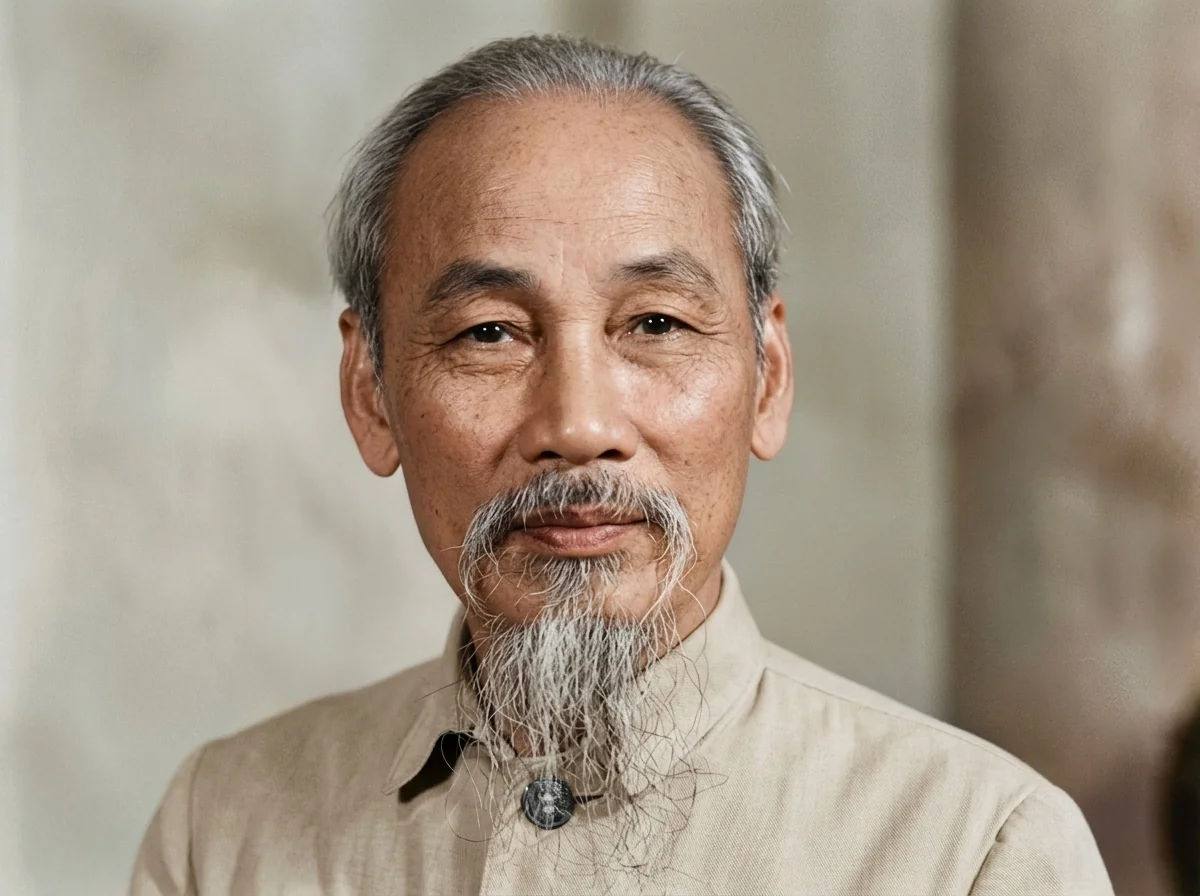
“马共于1930年4月30日成立。胡志明(当时化名阮爱国)以共产国际远东局代表身份出席了成立大会,指导制定了反帝反殖的无产阶级革命纲领。”"The CPM was established on April 30, 1930. Ho Chi Minh (then known as Nguyen Ai Quoc) attended as a representative of the Far East Bureau of the Communist International, guiding the formulation of its anti-colonial revolutionary platform."— 共产国际远东局与马共建党历史档案考据 | Comintern Far Eastern Bureau & CPM Founding Archival Records
1943年5月15日,共产国际执行委员会主席团作出历史性决定,宣布解散共产国际(第三国际),以适应世界反法西斯战争的新格局与各国革命力量独立自主发展的需要。令人惊叹的是,在日军铁蹄封锁马来半岛的严酷敌后环境下,仅相隔三周后的1943年6月8日,马共中央代表便在《四三年雪州六月谈话》中向地方党组织准确传达了《B. 第三国际解散的三个原因》,并精辟批注道:“第三国际已经完成了它的历史使命,共产主义脱离不了民族问题。”这一珍贵手抄文献雄辩地证明,马共在历经十余年革命洗礼后,已从早期依托共产国际指导的支部形态,彻底成长为深深扎根马来亚本土各民族解放事业、能够在复杂环境下独立创造革命策略的成熟马克思列宁主义政党。
On May 15, 1943, the Presidium of the Executive Committee of the Communist International adopted the historic decision to dissolve the Comintern, adapting to the global anti-fascist war and the need for national communist parties to chart independent paths suited to their own conditions. Remarkable for a party operating under total Japanese military blockade, just three weeks later on June 8, 1943, a CPM Central Committee representative delivered the "June 1943 Selangor Talk," systematically explaining the "Three Reasons for the Dissolution of the Third International" and inscribing the incisive annotation: "The Third International has fulfilled its historical mission; Communism cannot be divorced from the national question." This primary manuscript demonstrates that after more than a decade of struggle, the CPM had matured from a Comintern-guided section into an independent Marxist-Leninist party deeply rooted in the multi-ethnic national liberation of Malaya.
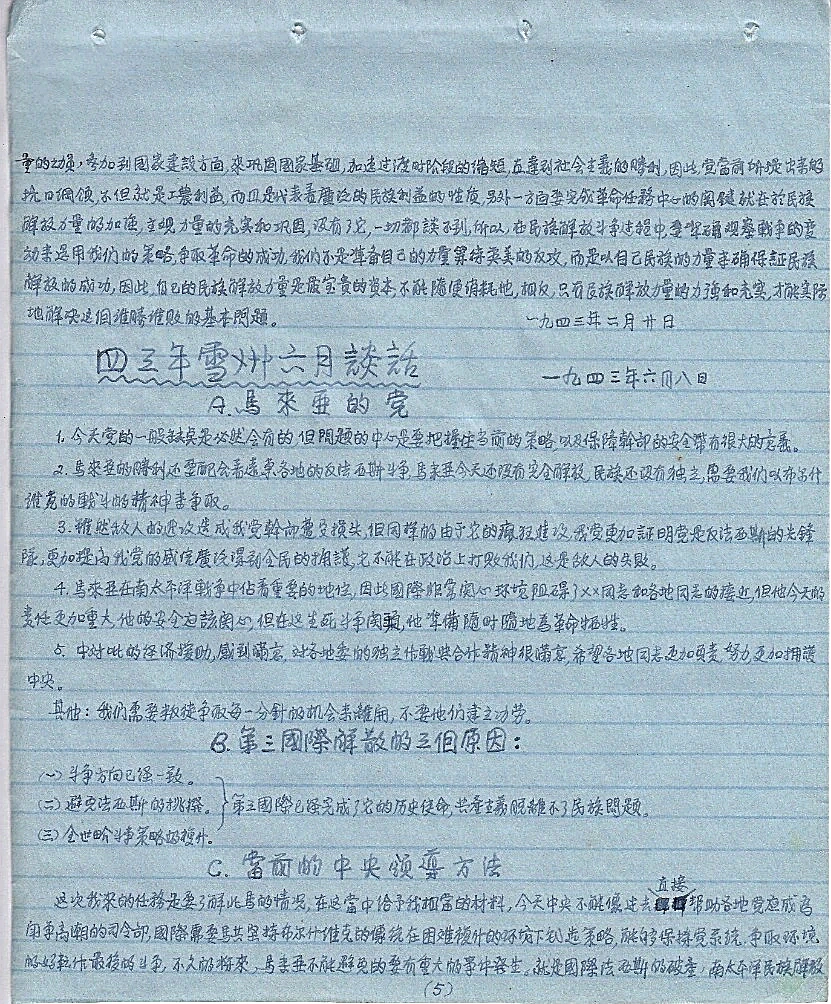
<strong class="text-[#771113] font-bold">B. 第三国际解散的三个原因(一九四三年六月八日《四三年雪州六月谈话》手抄原件摘录)</strong>
(一)斗争方向已经一致。
(二)避免法西斯的挑拨。〔原稿括注:第三国际已经完成了它的历史使命,共产主义脱离不了民族问题。〕
(三)全世界斗争策略的提升。
<strong class="text-[#771113] font-bold">C. 当前的中央领导方法</strong>
今天中央不能像过去直接帮助各地党变成各斗争高潮的司令部,国际需要马共保持布尔什维克的传统,在困难复杂的环境下创造策略,能够保持党系统,争取环境的好转,作最后的斗争。<strong class="text-[#771113] font-bold">B. Three Reasons for the Dissolution of the Third International (Excerpt from the Handwritten Manuscript "June 1943 Selangor Talk", 8 June 1943)</strong>— 马共中央代表《四三年雪州六月谈话》手抄原件(1943年6月8日,原件第5页) | Handwritten Manuscript of the "June 1943 Selangor Talk" (8 June 1943, Page 5)
(1) The direction of struggle has already been unified.
(2) To foil fascist provocation. [Manuscript bracketed note: The Third International has fulfilled its historical mission; Communism cannot be divorced from the national question.]
(3) The elevation of struggle strategies worldwide.
<strong class="text-[#771113] font-bold">C. Current Leadership Methods of the Central Committee</strong>
Today the Central Committee can no longer directly command each local Party organization as the headquarters of every struggle upsurge as in the past. The international movement requires the CPM to uphold Bolshevik traditions, creatively formulate strategies under arduous and complex conditions, preserve the Party system, and strive for a turn for the better to wage the final struggle.
第二章:血浓于水:抗日民族统一战线、南侨机工与南洋援华斗争(1937–1945)
Chapter 2: Blood and Soil: The Anti-Japanese United Front, Nanyang Mechanics, and Peninsular Solidarity (1937–1945)
1937年“七七事变”爆发,日本法西斯发动全面侵华战争,中华民族陷入生死存亡的历史关头。在共产国际与中国共产党抗日民族统一战线号召的感召下,马共坚决站在世界反法西斯正义斗争的最前列。马共通过在全马各地广泛建立的“抗敌后援会”(Anti-Enemy Backing-Up Society)等抗日群众组织,以极高的政治动员力唤醒各阶层劳苦大众,掀起了波澜壮阔的抗日援华救亡风暴。
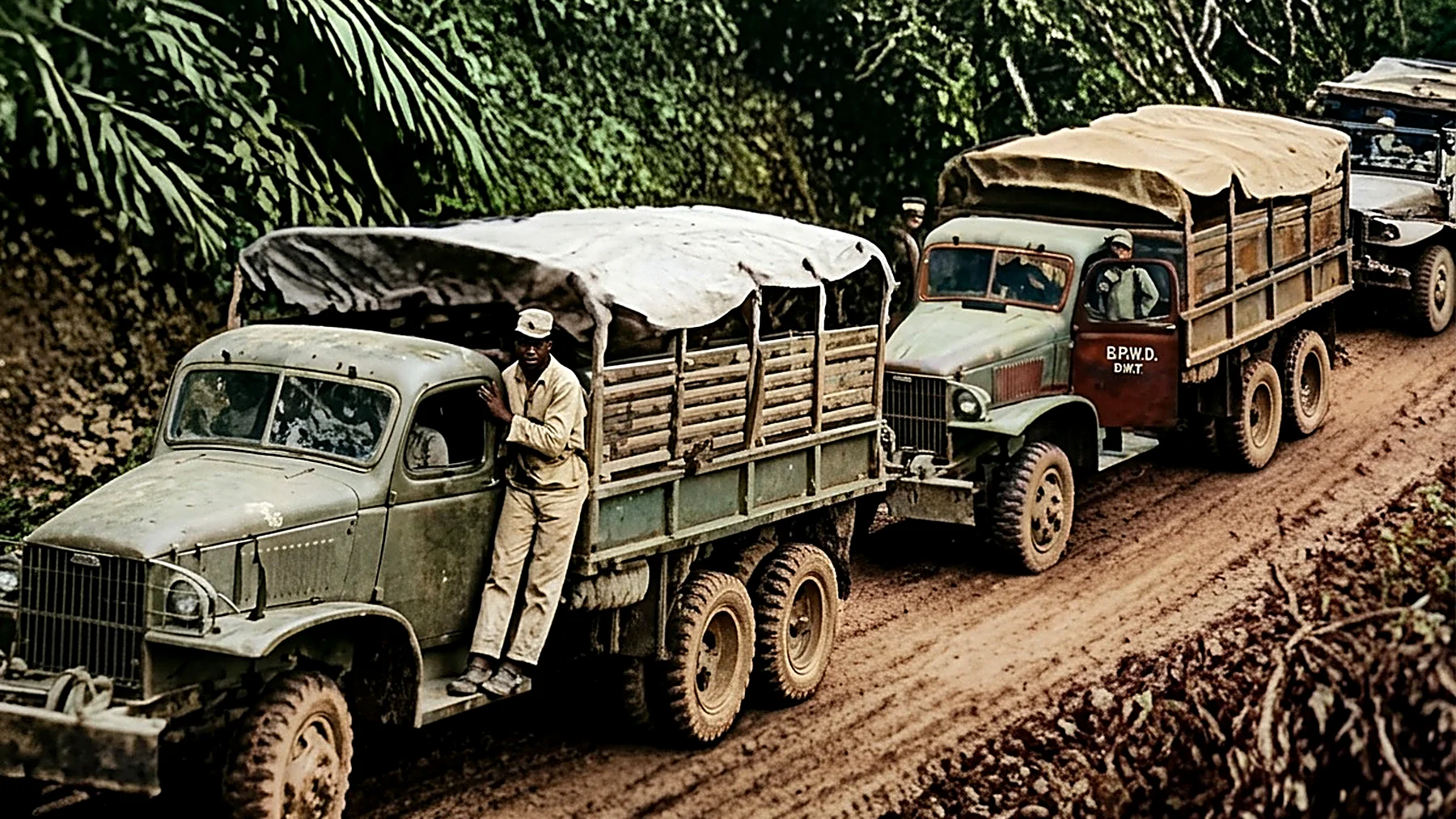
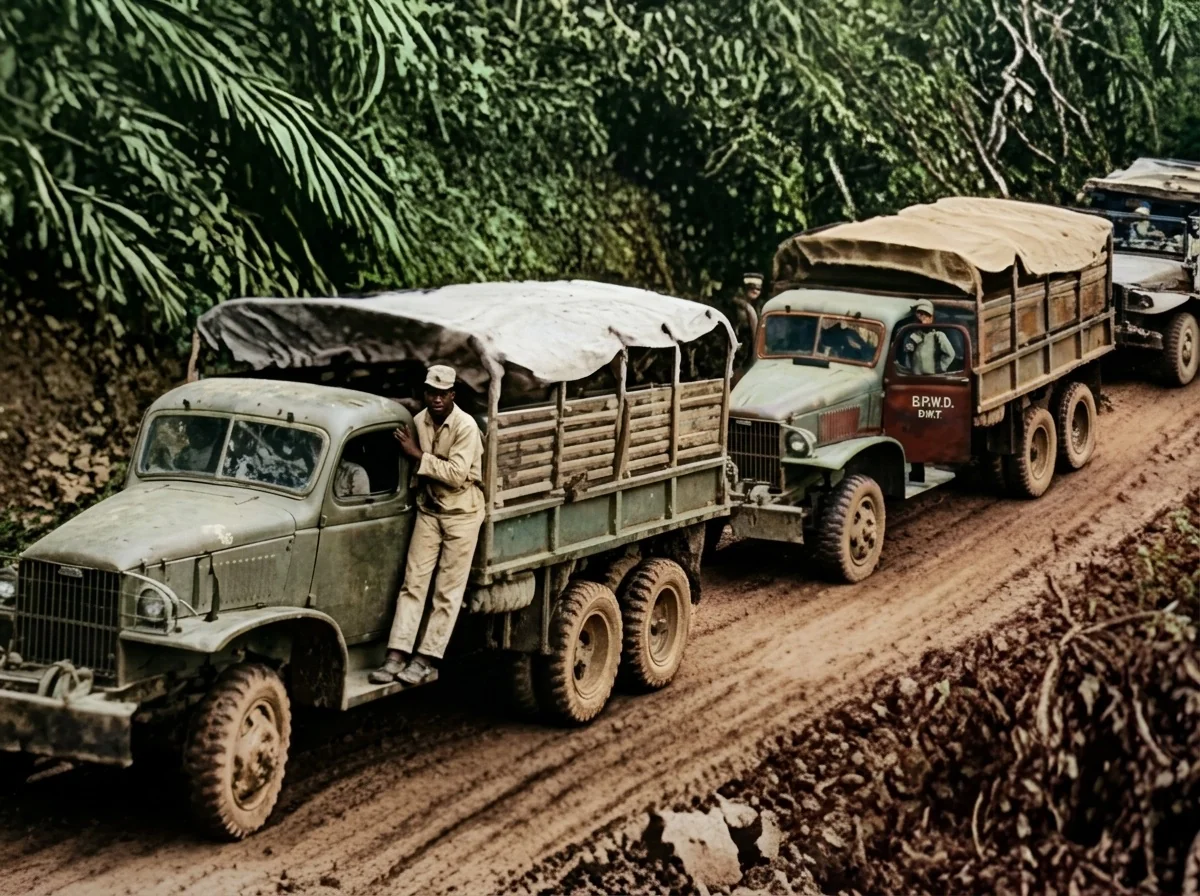
在此期间,著名爱国侨领陈嘉庚先生领导的“南洋华侨筹赈祖国难民总会”(南侨总会)向全东南亚发出招募技术工人的紧急呼吁。在短短数月内,三千余名被誉为“南侨机工”的青年司机与修理技术骨干,义无反顾告别优渥生活,跨过重洋奔赴烽火连天的中国西南边陲,承担起抢运国际战略物资的“抗战输血线”:滇缅公路的驾驶与抢修重任。马共凭借其遍布新马的强大工运网络与地下宣传管道,在南侨机工的动员、选拔与护送中发挥了不可替代的基石配合作用。数百名机工长眠在滇缅公路的崇山峻岭与日军轰炸的弹坑之中,用青春和热血谱写了南洋各民族人民与中国人民同仇敌忾反抗法西斯的壮烈英雄史诗!
随着太平洋战争爆发与日本侵略军南下占领马来半岛,马共毅然组建马来亚人民抗日军(MPAJA),转入热带雨林开展了长达三年零八个月艰苦卓绝的敌后抗日游击战争。正是在这一烽火连天的战壕里,马共自1944年起与泰国共产党(CPT)正式建立起生死相依的兄弟党战略协作关系。
两党在泰马边境崇山峻岭中携手合作,共同勘察建立了纵贯泰南的秘密人员走廊与后勤补给通道,共享电台密码与战略情报。这种在反抗日本侵略战争烈火中铸就的战友深情,为后来数十年马共在泰南坚持反帝反殖民族解放根据地打下了最坚实的地理与政治依托。
Following the Marco Polo Bridge Incident in July 1937, imperial Japan launched full-scale aggression against China. Responsive to the anti-fascist united front line of the Comintern and the Chinese Communist Party, the CPM mobilized thousands of workers, youths, and cultural societies across Malaya and Singapore through mass front groups such as the Anti-Enemy Backing-Up Society.
Simultaneously, when community leader Tan Kah Kee issued an urgent call under the Nanyang Relief Association for skilled personnel to keep the vital Burma Road operational, over 3,000 volunteer drivers and mechanics: the famed 'Nanyang Transport Corps': departed Southeast Asia for the warfront. The CPM utilized its extensive trade union networks and clandestine press to facilitate this historic mobilization. Hundreds sacrificed their lives under aerial bombardment and tropical disease, forging an unbreakable bond of anti-fascist solidarity.
When Japanese forces swept across Malaya in December 1941, the CPM established the Malayan Peoples' Anti-Japanese Army (MPAJA), waging over three years of relentless guerrilla warfare. Amidst this crucible, the CPM forged an enduring alliance with the Communist Party of Thailand (CPT) beginning in 1944.
Operating along the rugged frontier, the two fraternal parties co-constructed clandestine supply trails and secure intelligence corridors, sharing communications and survival resources. Forged in anti-fascist combat, this strategic alliance provided the indispensable geopolitical foundation for the CPM's border sanctuaries during the subsequent decades of struggle.
1937年“七七事变”爆发,日本法西斯发动全面侵华战争,中华民族陷入生死存亡的历史关头。在共产国际与中国共产党抗日民族统一战线号召的感召下,马共坚决站在世界反法西斯正义斗争的最前列。马共通过在全马各地广泛建立的“抗敌后援会”(Anti-Enemy Backing-Up Society)等抗日群众组织,以极高的政治动员力唤醒各阶层劳苦大众,掀起了波澜壮阔的抗日援华救亡风暴。
在此期间,著名爱国侨领陈嘉庚先生领导的“南洋华侨筹赈祖国难民总会”(南侨总会)向全东南亚发出招募技术工人的紧急呼吁。在短短数月内,三千余名被誉为“南侨机工”的青年司机与修理技术骨干,义无反顾告别优渥生活,跨过重洋奔赴烽火连天的中国西南边陲,承担起抢运国际战略物资的“抗战输血线”:滇缅公路的驾驶与抢修重任。马共凭借其遍布新马的强大工运网络与地下宣传管道,在南侨机工的动员、选拔与护送中发挥了不可替代的基石配合作用。数百名机工长眠在滇缅公路的崇山峻岭与日军轰炸的弹坑之中,用青春和热血谱写了南洋各民族人民与中国人民同仇敌忾反抗法西斯的壮烈英雄史诗!
Following the Marco Polo Bridge Incident in July 1937, imperial Japan launched full-scale aggression against China. Responsive to the anti-fascist united front line of the Comintern and the Chinese Communist Party, the CPM mobilized thousands of workers, youths, and cultural societies across Malaya and Singapore through mass front groups such as the Anti-Enemy Backing-Up Society.
Simultaneously, when community leader Tan Kah Kee issued an urgent call under the Nanyang Relief Association for skilled personnel to keep the vital Burma Road operational, over 3,000 volunteer drivers and mechanics: the famed 'Nanyang Transport Corps': departed Southeast Asia for the warfront. The CPM utilized its extensive trade union networks and clandestine press to facilitate this historic mobilization. Hundreds sacrificed their lives under aerial bombardment and tropical disease, forging an unbreakable bond of anti-fascist solidarity.
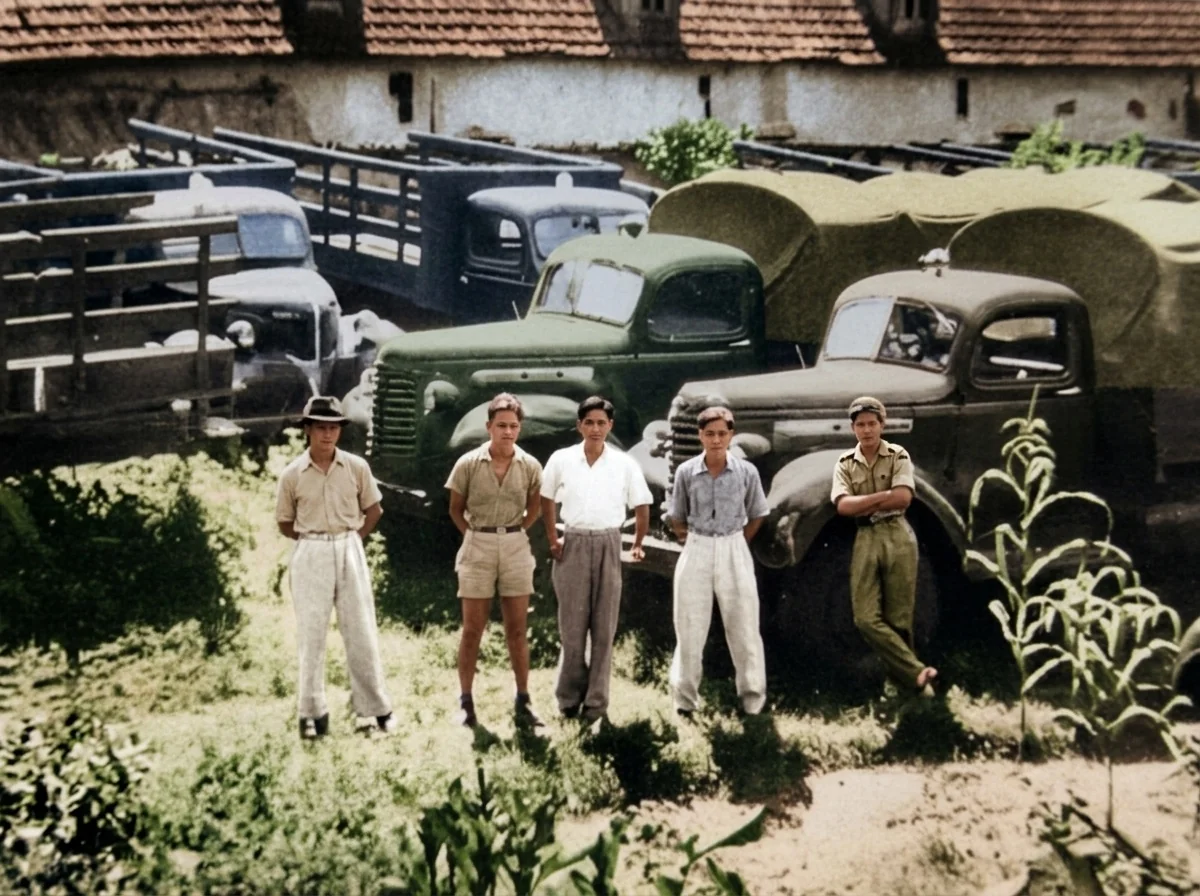
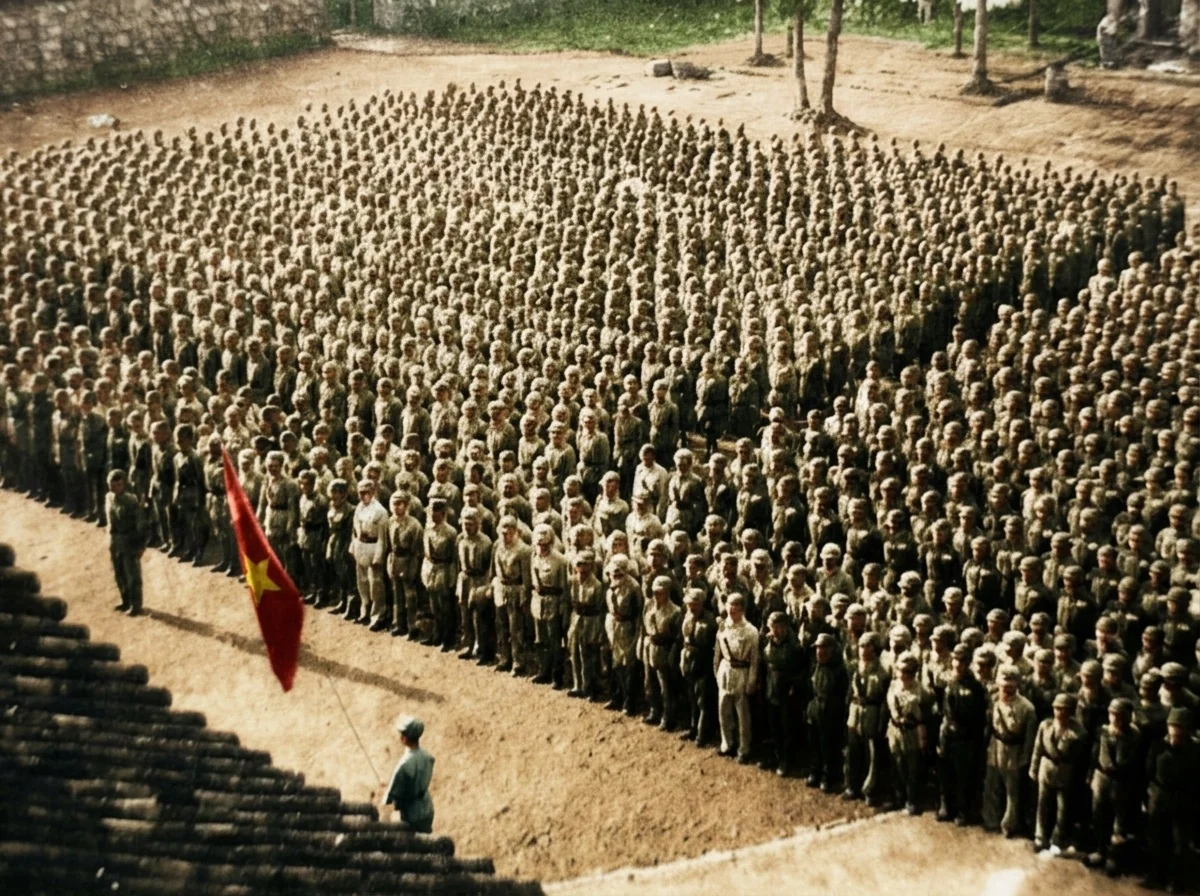
随着太平洋战争爆发与日本侵略军南下占领马来半岛,马共毅然组建马来亚人民抗日军(MPAJA),转入热带雨林开展了长达三年零八个月艰苦卓绝的敌后抗日游击战争。正是在这一烽火连天的战壕里,马共自1944年起与泰国共产党(CPT)正式建立起生死相依的兄弟党战略协作关系。
两党在泰马边境崇山峻岭中携手合作,共同勘察建立了纵贯泰南的秘密人员走廊与后勤补给通道,共享电台密码与战略情报。这种在反抗日本侵略战争烈火中铸就的战友深情,为后来数十年马共在泰南坚持反帝反殖民族解放根据地打下了最坚实的地理与政治依托。
When Japanese forces swept across Malaya in December 1941, the CPM established the Malayan Peoples' Anti-Japanese Army (MPAJA), waging over three years of relentless guerrilla warfare. Amidst this crucible, the CPM forged an enduring alliance with the Communist Party of Thailand (CPT) beginning in 1944.
Operating along the rugged frontier, the two fraternal parties co-constructed clandestine supply trails and secure intelligence corridors, sharing communications and survival resources. Forged in anti-fascist combat, this strategic alliance provided the indispensable geopolitical foundation for the CPM's border sanctuaries during the subsequent decades of struggle.
第三章:赤子长歌:中国共产党对马来亚革命的无产阶级国际主义支援(1950s–1980s)
Chapter 3: Red Echoes across Continents: The CPC's Proletarian Internationalist Support for the Malayan Revolution (1950s–1980s)
1948年6月,英帝国主义在全马悍然颁布紧急状态令,对工会领袖与民主人士展开法西斯大清洗,马共被迫全面转入热带雨林开展武装自卫与民族解放战争。面对装备精良的英联邦海陆空军数十万部队的残酷“滚筒式”围剿,马共陷入极端孤立与艰苦卓绝的战局。正是在这一关乎革命存亡的艰难岁月里,刚刚建立新中国的中国共产党,毅然向马来亚共产党伸出了崇高无私的无产阶级国际主义援助之手!
自1950年代初起,在毛泽东主席、周恩来总理等老一辈无产阶级革命家的深切关怀下,中共中央为马共领导机构在北京提供了安全稳定的战略落脚点。中国不仅在国际外交舞台上坚决声援马共反抗殖民奴役的正义自卫斗争,更为马共源源不断地开办了高规格的学习深造与专业培训项目,涵盖现代战伤救治、战地外科手术、无线电机要通讯、军事爆破与游击战术理论,为马共培养并输送了一整代军政骨干人才。同时,在长达三十年的漫长岁月里,中共中央为马共提供持续坚定的财政与物资支援,直至1980年代初因国际格局演变才逐步削减。
毛泽东主席生前多次在北京亲切会见马共中央总书记陈平、中央主席穆沙·阿默德、副总书记李安东、政治局常委章凌云、政治局委员陈田以及中央委员陈瑞(单汝洪)等领导人。毛主席多次在会见中高度赞赏马共坚决反对帝国主义、坚决拒绝屈辱投降的英雄气概。在1956年初会见中,毛主席更对陈平在华玲谈判中义正言辞抗击官方威胁的表现给予极高评价:“这是英雄!在我们共产党人的字典里是找不到‘投降’两个字的!”
在所有援助项目中,最具历史震撼力与战略意义的,莫过于经毛泽东主席与周恩来总理亲自批准、于湖南益阳安化深山建立的马共中央绝密广播电台基地:代号“691工程”!自1969年11月15日至1981年6月30日,这座拥有两台500千瓦超大功率短波发射机、由数百名中国人民解放军铁道兵与广播专家倾力建造的战备基地,以华语、马来语、泰米尔语和英语四种语言,将《马来亚革命之声》(Suara Revolusi Malaya)的战斗号角强力发射至全马半岛、新加坡、婆罗洲乃至全球各地,彻底粉碎了大英帝国与吉隆坡执政者的舆论封锁,成为指引千万工农群众投身反帝斗争的巍峨灯塔!
In June 1948, the British colonial regime declared a State of Emergency across Malaya, unleashing mass arrests against trade unionists and pushing the CPM into the rainforests to wage a protracted national liberation war. Facing overwhelming Commonwealth air, naval, and ground forces, the CPM encountered extreme encirclement. During these perilous decades, the newly founded People's Republic of China and the CPC extended unwavering proletarian internationalist support.
From the early 1950s, under the guidance of Chairman Mao Zedong and Premier Zhou Enlai, the CPC Central Committee provided the CPM leadership with a secure strategic base in Beijing. The CPC sponsored comprehensive training programs for CPM personnel in surgical field medicine, cryptography, telecommunications, and military strategy. Concurrently, China sustained financial and logistical subsidies for nearly three decades until geopolitical transitions in the early 1980s prompted a phased reduction.
Chairman Mao personally received CPM leaders on multiple occasions, consistently praising their unyielding defiance of colonial ultimatums. Following the 1955 Baling Talks, Mao commended Chin Peng's refusal to capitulate, affirming: 'That is heroism! In our communist dictionary, the word "surrender" does not exist!'
The crowning strategic achievement of this fraternal solidarity was the clandestine broadcasting installation in Yiyang, Hunan: officially designated 'Project 691.' Approved by Mao and Zhou Enlai, this high-powered 500-kilowatt shortwave facility transmitted the Voice of Malayan Revolution (Suara Revolusi Malaya) from November 1969 to June 1981 in Malay, Chinese, Tamil, and English. Project 691 completely dismantled colonial media monopolies, broadcasting revolutionary truth directly into rubber estates, factories, and rainforest bases.
1948年6月,英帝国主义在全马悍然颁布紧急状态令,对工会领袖与民主人士展开法西斯大清洗,马共被迫全面转入热带雨林开展武装自卫与民族解放战争。面对装备精良的英联邦海陆空军数十万部队的残酷“滚筒式”围剿,马共陷入极端孤立与艰苦卓绝的战局。正是在这一关乎革命存亡的艰难岁月里,刚刚建立新中国的中国共产党,毅然向马来亚共产党伸出了崇高无私的无产阶级国际主义援助之手!
自1950年代初起,在毛泽东主席、周恩来总理等老一辈无产阶级革命家的深切关怀下,中共中央为马共领导机构在北京提供了安全稳定的战略落脚点。中国不仅在国际外交舞台上坚决声援马共反抗殖民奴役的正义自卫斗争,更为马共源源不断地开办了高规格的学习深造与专业培训项目,涵盖现代战伤救治、战地外科手术、无线电机要通讯、军事爆破与游击战术理论,为马共培养并输送了一整代军政骨干人才。同时,在长达三十年的漫长岁月里,中共中央为马共提供持续坚定的财政与物资支援,直至1980年代初因国际格局演变才逐步削减。
In June 1948, the British colonial regime declared a State of Emergency across Malaya, unleashing mass arrests against trade unionists and pushing the CPM into the rainforests to wage a protracted national liberation war. Facing overwhelming Commonwealth air, naval, and ground forces, the CPM encountered extreme encirclement. During these perilous decades, the newly founded People's Republic of China and the CPC extended unwavering proletarian internationalist support.
From the early 1950s, under the guidance of Chairman Mao Zedong and Premier Zhou Enlai, the CPC Central Committee provided the CPM leadership with a secure strategic base in Beijing. The CPC sponsored comprehensive training programs for CPM personnel in surgical field medicine, cryptography, telecommunications, and military strategy. Concurrently, China sustained financial and logistical subsidies for nearly three decades until geopolitical transitions in the early 1980s prompted a phased reduction.
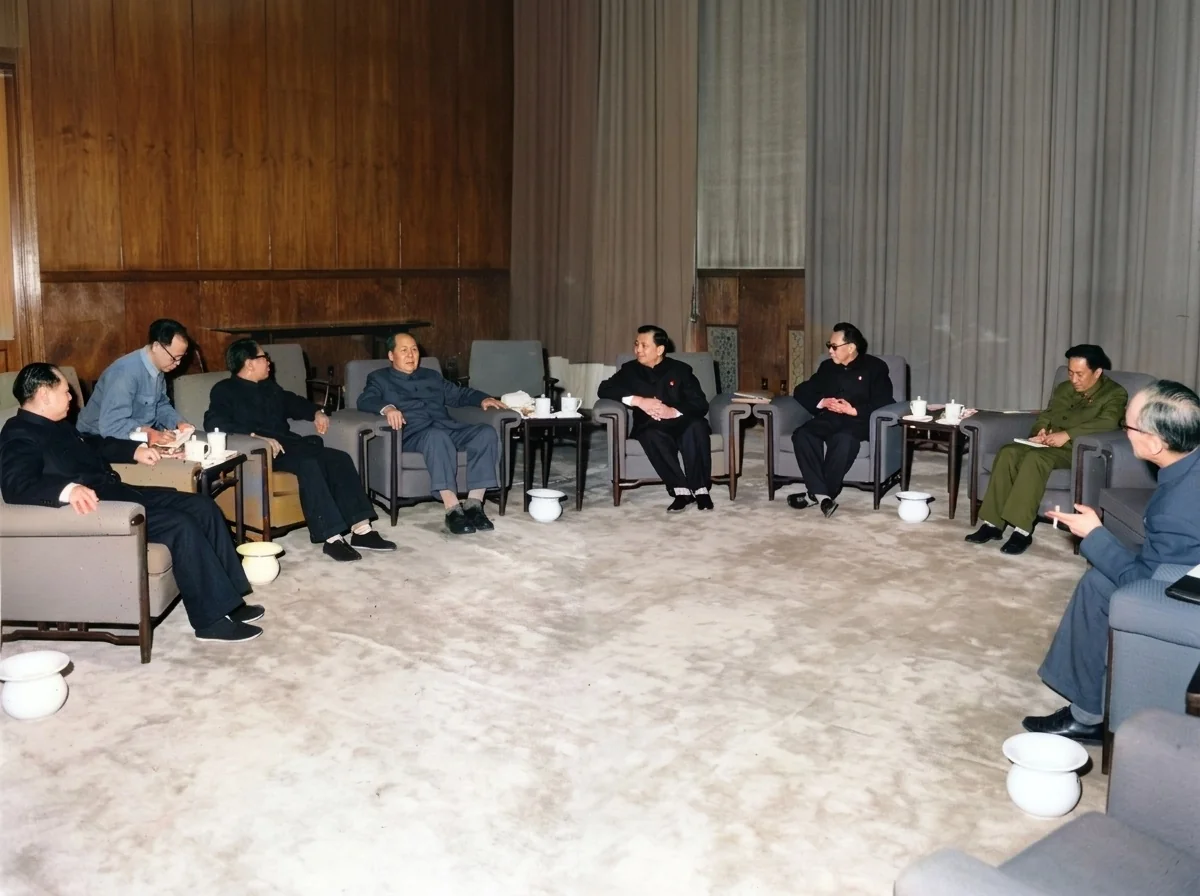
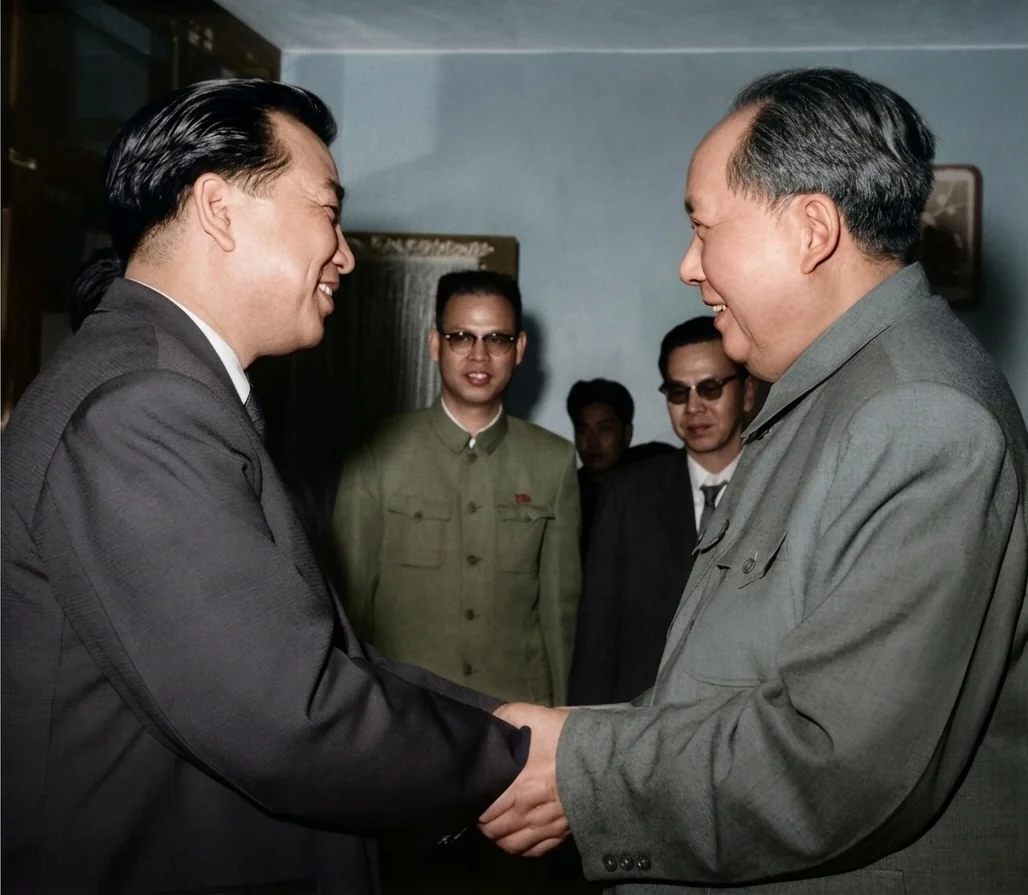
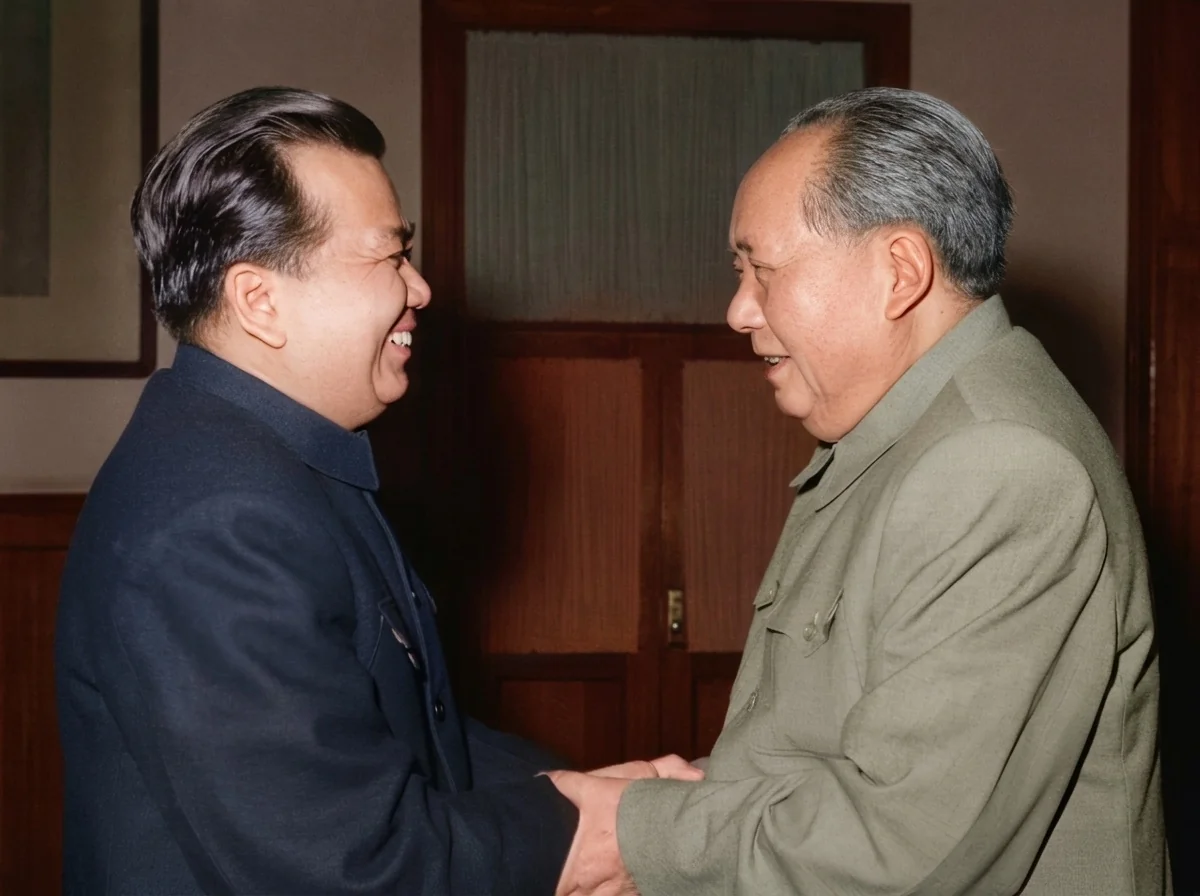
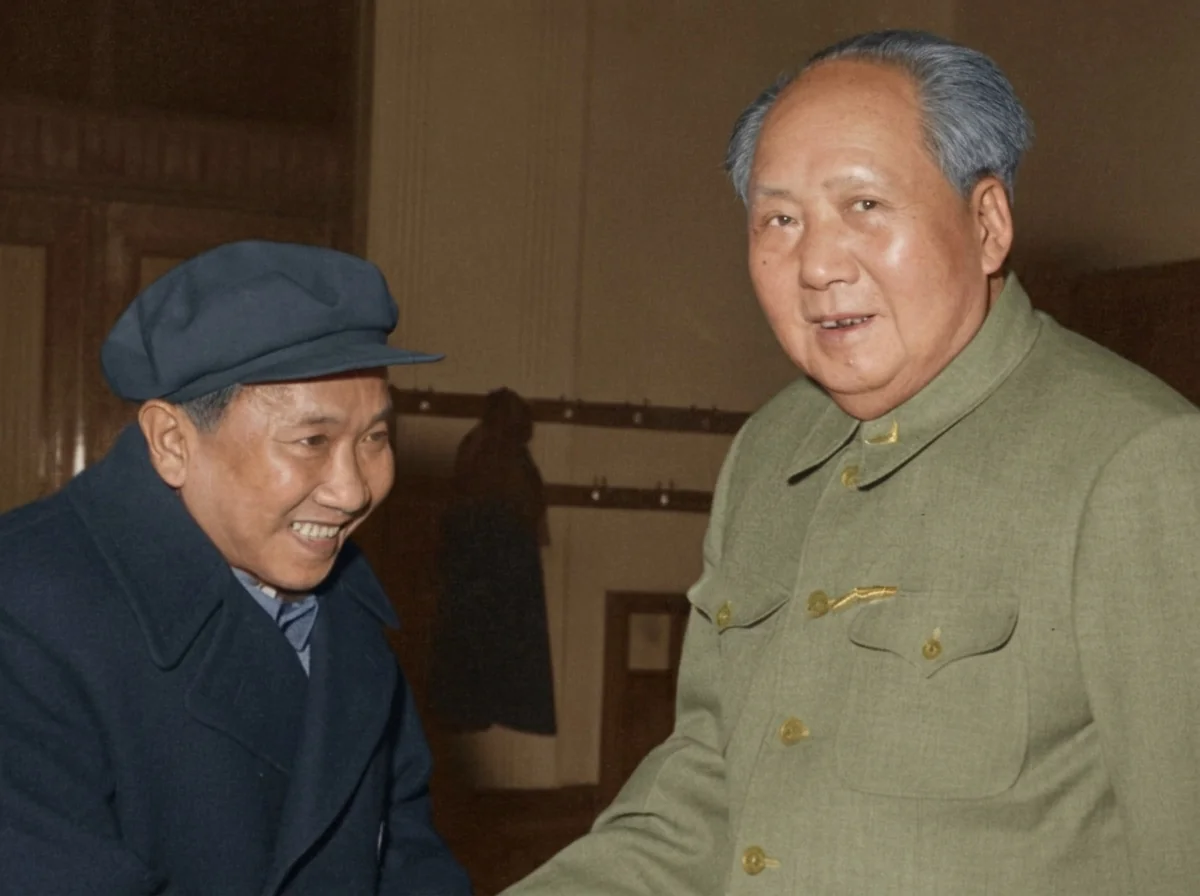
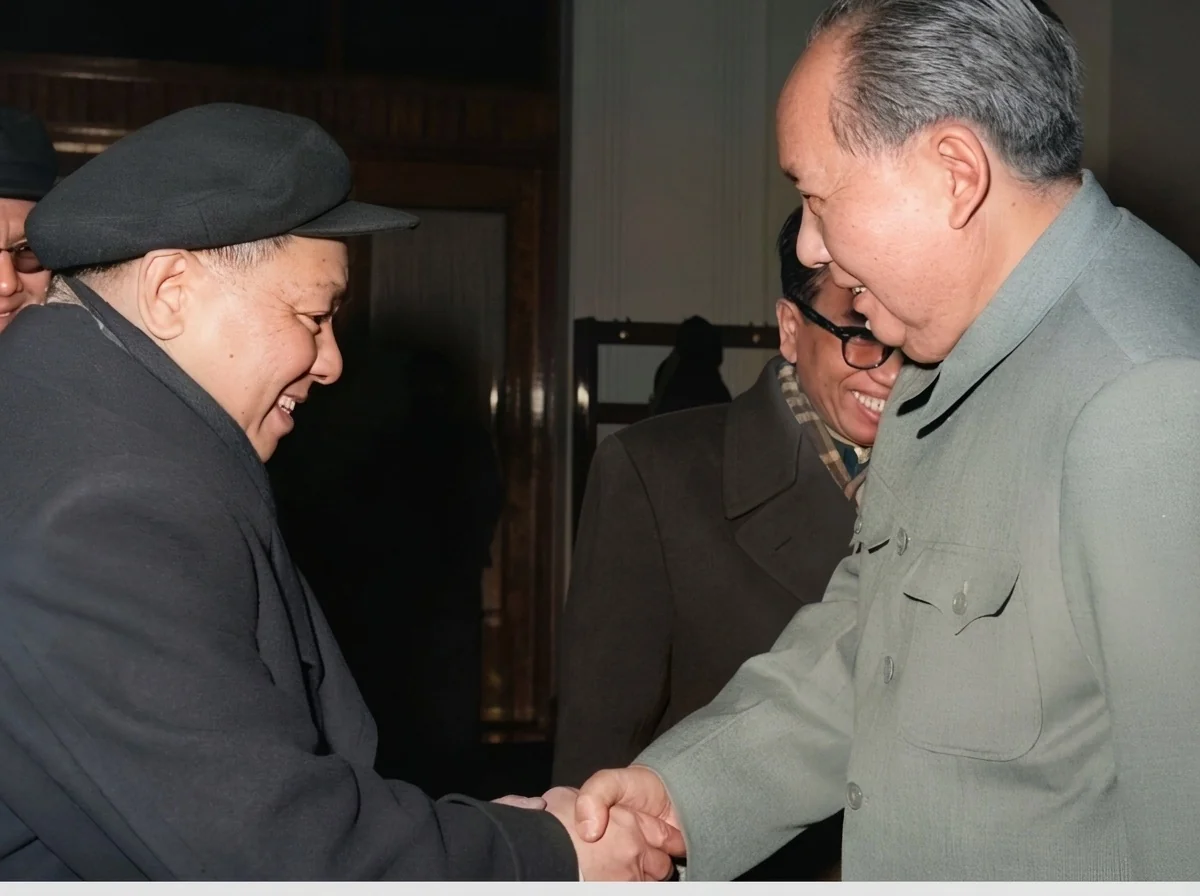
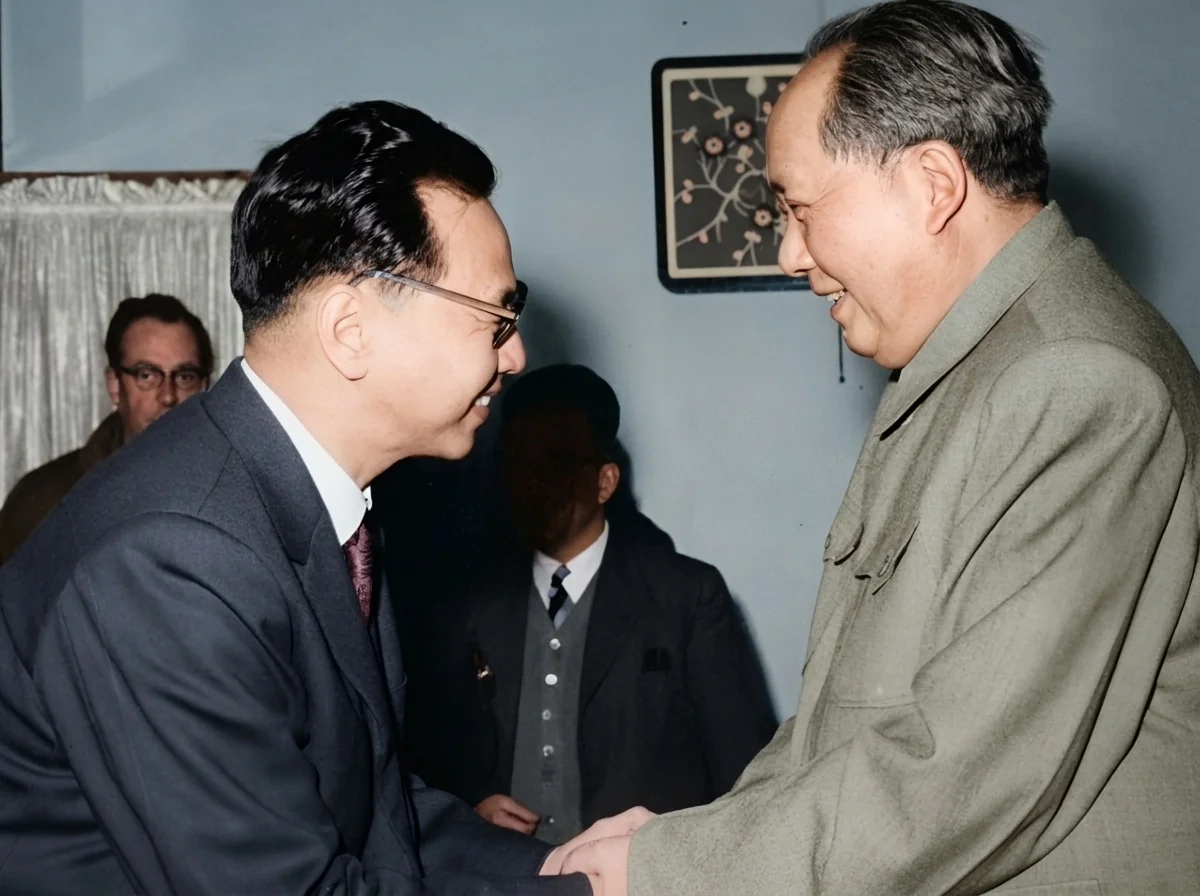
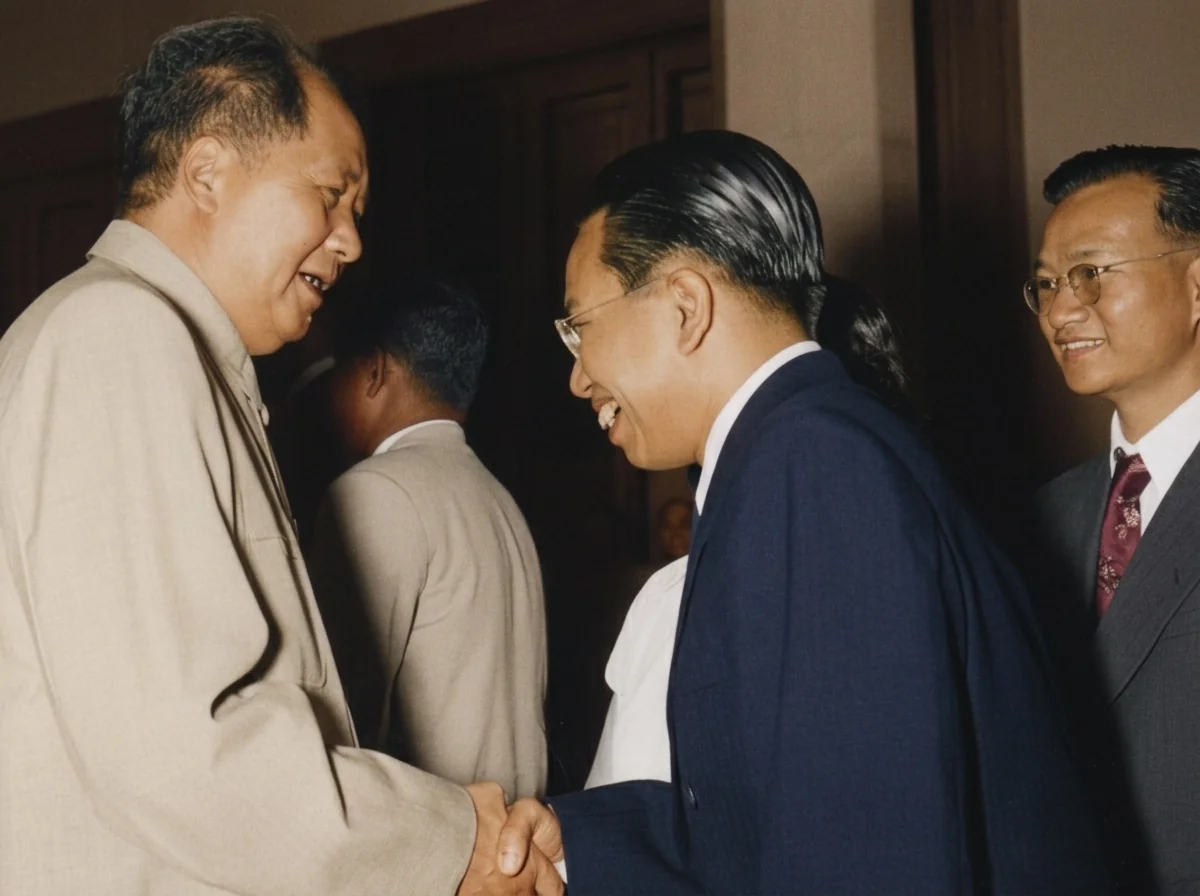
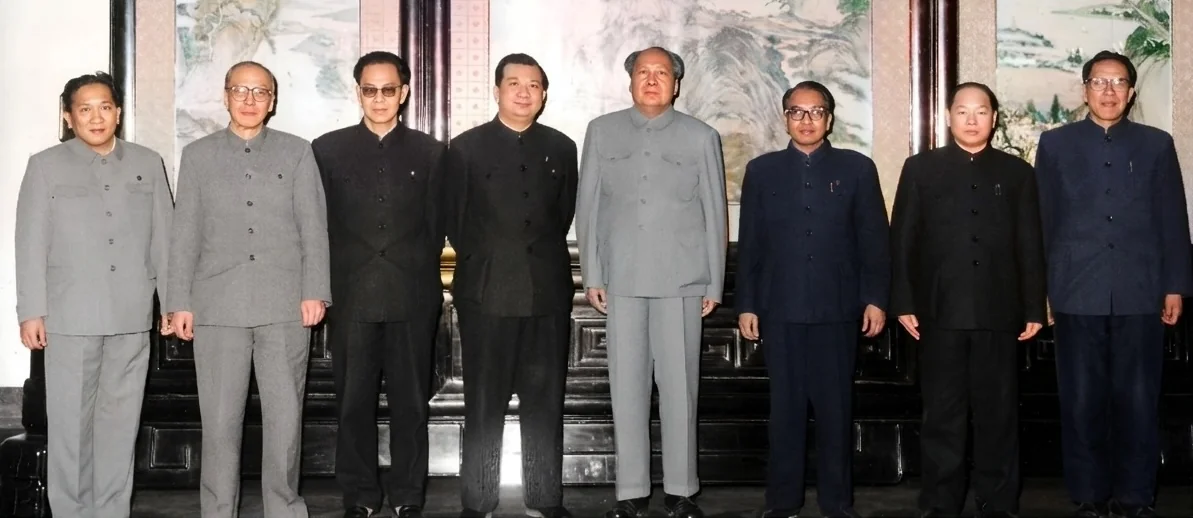
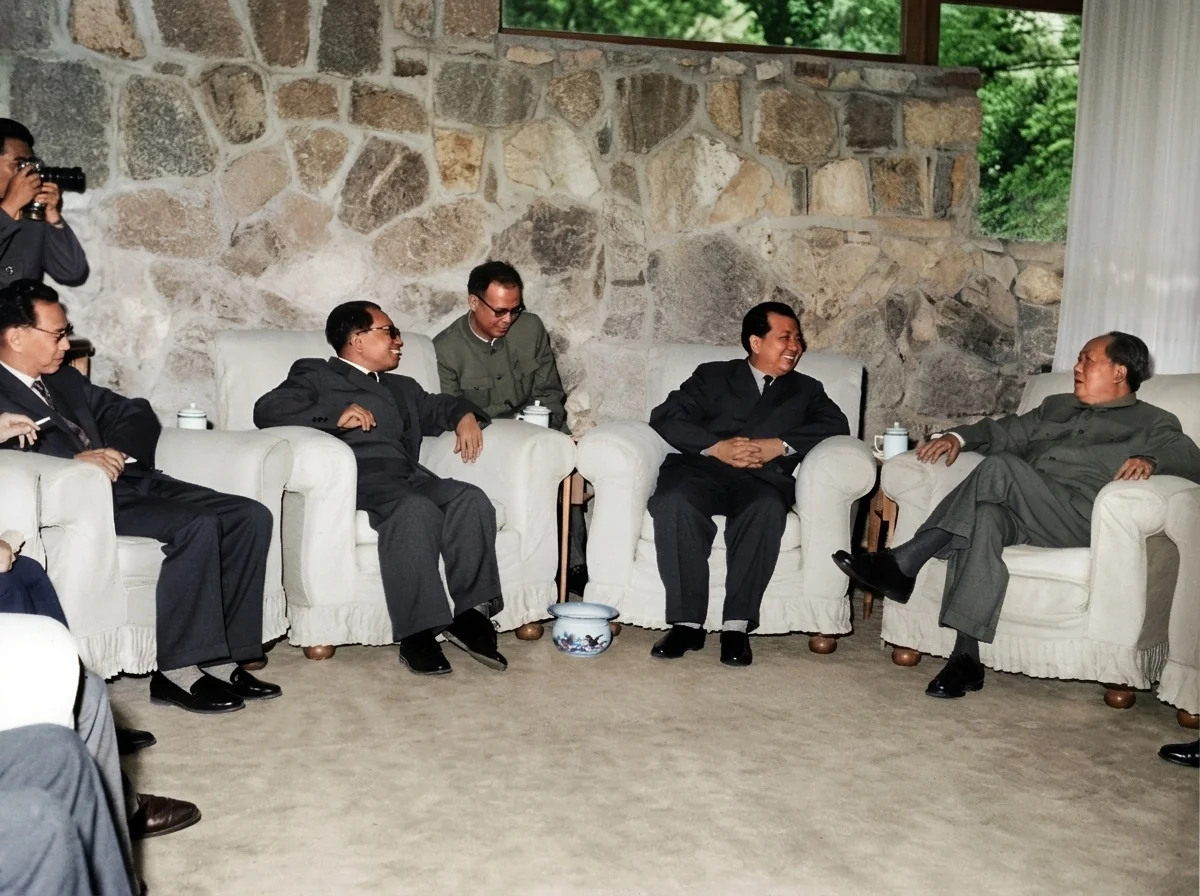
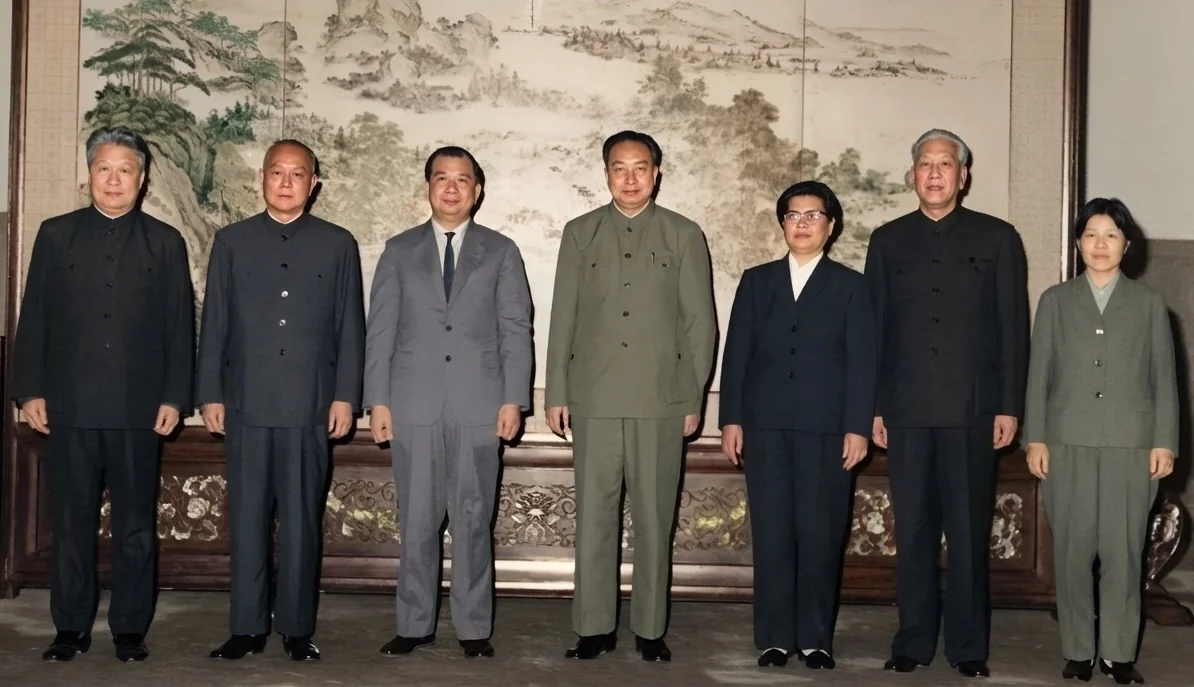
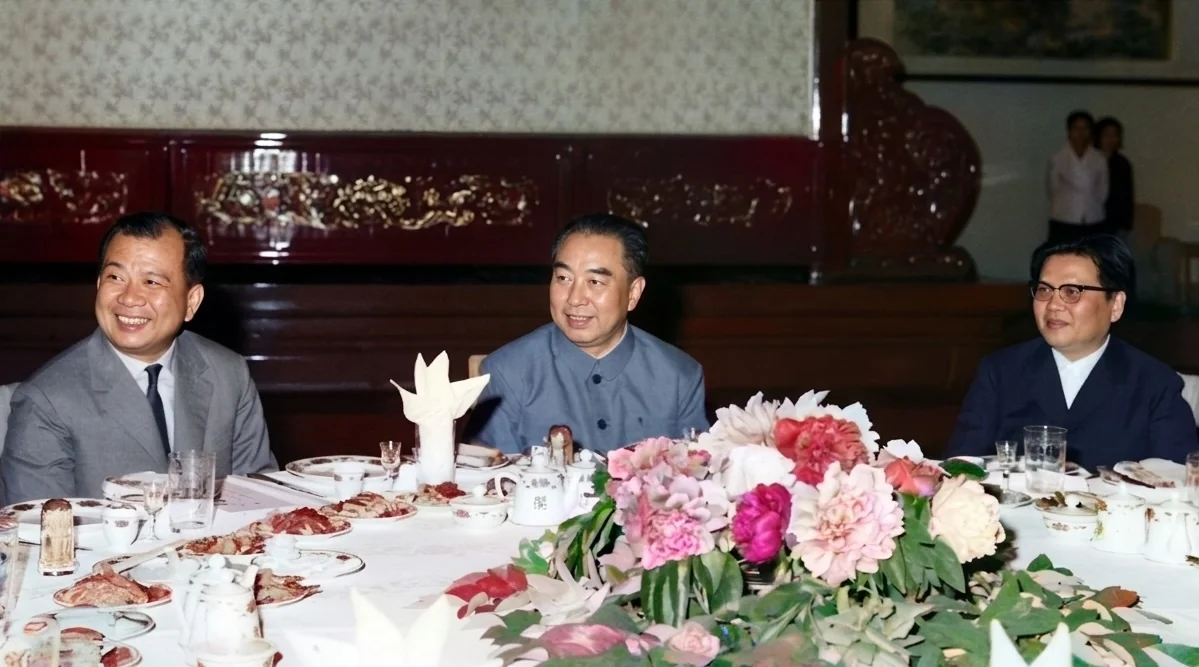
毛泽东主席生前多次在北京亲切会见马共中央总书记陈平、中央主席穆沙·阿默德、副总书记李安东、政治局常委章凌云、政治局委员陈田以及中央委员陈瑞(单汝洪)等领导人。毛主席多次在会见中高度赞赏马共坚决反对帝国主义、坚决拒绝屈辱投降的英雄气概。在1956年初会见中,毛主席更对陈平在华玲谈判中义正言辞抗击官方威胁的表现给予极高评价:“这是英雄!在我们共产党人的字典里是找不到‘投降’两个字的!”
在所有援助项目中,最具历史震撼力与战略意义的,莫过于经毛泽东主席与周恩来总理亲自批准、于湖南益阳安化深山建立的马共中央绝密广播电台基地:代号“691工程”!自1969年11月15日至1981年6月30日,这座拥有两台500千瓦超大功率短波发射机、由数百名中国人民解放军铁道兵与广播专家倾力建造的战备基地,以华语、马来语、泰米尔语和英语四种语言,将《马来亚革命之声》(Suara Revolusi Malaya)的战斗号角强力发射至全马半岛、新加坡、婆罗洲乃至全球各地,彻底粉碎了大英帝国与吉隆坡执政者的舆论封锁,成为指引千万工农群众投身反帝斗争的巍峨灯塔!
Chairman Mao personally received CPM leaders on multiple occasions, consistently praising their unyielding defiance of colonial ultimatums. Following the 1955 Baling Talks, Mao commended Chin Peng's refusal to capitulate, affirming: 'That is heroism! In our communist dictionary, the word "surrender" does not exist!'
The crowning strategic achievement of this fraternal solidarity was the clandestine broadcasting installation in Yiyang, Hunan: officially designated 'Project 691.' Approved by Mao and Zhou Enlai, this high-powered 500-kilowatt shortwave facility transmitted the Voice of Malayan Revolution (Suara Revolusi Malaya) from November 1969 to June 1981 in Malay, Chinese, Tamil, and English. Project 691 completely dismantled colonial media monopolies, broadcasting revolutionary truth directly into rubber estates, factories, and rainforest bases.
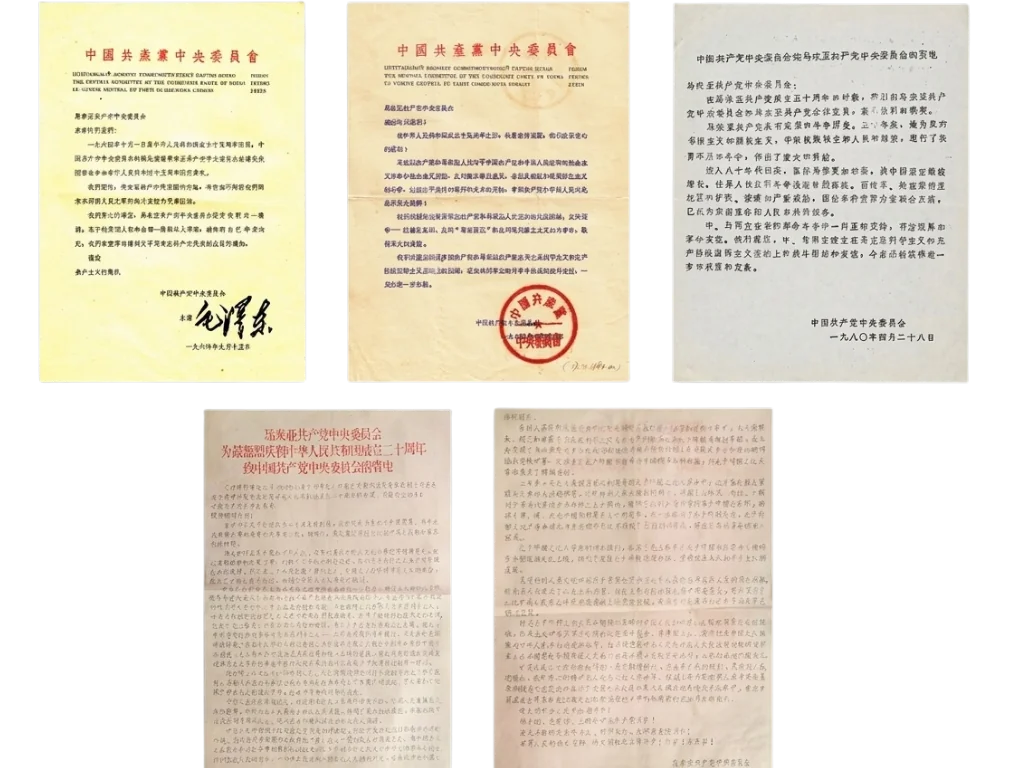
中共中央致马来亚共产党中央委员会的贺电(1980年4月28日):
“在马来亚共产党成立五十周年的时候,我们向马来亚共产党中央委员会和马来亚共产党全体党员,致以热烈的祝贺。……中、马两党在长期革命斗争中一贯互相支持,建立了深厚的革命友谊。中、马两党建立在马克思列宁主义和无产阶级国际主义基础上的战斗团结和友谊,今后必将继续发展!”"Congratulatory Message from the Central Committee of the Communist Party of China to the Central Committee of the Communist Party of Malaya (April 28, 1980):— 中国共产党中央委员会(1980年4月28日) | Central Committee of the Communist Party of China (April 28, 1980)
'On the occasion of the fiftieth anniversary of the founding of the Communist Party of Malaya, we extend our warmest fraternal congratulations to the CPM Central Committee and all party members... In the prolonged course of revolutionary struggle, the Communist Party of China and the Communist Party of Malaya have consistently supported one another, forging deep revolutionary ties. The militant unity and fraternal friendship between our two parties, founded upon Marxism-Leninism and proletarian internationalism, will surely continue to flourish!'"
第四章:红河壮澜:越南劳动党与马共的战友深情(1960s)
Chapter 4: Waves along the Red River: Fraternal Comradeship with the Vietnam Workers' Party (1960s)
除了中国共产党之外,在印支半岛反抗法美帝国主义最前线的越南劳动党(后改称越南共产党),与马共同样保持着血肉交融的革命情谊。自胡志明1930年指导马共建党起,两党之间的特殊纽带便在漫长岁月里历久弥坚。
进入1960年代初期,面对马来亚联合邦与英国新殖民主义阴谋炮制的“马来西亚计划”,马共正处在筹划重新恢复丛林武装斗争的关键历史转折点。1962年4月,马共第三号核心领导人、政治局常委章凌云奉命自海外返回马泰边境前线指挥战斗。在章凌云启程前夕,总书记陈平与副总书记李安东专程赶赴北越河内与章凌云会合。在越南劳动党兄弟般的热情接待与高度安全保卫下,三位马共最高决策层领导人在河内举行了具有决定性历史意义的高层政治局常委会议,全面总结了华玲和谈后的局势,最终敲定了重返丛林、恢复游击战的重大战略方针!
1964年,马共的斗争得到了越南劳动党最高统帅部的进一步全力支持。越南劳动党中央委员会主席胡志明与第一书记黎笋亲自拍板批准,决定在北越境内为马共援建一座秘密短波广播电台!越方不仅在公文中明确承诺提供全套发射技术人员与设备清单,更在河内专门为马共机要骨干开办了专门的无线电技术培训班。然而,随着北部湾事件爆发,美帝国主义对北越发动惨无人道的大规模狂轰滥炸,加上大型发射机因战时交通阻绝无法按期运抵,北越面临极其严酷的防空战事,该电台援建计划最终遗憾未能如期实施,转而为后来湖南益阳“691工程”的落地奠定了技术准备。
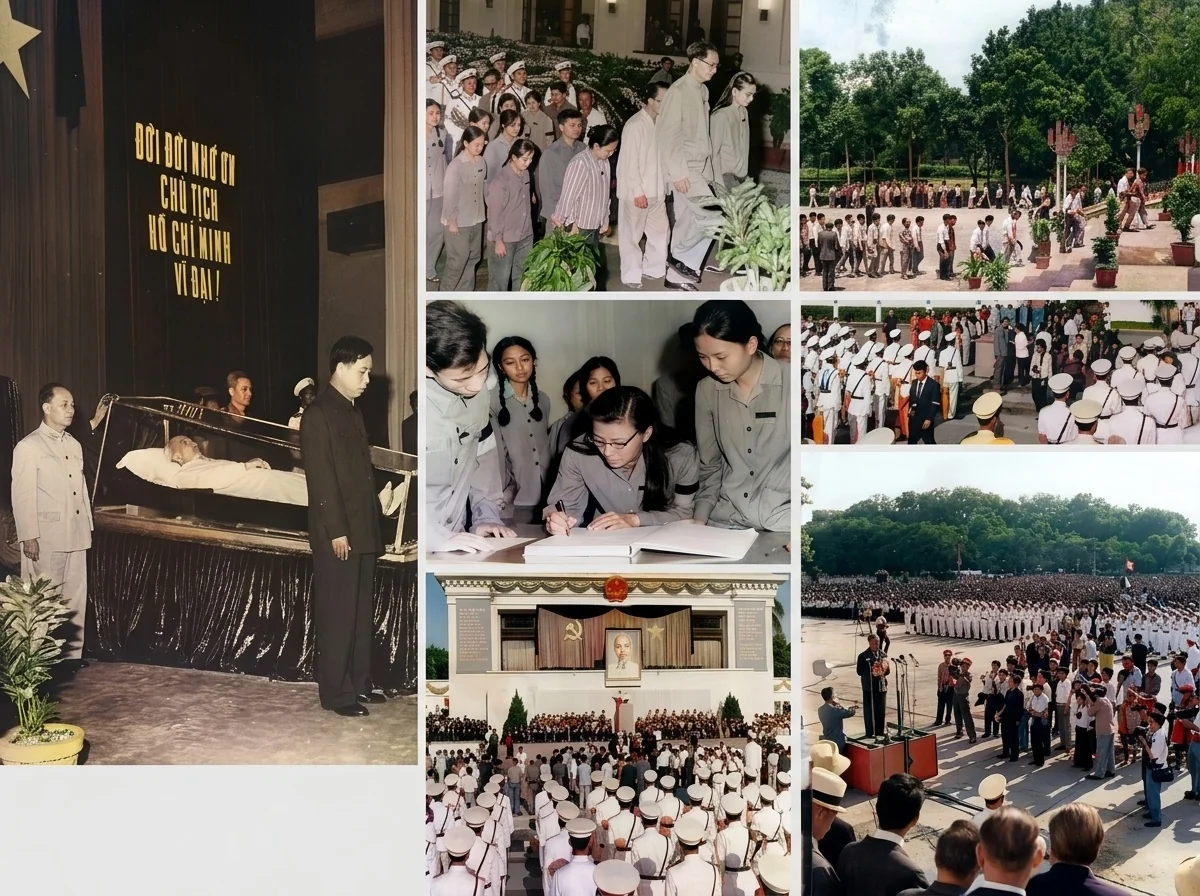
1969年9月,越南党和人民的领袖胡志明主席不幸与世长辞。在美军炮火连天、国际局势极其严峻的时刻,马共驻越代表陈夏率全体在越工作与学习人员,亲赴河内巴亭广场肃立默哀参加国葬,向这位指导马共诞生的国际共运先驱沉痛告别,将中越马三国跨越半个世纪的战斗友谊永远载入了史册!
Beyond China, the Vietnam Workers' Party (later Communist Party of Vietnam) maintained profound operational bonds with the CPM. Since Ho Chi Minh's personal role in establishing the CPM in 1930, relations between the two revolutionary movements remained exceptionally close.
In April 1962, as the CPM prepared to resume peninsular armed operations to counter British neo-colonial consolidation via the 'Malaysia' federation project, Politburo Standing Committee member Zhang Ling Yun prepared to return to the jungle frontier. Prior to his departure, Secretary-General Chin Peng and Deputy Secretary-General Lee An Tung met him in Hanoi. Hosted under stringent security by Vietnamese comrades, the triumvirate convened a historic high-level summit, finalizing the strategy to reactivate peninsular guerrilla bases.
In 1964, direct Vietnamese support escalated when President Ho Chi Minh and First Secretary Le Duan personally approved the installation of a clandestine CPM radio station inside North Vietnam. Hanoi committed technical advisors, transmitting hardware, and cadre instruction. However, following the Gulf of Tonkin incident and escalating American bombing offensives, the plan was rendered unfeasible, paving the path for the subsequent establishment of Project 691 in China.
When President Ho Chi Minh passed away in September 1969, the CPM dispatched an official delegation led by Chen Xia to Hanoi to attend the state funeral. Paying their deepest respects at Ba Dinh Square, the CPM honored the Comintern revolutionary who had guided their inaugural congress nearly four decades earlier.
除了中国共产党之外,在印支半岛反抗法美帝国主义最前线的越南劳动党(后改称越南共产党),与马共同样保持着血肉交融的革命情谊。自胡志明1930年指导马共建党起,两党之间的特殊纽带便在漫长岁月里历久弥坚。
进入1960年代初期,面对马来亚联合邦与英国新殖民主义阴谋炮制的“马来西亚计划”,马共正处在筹划重新恢复丛林武装斗争的关键历史转折点。1962年4月,马共第三号核心领导人、政治局常委章凌云奉命自海外返回马泰边境前线指挥战斗。在章凌云启程前夕,总书记陈平与副总书记李安东专程赶赴北越河内与章凌云会合。在越南劳动党兄弟般的热情接待与高度安全保卫下,三位马共最高决策层领导人在河内举行了具有决定性历史意义的高层政治局常委会议,全面总结了华玲和谈后的局势,最终敲定了重返丛林、恢复游击战的重大战略方针!
Beyond China, the Vietnam Workers' Party (later Communist Party of Vietnam) maintained profound operational bonds with the CPM. Since Ho Chi Minh's personal role in establishing the CPM in 1930, relations between the two revolutionary movements remained exceptionally close.
In April 1962, as the CPM prepared to resume peninsular armed operations to counter British neo-colonial consolidation via the 'Malaysia' federation project, Politburo Standing Committee member Zhang Ling Yun prepared to return to the jungle frontier. Prior to his departure, Secretary-General Chin Peng and Deputy Secretary-General Lee An Tung met him in Hanoi. Hosted under stringent security by Vietnamese comrades, the triumvirate convened a historic high-level summit, finalizing the strategy to reactivate peninsular guerrilla bases.
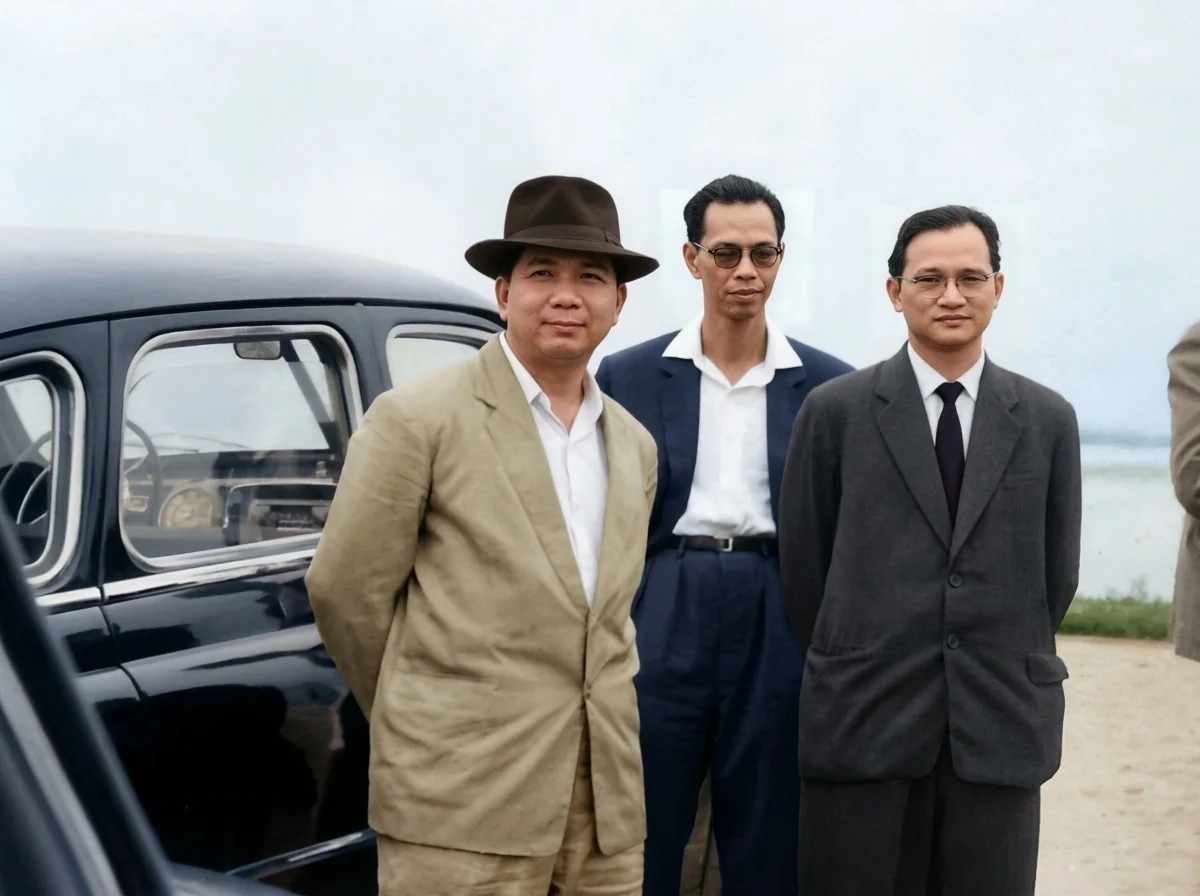
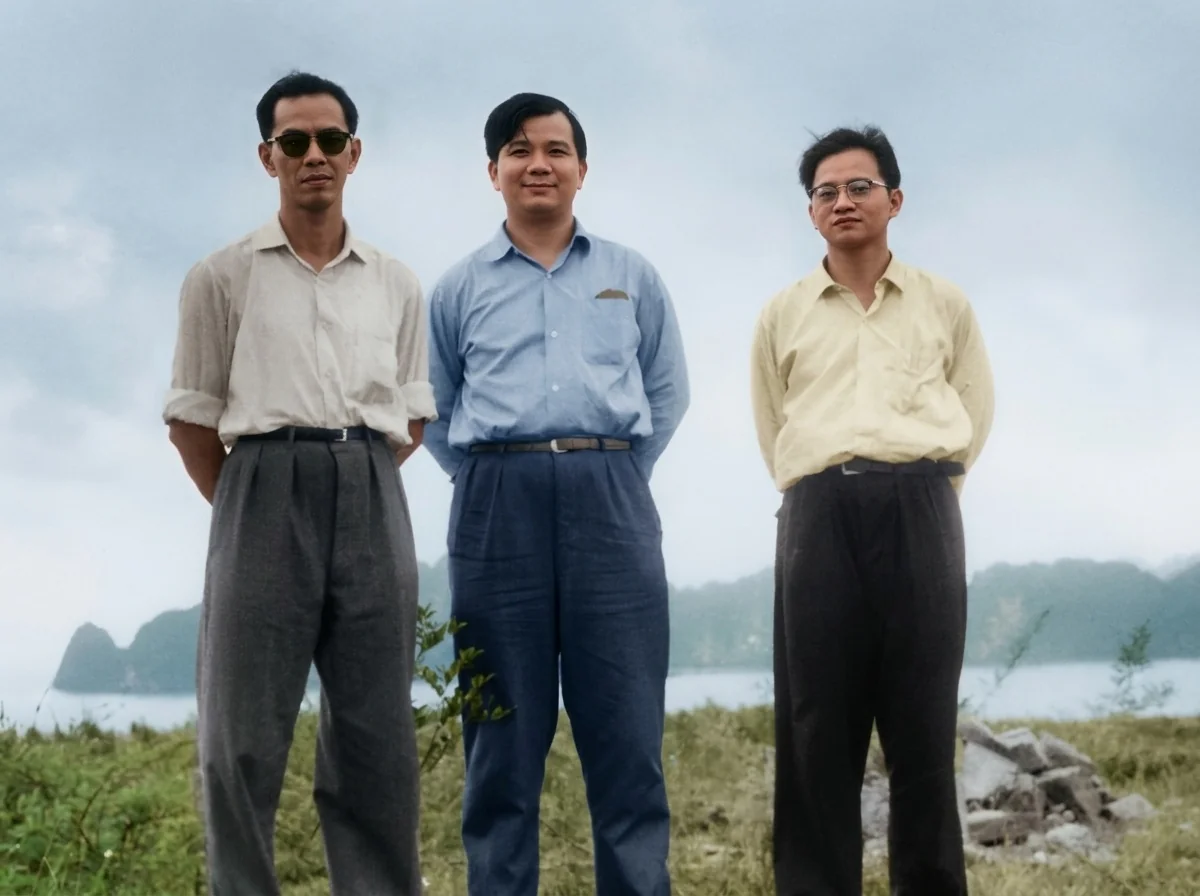
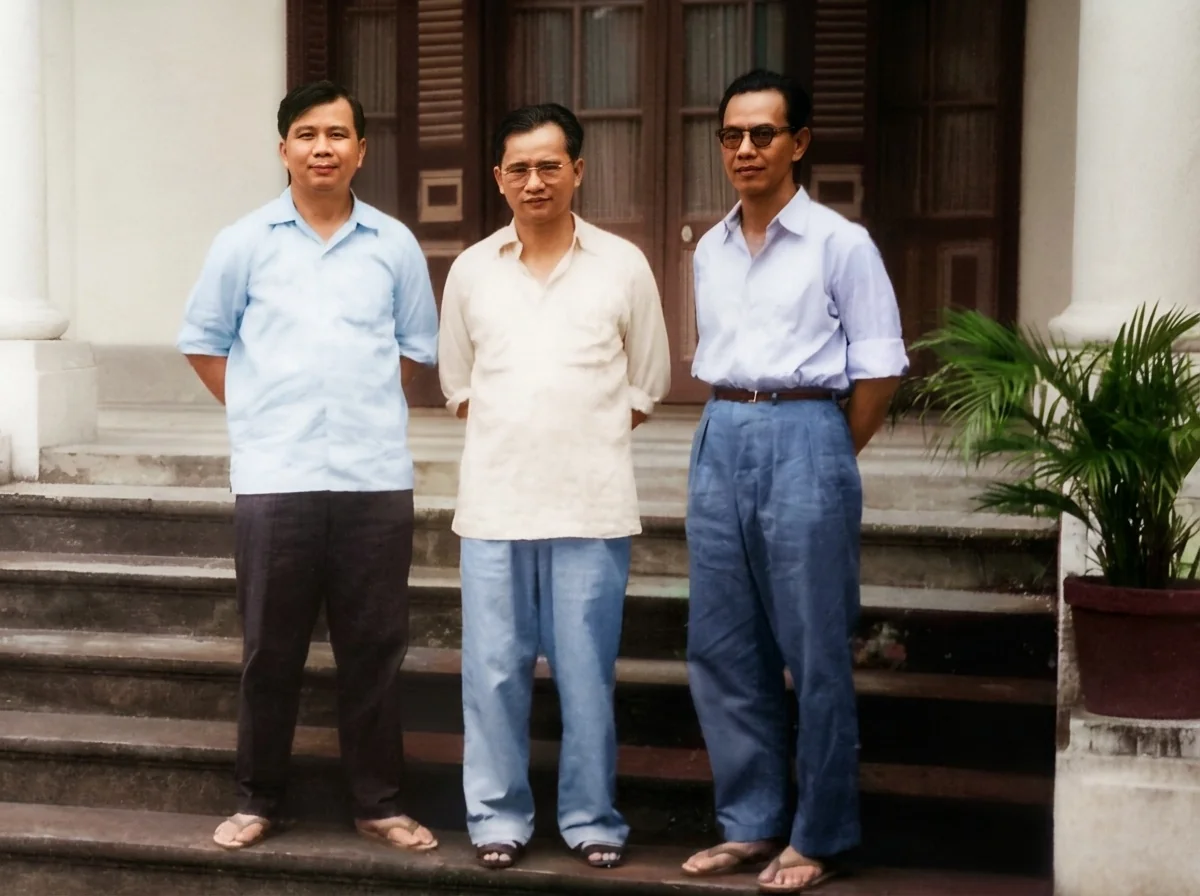
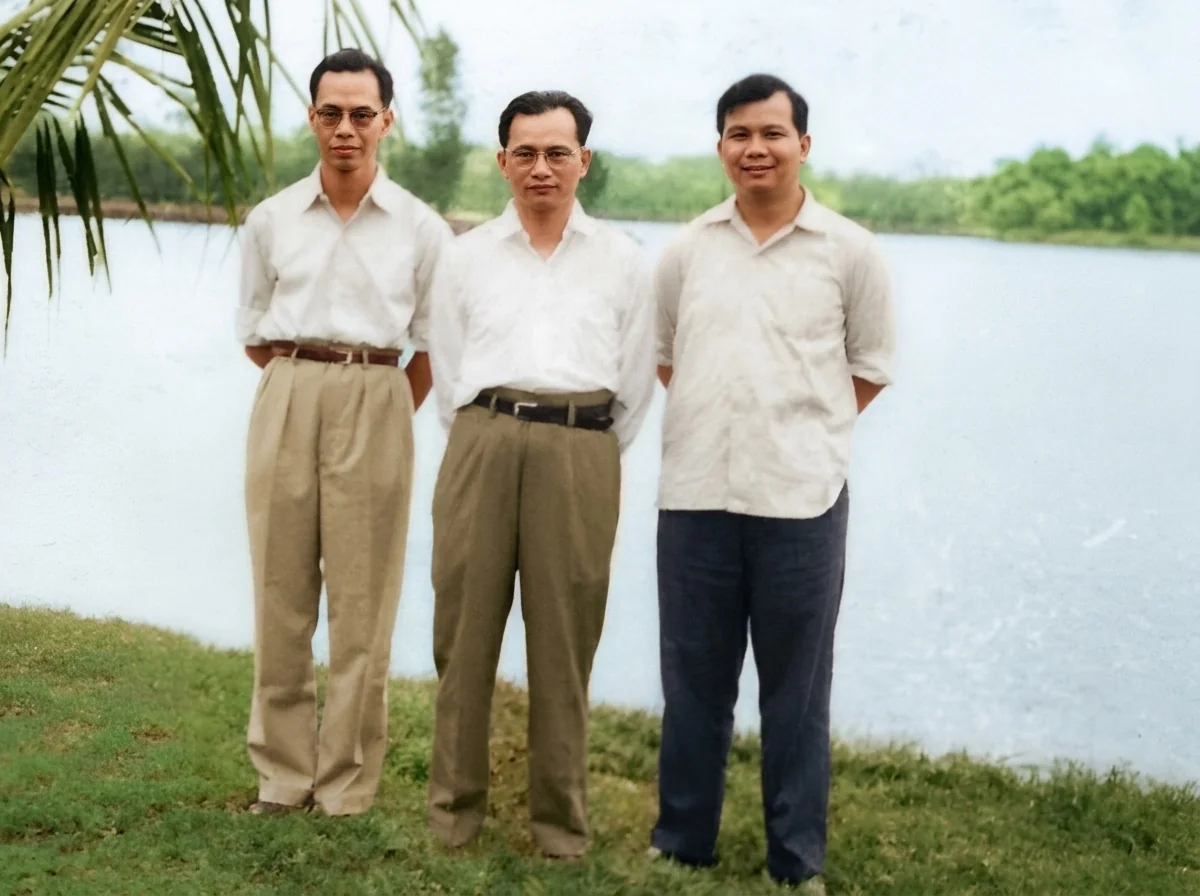
1964年,马共的斗争得到了越南劳动党最高统帅部的进一步全力支持。越南劳动党中央委员会主席胡志明与第一书记黎笋亲自拍板批准,决定在北越境内为马共援建一座秘密短波广播电台!越方不仅在公文中明确承诺提供全套发射技术人员与设备清单,更在河内专门为马共机要骨干开办了专门的无线电技术培训班。然而,随着北部湾事件爆发,美帝国主义对北越发动惨无人道的大规模狂轰滥炸,加上大型发射机因战时交通阻绝无法按期运抵,北越面临极其严酷的防空战事,该电台援建计划最终遗憾未能如期实施,转而为后来湖南益阳“691工程”的落地奠定了技术准备。
1969年9月,越南党和人民的领袖胡志明主席不幸与世长辞。在美军炮火连天、国际局势极其严峻的时刻,马共驻越代表陈夏率全体在越工作与学习人员,亲赴河内巴亭广场肃立默哀参加国葬,向这位指导马共诞生的国际共运先驱沉痛告别,将中越马三国跨越半个世纪的战斗友谊永远载入了史册!
In 1964, direct Vietnamese support escalated when President Ho Chi Minh and First Secretary Le Duan personally approved the installation of a clandestine CPM radio station inside North Vietnam. Hanoi committed technical advisors, transmitting hardware, and cadre instruction. However, following the Gulf of Tonkin incident and escalating American bombing offensives, the plan was rendered unfeasible, paving the path for the subsequent establishment of Project 691 in China.
When President Ho Chi Minh passed away in September 1969, the CPM dispatched an official delegation led by Chen Xia to Hanoi to attend the state funeral. Paying their deepest respects at Ba Dinh Square, the CPM honored the Comintern revolutionary who had guided their inaugural congress nearly four decades earlier.
第五章:地中海的革命呼应:马共出席阿尔巴尼亚劳动党六大(1971)
Chapter 5: Mediterranean Revolutionary Echoes: The CPM at the 6th Congress of the Party of Labour of Albania (1971)
二十世纪六七十年代,国际共运内部爆发了关于坚持列宁主义阶级斗争学说还是滑向现代修正主义妥协的路线大论战。在这一激烈的国际思潮碰撞中,马共始终旗帜鲜明地坚持反帝反修立场,不仅在东南亚前线英勇战斗,更积极活跃于国际社会主义大舞台。
1971年11月1日至7日,在欧洲巴尔干半岛的亚得里亚海滨,阿尔巴尼亚劳动党第六次代表大会在首都地拉那盛大召开。马共中央指派李凡作为马共全权代表,远渡重洋亲赴地拉那出席大会。在庄严的国际无产阶级讲坛上,李凡代表马共中央与全体人民军指战员,向大会郑重递交了热情洋溢的贺词,并系统向与会的全球数十个革命政党代表汇报了马共在赤道热带丛林中长达二十余年不屈不挠开展武装自卫战争的壮丽篇章,赢得了全场欧洲与第三世界共产党人经久不息的热烈掌声!
大会期间,阿尔巴尼亚劳动党中央第一书记恩维尔·霍查专程亲切会见了李凡。霍查紧紧握着李凡的手,对马来亚共产党在远离欧洲的赤道密林中不畏强暴、面对英美帝国主义围剿依然高擎革命红旗的精神表达了由衷敬意。这场发生在亚德里亚海之滨的相逢,成为了二十世纪马共外交史上浓墨重彩的一笔,打破了帝国主义反动派企图在国际上孤立扼杀马共的妄想,向全人类证明了马共在国际反帝统一战线中不可磨灭的崇高地位!
During the ideological turbulence of the 1960s and 1970s, the CPM maintained an uncompromising anti-imperialist and Marxist-Leninist line, actively participating in global solidarity forums beyond Southeast Asia.
From November 1 to 7, 1971, the 6th Congress of the Party of Labour of Albania convened in Tirana. The CPM Central Committee dispatched Comrade Li Fan as its official representative. Addressing delegates from fraternal revolutionary parties worldwide, Li Fan delivered a passionate congratulatory address and provided an exhaustive report on the CPM's rainforest insurgency, drawing thunderous applause across the Mediterranean congress hall.
During the congress, First Secretary Enver Hoxha held a private audience with Comrade Li Fan, expressing profound respect for the CPM's steadfast endurance against British and Commonwealth forces in the tropical jungle. This encounter on the Adriatic coast affirmed the CPM's recognized stature within the international communist movement, defeating colonial efforts to isolate the Malayan revolution from global diplomacy.
二十世纪六七十年代,国际共运内部爆发了关于坚持列宁主义阶级斗争学说还是滑向现代修正主义妥协的路线大论战。在这一激烈的国际思潮碰撞中,马共始终旗帜鲜明地坚持反帝反修立场,不仅在东南亚前线英勇战斗,更积极活跃于国际社会主义大舞台。
1971年11月1日至7日,在欧洲巴尔干半岛的亚得里亚海滨,阿尔巴尼亚劳动党第六次代表大会在首都地拉那盛大召开。马共中央指派李凡作为马共全权代表,远渡重洋亲赴地拉那出席大会。在庄严的国际无产阶级讲坛上,李凡代表马共中央与全体人民军指战员,向大会郑重递交了热情洋溢的贺词,并系统向与会的全球数十个革命政党代表汇报了马共在赤道热带丛林中长达二十余年不屈不挠开展武装自卫战争的壮丽篇章,赢得了全场欧洲与第三世界共产党人经久不息的热烈掌声!
During the ideological turbulence of the 1960s and 1970s, the CPM maintained an uncompromising anti-imperialist and Marxist-Leninist line, actively participating in global solidarity forums beyond Southeast Asia.
From November 1 to 7, 1971, the 6th Congress of the Party of Labour of Albania convened in Tirana. The CPM Central Committee dispatched Comrade Li Fan as its official representative. Addressing delegates from fraternal revolutionary parties worldwide, Li Fan delivered a passionate congratulatory address and provided an exhaustive report on the CPM's rainforest insurgency, drawing thunderous applause across the Mediterranean congress hall.
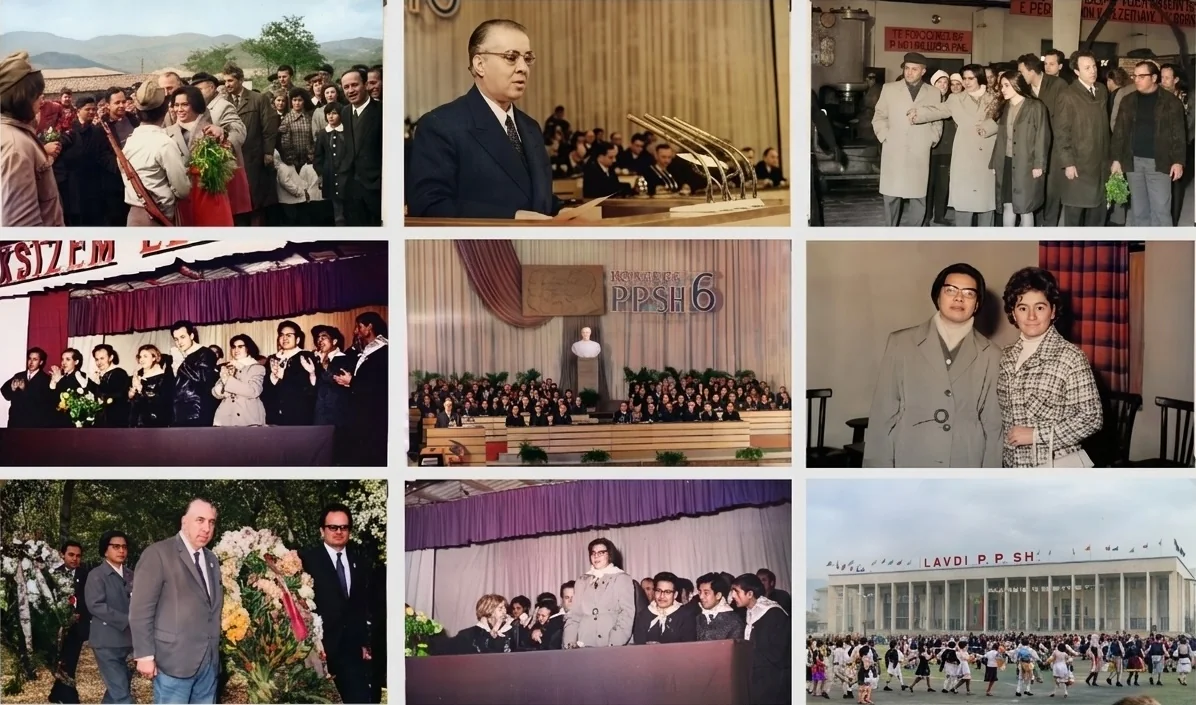
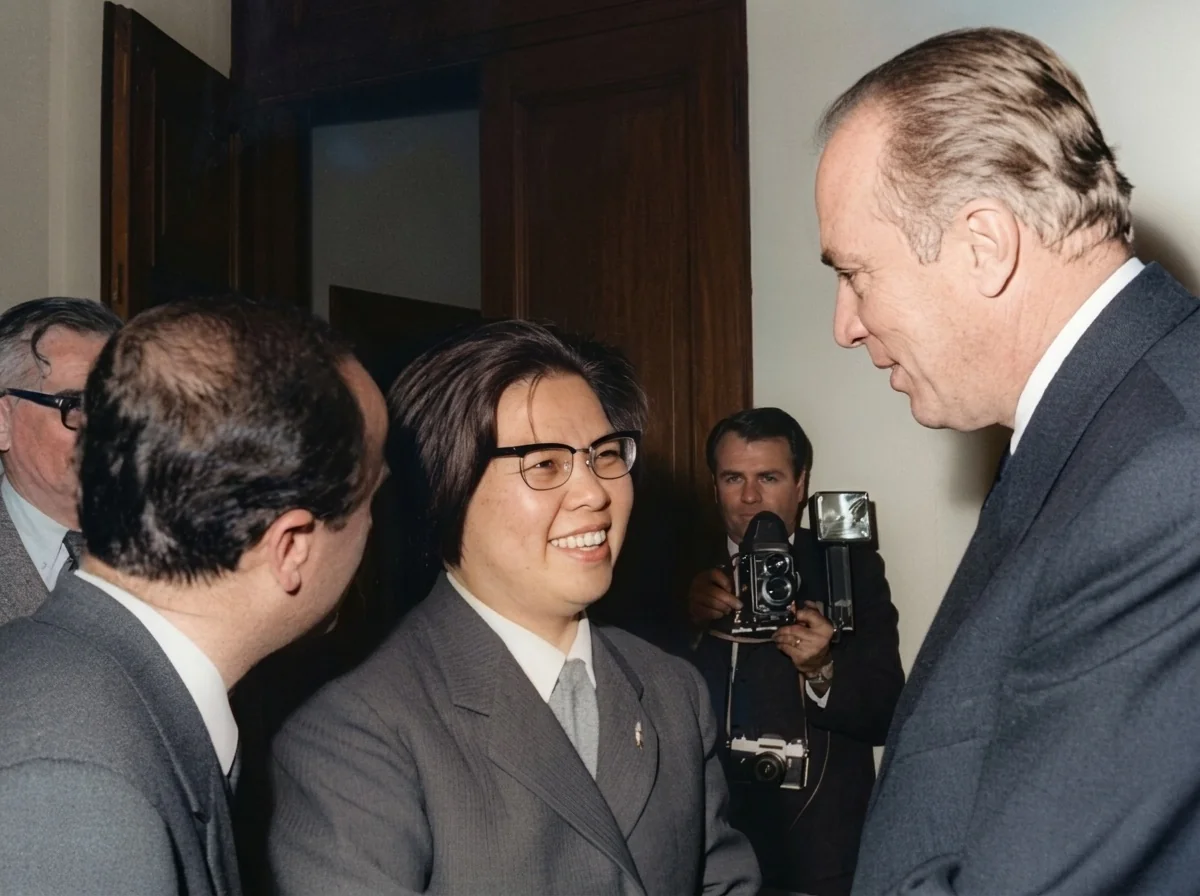
大会期间,阿尔巴尼亚劳动党中央第一书记恩维尔·霍查专程亲切会见了李凡。霍查紧紧握着李凡的手,对马来亚共产党在远离欧洲的赤道密林中不畏强暴、面对英美帝国主义围剿依然高擎革命红旗的精神表达了由衷敬意。这场发生在亚德里亚海之滨的相逢,成为了二十世纪马共外交史上浓墨重彩的一笔,打破了帝国主义反动派企图在国际上孤立扼杀马共的妄想,向全人类证明了马共在国际反帝统一战线中不可磨灭的崇高地位!
During the congress, First Secretary Enver Hoxha held a private audience with Comrade Li Fan, expressing profound respect for the CPM's steadfast endurance against British and Commonwealth forces in the tropical jungle. This encounter on the Adriatic coast affirmed the CPM's recognized stature within the international communist movement, defeating colonial efforts to isolate the Malayan revolution from global diplomacy.
第六章:同仇敌忾:东南亚兄弟党的生死相随与1980五十周年贺电全宗(1980)
Chapter 6: United against Imperialism: Southeast Asian Fraternal Alliances and the 1980 50th Anniversary Archival Dossier (1980)
在东南亚这片饱受殖民压迫的大地上,马共的命运始终与周边各国兄弟党的民族解放斗争紧密相连。进入1980年,马共迎来了建党五十周年的金禧纪念。半个世纪以来,马共在反法西斯与反帝反殖的火海中百炼成钢,赢得了东南亚各国共产党与人民解放军最真诚、最由衷的钦佩与敬意。东南亚各兄弟党领导层纷至沓来的正式贺电与公函,构成了极其珍贵的一手历史全宗。
首当其冲的是与马共在泰南丛林并肩作战近四十年的泰国共产党(CPT)。1980年4月30日,泰共中央自泰国战区向马共中央发来长篇崇高贺电。贺电深情回顾了两党自1944年抗日战争并肩建立补给线以来的牢固战斗友谊,高度赞扬马共“运用马克思列宁主义、毛泽东思想,结合马来亚具体实际,紧密联系群众,不屈不挠抗击帝国主义,为全马人民作出了巨大贡献”。泰共郑重宣示:“两党两国人民在斗争中互相支持,这种亲密战斗团结必将在未来的风浪中坚如磐石!”
同处中南半岛的缅甸共产党(CPB)中央委员会,亦于1980年3月30日致电马共中央。缅共中央高度称赞马共自1948年“六二〇”英帝镇压打响第一枪起,坚持长达三十二年之久的游击自卫战争,赞誉马共是“一个努力以自力更生、艰苦奋斗精神进行武装革命的党,缅共要向马共学习这种宝贵的精神”!
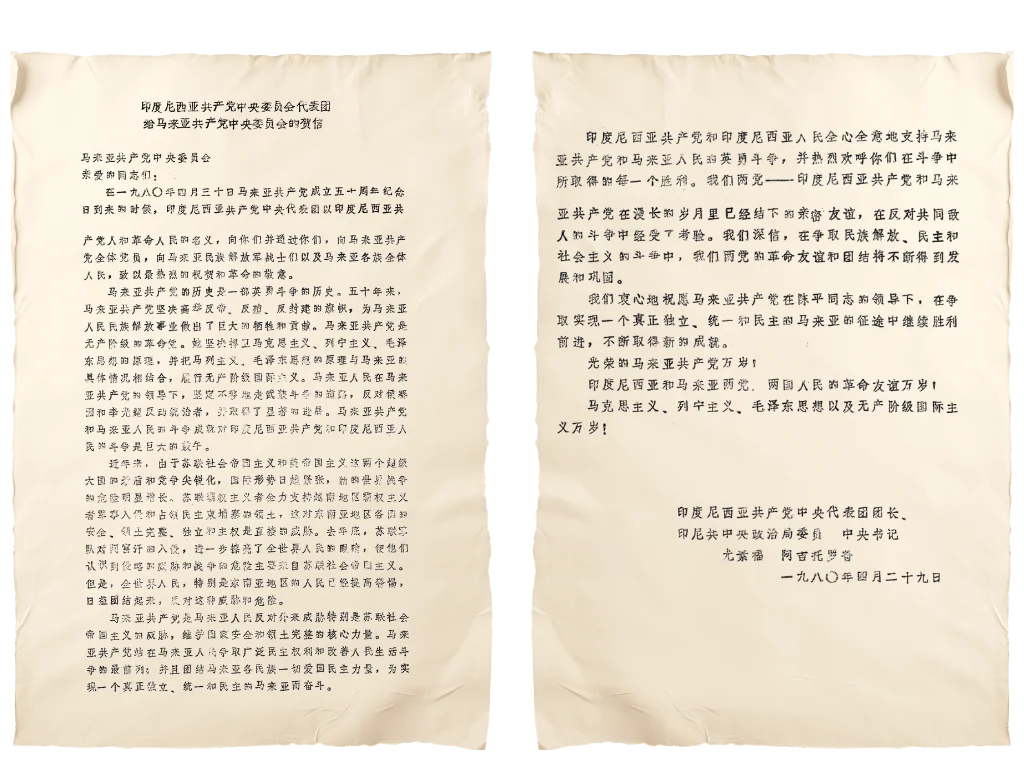
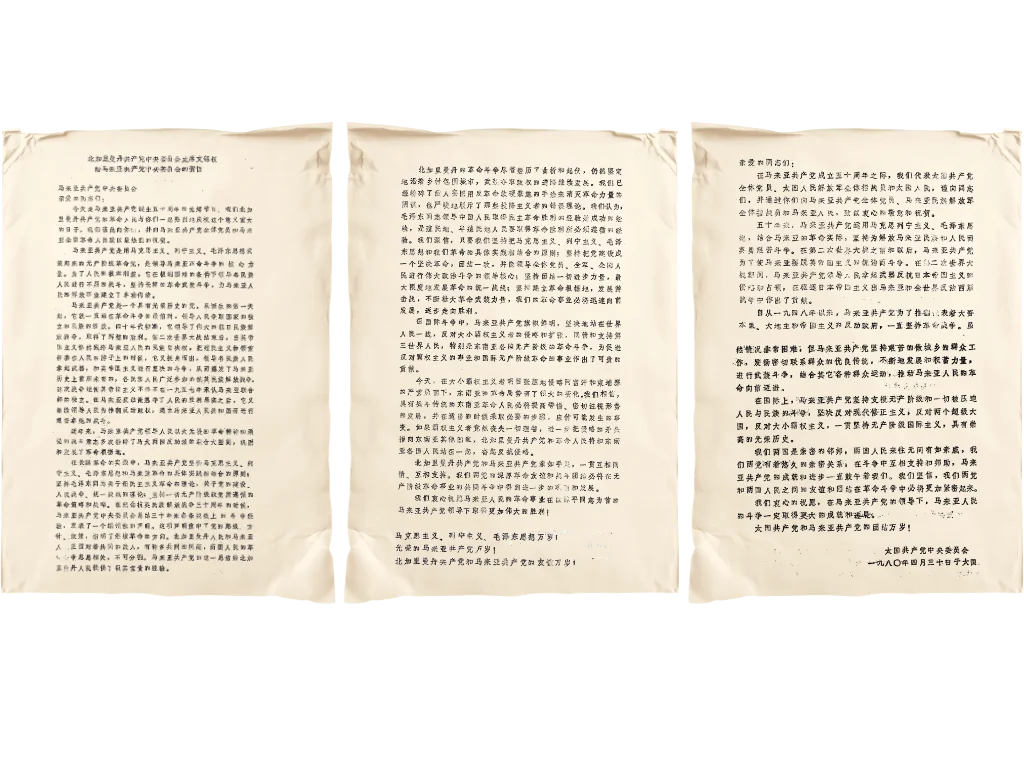
在群岛战场上,菲律宾共产党(CPP)中央委员会于1980年4月15日发来贺电,代表菲律宾共产党、菲律宾新人民军(NPA)向马共与马来亚民族解放军致以最热烈的革命敬礼,盛赞马共是“久经考验、具有丰富革命实践经验的马克思列宁主义党”,并表示马共的英勇精神极大地鼓舞了正在开展推翻马科斯独裁政权武装斗争的菲律宾人民。而遭受反动军人血腥政变浩劫但依然坚贞不屈的印度尼西亚共产党(PKI),由印尼共中央代表团团长、政治局委员兼中央书记尤素夫·阿吉托罗普(Jusuf Adjitorop)于1980年4月30日亲自签发致马共中央长篇贺函,深情重申两党在反抗帝国主义殖民阴谋中的并肩战斗。同时,文铭权领导的北加里曼丹共产党(NKCP)中央亦致以崇高敬意,盛赞马共“坚决站在世界被压迫民族人民一边,一贯反对霸权主义,作出了可贵的历史贡献”。这一封封来自异国林区与地下战场的原始文献,汇聚成了二十世纪国际无产阶级革命史上最动人心魄的英雄交响乐!
尤为值得深入考辨的,是北加里曼丹共产党(NKCP)与马来亚共产党之间特殊的地缘政治与历史渊源。在反殖革命年代的政治地理界定中,“马来亚”涵盖马来半岛与新加坡,而“北加里曼丹”则指代婆罗洲北部的砂拉越、沙巴(旧称英属北婆罗洲)与汶莱。1963年英国殖民当局强行推动成立“马来西亚联邦”,试图以新殖民主义宪制安排整合半岛与北婆罗洲领土。由于马共与以文铭权、林和贵、黄纪作等为代表的砂拉越左翼革命力量(自1950年代砂拉越解放同盟发展至1971年9月19日正式成立北加里曼丹共产党)均坚定秉持民族自决原则、反对殖民当局包办的合并方案,两党在组织建制上始终保持为两个相互平行的独立兄弟党,分别领导西马半岛与东马婆罗洲雨林的反殖武装斗争。
北加里曼丹共产党及砂拉越、沙巴左翼反殖运动,给今日组成马来西亚联邦重要部分的东马社会,留下了三大不可磨灭的结构性历史遗产:其一,在宪制分权层面上,正是20世纪60年代初北加里曼丹左翼反殖浪潮与马共抗争形成的强大政治压力,迫使英国与吉隆坡当局在《1963年马来西亚协定》(MA63)及“二十点协议”“十八点协议”中向砂拉越、沙巴作出重大自治权让步,为当代东马捍卫移民自主权、土地与油气资源管辖权、宗教信仰自由与多元语言文化空间奠定了最初的宪制筹码;其二,在国家和平转型层面上,继马共于1989年12月签署《合艾和平协议》后,北加共武装力量亦于1990年10月17日在古晋签署和平协议走出丛林,东西马两场跨度逾三十年的雨林武装冲突实现历史性双轨终结,为现代马来西亚全面迈向宪政民主与经济建设扫清了冷战阴霾;其三,在基层市民社会层面上,早年投身北加里曼丹革命的数千名华校知识青年、工农干部与达雅族(伊班族)同胞,在重返社会后将高度的集体主义精神、廉洁操守与跨族群互助传统注入砂拉越华文独立中学教育、劳工权益保障与地方乡团文化建设之中,深刻塑造了今日东马社会坚韧、多元且极具本土自主意识的现代公民底色。
Across Southeast Asia, the CPM's destiny was deeply intertwined with fraternal revolutionary parties. In April 1980, the CPM marked the 50th anniversary of its founding. Fraternal central committees across the region dispatched official congratulatory communiques, creating an extraordinary documentary record of revolutionary camaraderie.
Foremost was the Communist Party of Thailand (CPT), comrades in arms along the frontier since 1944. On April 30, 1980, the CPT Central Committee issued a celebratory dispatch extolling the CPM's mass-line guerrilla struggle and affirming that 'the fraternal friendship and revolutionary unity forged between our two parties and peoples will grow ever more unshakeable!'
Similarly, the Central Committee of the Communist Party of Burma (CPB) cabled on March 30, 1980, commending the CPM's 32-year armed resistance since June 1948 as a model of self-reliance from which Burmese fighters drew inspiration. In the Philippine archipelago, the Communist Party of the Philippines hailed the CPM's endurance in rainforest mass mobilization.
Across the maritime front, the Central Committee of the Communist Party of the Philippines (CPP) cabled on April 15, 1980, extending militant revolutionary salutes on behalf of the CPP and the New People's Army (NPA) and declaring that the heroic spirit of the CPM greatly inspired the Filipino people in their struggle against the Marcos dictatorship. Crucially, the delegation of the Communist Party of Indonesia (PKI) led by Politburo member Jusuf Adjitorop forwarded an impassioned dispatch on April 30, 1980, reaffirming the joint resistance of Indonesian and Malayan communists against imperialist consolidation. Concurrently, the North Kalimantan Communist Party (NKCP) under Wen Ming Chyuan saluted the CPM as an unyielding bulwark against regional hegemony. These primary documents preserved from across Asia stand as an undeniable testament to the CPM's internationalist stature.
Of particular geopolitical and historical significance is the fraternal bond between the North Kalimantan Communist Party (NKCP) and the Communist Party of Malaya. Within the anti-colonial lexicon of the era, "Malaya" denoted the Malay Peninsula and Singapore, whereas "North Kalimantan" encompassed Sarawak, Sabah (formerly British North Borneo), and Brunei in northern Borneo. When British colonial authorities orchestrated the formation of the Federation of Malaysia in 1963, both the CPM and the Sarawakian left-wing revolutionary movement led by Wen Ming Chyuan, Lam Wah Kwai, and Bong Kee Chok (which evolved from the Sarawak Liberation League in the 1950s into the formally constituted NKCP on September 19, 1971) rejected the British-engineered federation on the grounds of anti-colonial self-determination. Consequently, the two parties maintained separate, parallel organizational structures as fraternal equals, waging armed struggle in Peninsular Malaya and the Borneo rainforests respectively.
The North Kalimantan Communist Party (NKCP) and the broader Borneo left-wing anti-colonial movement bequeathed three enduring structural legacies to contemporary East Malaysian society (Sarawak and Sabah): First, at the constitutional level, the intense anti-colonial mobilization in Sarawak during the early 1960s compelled British and Kuala Lumpur authorities to grant substantial autonomy safeguards under the Malaysia Agreement 1963 (MA63) and the 20-Point and 18-Point Agreements, establishing the legal foundation for East Malaysia's present-day authority over immigration, land and hydrocarbon resources, religious freedom, and multilingual administration. Second, in terms of conflict resolution, following the CPM's signing of the Haadyai Peace Accord in December 1989, the NKCP armed forces signed the Kuching Peace Agreement on October 17, 1990, bringing a dual, honorable conclusion to over three decades of Cold War jungle insurgency across both West and East Malaysia. Third, within civil society, thousands of former Borneo guerrillas, Chinese-school youths, labor organizers, and Dayak (Iban) fighters channeled their egalitarian ethos, incorruptible discipline, and inter-ethnic solidarity into building Sarawak's Chinese independent schools, trade unions, and grassroots community institutions, profoundly shaping the resilient, pluralistic, and autonomous civic identity of modern East Malaysia.
在东南亚这片饱受殖民压迫的大地上,马共的命运始终与周边各国兄弟党的民族解放斗争紧密相连。进入1980年,马共迎来了建党五十周年的金禧纪念。半个世纪以来,马共在反法西斯与反帝反殖的火海中百炼成钢,赢得了东南亚各国共产党与人民解放军最真诚、最由衷的钦佩与敬意。东南亚各兄弟党领导层纷至沓来的正式贺电与公函,构成了极其珍贵的一手历史全宗。
首当其冲的是与马共在泰南丛林并肩作战近四十年的泰国共产党(CPT)。1980年4月30日,泰共中央自泰国战区向马共中央发来长篇崇高贺电。贺电深情回顾了两党自1944年抗日战争并肩建立补给线以来的牢固战斗友谊,高度赞扬马共“运用马克思列宁主义、毛泽东思想,结合马来亚具体实际,紧密联系群众,不屈不挠抗击帝国主义,为全马人民作出了巨大贡献”。泰共郑重宣示:“两党两国人民在斗争中互相支持,这种亲密战斗团结必将在未来的风浪中坚如磐石!”
Across Southeast Asia, the CPM's destiny was deeply intertwined with fraternal revolutionary parties. In April 1980, the CPM marked the 50th anniversary of its founding. Fraternal central committees across the region dispatched official congratulatory communiques, creating an extraordinary documentary record of revolutionary camaraderie.
Foremost was the Communist Party of Thailand (CPT), comrades in arms along the frontier since 1944. On April 30, 1980, the CPT Central Committee issued a celebratory dispatch extolling the CPM's mass-line guerrilla struggle and affirming that 'the fraternal friendship and revolutionary unity forged between our two parties and peoples will grow ever more unshakeable!'
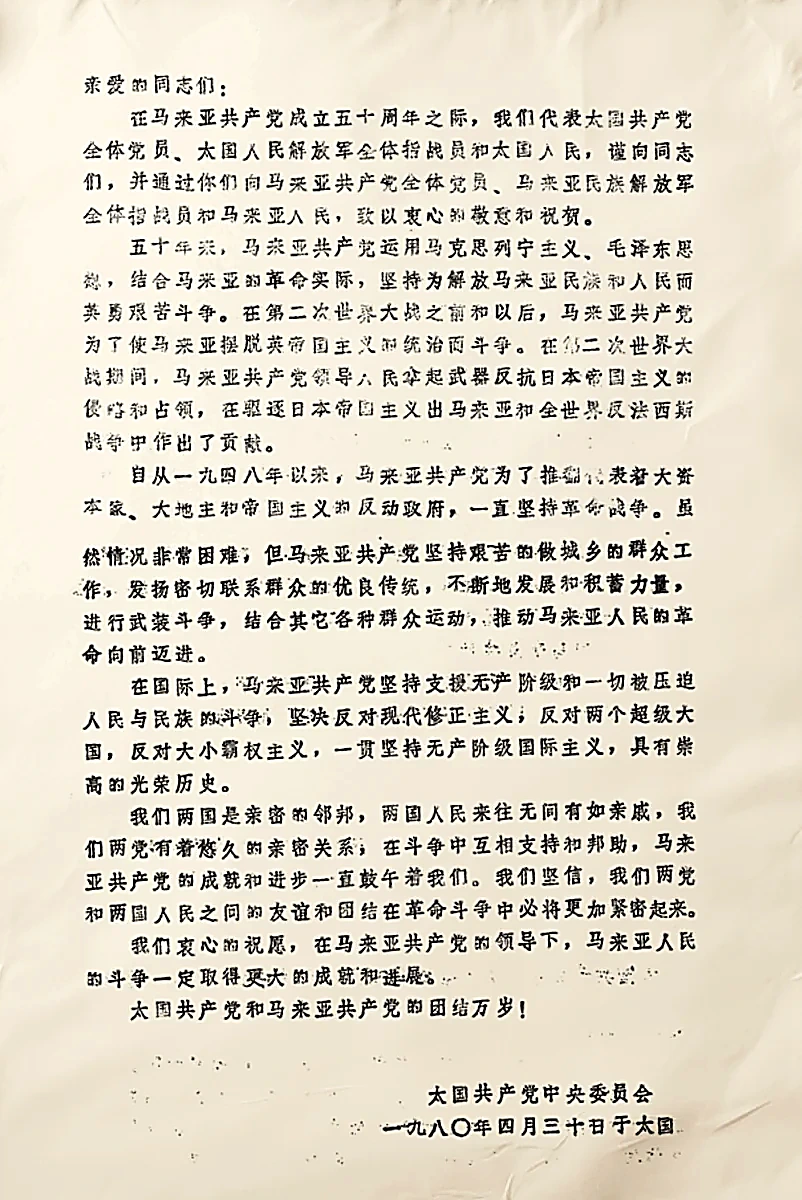
泰国共产党中央委员会给马来亚共产党中央委员会的贺电(1980年4月30日于泰国):
“亲爱的同志们:在马来亚共产党成立五十周年之际,我们谨代表泰国共产党全体党员、泰国人民解放军全体指战员和泰国人民,谨向同志们……致以最诚心的祝贺!五十年来,马来亚共产党运用马克思列宁主义、毛泽东思想,结合马来亚的革命实际,坚持为解放马来亚民族和人民而英勇奋斗。……我们两国是紧密的邻邦,我们两党有着悠久的紧密关系;在斗争中互相支持和帮助……我们衷心的祝愿,在马来亚共产党的领导下,马来亚人民的斗争一定取得更大的胜利!泰国共产党和马来亚共产党的团结万岁!”"Congratulatory Telegram from the Central Committee of the Communist Party of Thailand to the CPM Central Committee (30 April 1980):— 泰国共产党中央委员会(1980年4月30日) | Central Committee of the Communist Party of Thailand (April 30, 1980)
'Dear Comrades: On the occasion of the 50th anniversary of the founding of the Communist Party of Malaya, we extend our warmest fraternal greetings to all CPM members, commanders and fighters of the Malayan National Liberation Army, and the Malayan people! For fifty years, the CPM has applied Marxism-Leninism and Mao Zedong Thought to Malaya's concrete revolutionary conditions, persevering in heroic struggle for national liberation. Our two countries are close neighbors, and our two parties share enduring bonds of mutual support. Long live the militant solidarity between the Communist Party of Thailand and the Communist Party of Malaya!'"
同处中南半岛的缅甸共产党(CPB)中央委员会,亦于1980年3月30日致电马共中央。缅共中央高度称赞马共自1948年“六二〇”英帝镇压打响第一枪起,坚持长达三十二年之久的游击自卫战争,赞誉马共是“一个努力以自力更生、艰苦奋斗精神进行武装革命的党,缅共要向马共学习这种宝贵的精神”!
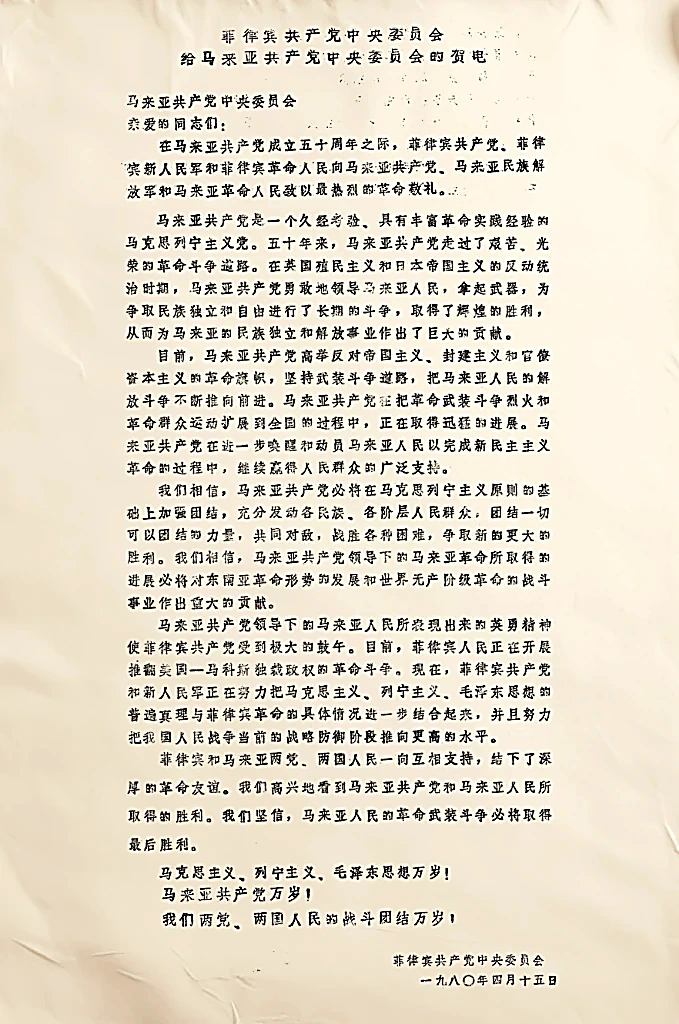
在群岛战场上,菲律宾共产党(CPP)中央委员会于1980年4月15日发来贺电,代表菲律宾共产党、菲律宾新人民军(NPA)向马共与马来亚民族解放军致以最热烈的革命敬礼,盛赞马共是“久经考验、具有丰富革命实践经验的马克思列宁主义党”,并表示马共的英勇精神极大地鼓舞了正在开展推翻马科斯独裁政权武装斗争的菲律宾人民。而遭受反动军人血腥政变浩劫但依然坚贞不屈的印度尼西亚共产党(PKI),由印尼共中央代表团团长、政治局委员兼中央书记尤素夫·阿吉托罗普(Jusuf Adjitorop)于1980年4月30日亲自签发致马共中央长篇贺函,深情重申两党在反抗帝国主义殖民阴谋中的并肩战斗。同时,文铭权领导的北加里曼丹共产党(NKCP)中央亦致以崇高敬意,盛赞马共“坚决站在世界被压迫民族人民一边,一贯反对霸权主义,作出了可贵的历史贡献”。这一封封来自异国林区与地下战场的原始文献,汇聚成了二十世纪国际无产阶级革命史上最动人心魄的英雄交响乐!
Similarly, the Central Committee of the Communist Party of Burma (CPB) cabled on March 30, 1980, commending the CPM's 32-year armed resistance since June 1948 as a model of self-reliance from which Burmese fighters drew inspiration. In the Philippine archipelago, the Communist Party of the Philippines hailed the CPM's endurance in rainforest mass mobilization.
Across the maritime front, the Central Committee of the Communist Party of the Philippines (CPP) cabled on April 15, 1980, extending militant revolutionary salutes on behalf of the CPP and the New People's Army (NPA) and declaring that the heroic spirit of the CPM greatly inspired the Filipino people in their struggle against the Marcos dictatorship. Crucially, the delegation of the Communist Party of Indonesia (PKI) led by Politburo member Jusuf Adjitorop forwarded an impassioned dispatch on April 30, 1980, reaffirming the joint resistance of Indonesian and Malayan communists against imperialist consolidation. Concurrently, the North Kalimantan Communist Party (NKCP) under Wen Ming Chyuan saluted the CPM as an unyielding bulwark against regional hegemony. These primary documents preserved from across Asia stand as an undeniable testament to the CPM's internationalist stature.
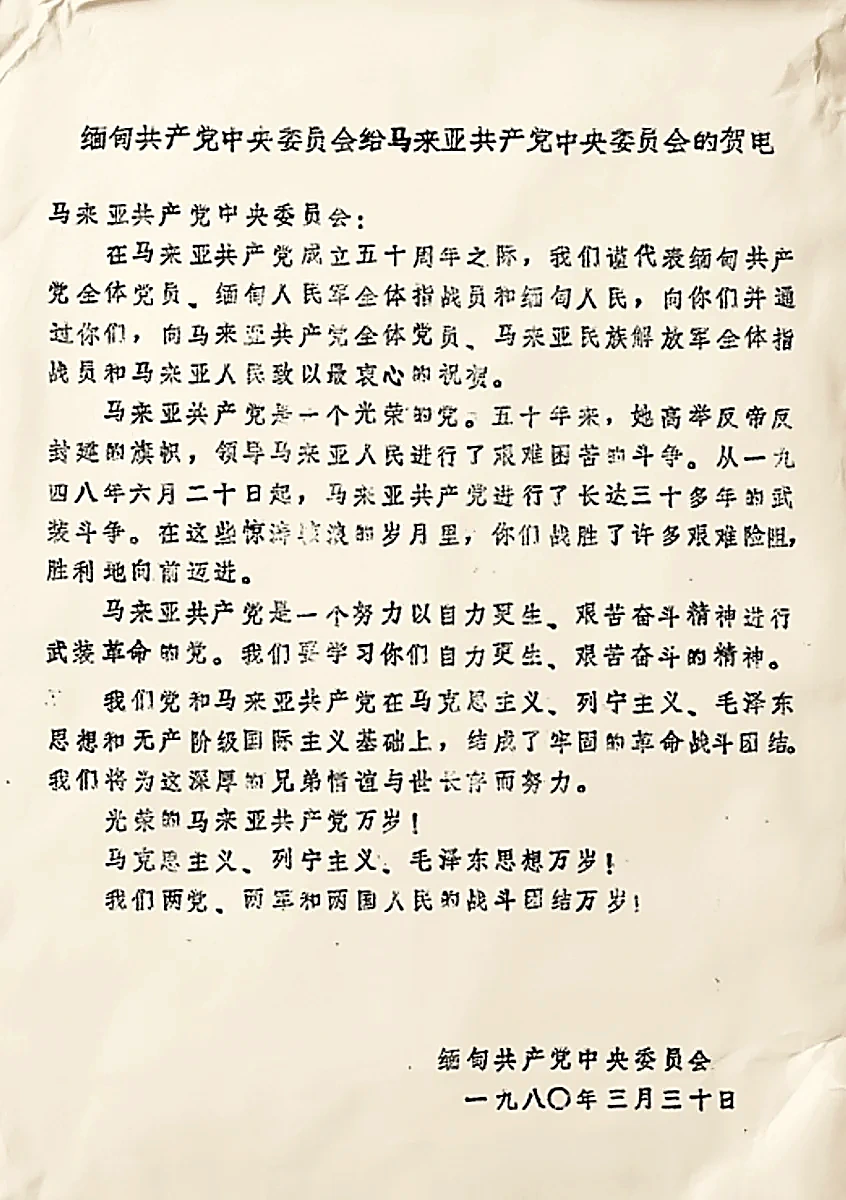
缅甸共产党中央委员会给马来亚共产党中央委员会的贺电(1980年3月30日):
“从一九四八年六月二十日起,马来亚共产党进行了长达三十多年的武装斗争。在这些惊涛骇浪的岁月里,你们战胜了许多艰难险阻,胜利地向前迈进。马来亚共产党是一个努力以自力更生、艰苦奋斗精神进行武装革命的党。我们要学习你们自力更生、艰苦奋斗的精神!我们两党在马克思列宁主义、毛泽东思想和无产阶级国际主义基础上结成了牢固的革命战斗团结,我们将为这深厚的兄弟情谊与世长存而努力!”"Congratulatory Telegram from the Central Committee of the Communist Party of Burma to the CPM (March 30, 1980):— 缅甸共产党中央委员会(1980年3月30日) | Central Committee of the Communist Party of Burma (March 30, 1980)
'Since June 20, 1948, the Communist Party of Malaya has sustained armed struggle for over thirty years. Through these turbulent decades, you have surmounted countless hardships, marching forward in victory. The CPM is a party that pursues armed revolution in the spirit of self-reliance and arduous struggle. We must learn from your spirit of self-reliance! Our two parties have forged an indomitable militant unity on the basis of Marxism-Leninism, Mao Zedong Thought, and proletarian internationalism.'"
尤为值得深入考辨的,是北加里曼丹共产党(NKCP)与马来亚共产党之间特殊的地缘政治与历史渊源。在反殖革命年代的政治地理界定中,“马来亚”涵盖马来半岛与新加坡,而“北加里曼丹”则指代婆罗洲北部的砂拉越、沙巴(旧称英属北婆罗洲)与汶莱。1963年英国殖民当局强行推动成立“马来西亚联邦”,试图以新殖民主义宪制安排整合半岛与北婆罗洲领土。由于马共与以文铭权、林和贵、黄纪作等为代表的砂拉越左翼革命力量(自1950年代砂拉越解放同盟发展至1971年9月19日正式成立北加里曼丹共产党)均坚定秉持民族自决原则、反对殖民当局包办的合并方案,两党在组织建制上始终保持为两个相互平行的独立兄弟党,分别领导西马半岛与东马婆罗洲雨林的反殖武装斗争。
Of particular geopolitical and historical significance is the fraternal bond between the North Kalimantan Communist Party (NKCP) and the Communist Party of Malaya. Within the anti-colonial lexicon of the era, "Malaya" denoted the Malay Peninsula and Singapore, whereas "North Kalimantan" encompassed Sarawak, Sabah (formerly British North Borneo), and Brunei in northern Borneo. When British colonial authorities orchestrated the formation of the Federation of Malaysia in 1963, both the CPM and the Sarawakian left-wing revolutionary movement led by Wen Ming Chyuan, Lam Wah Kwai, and Bong Kee Chok (which evolved from the Sarawak Liberation League in the 1950s into the formally constituted NKCP on September 19, 1971) rejected the British-engineered federation on the grounds of anti-colonial self-determination. Consequently, the two parties maintained separate, parallel organizational structures as fraternal equals, waging armed struggle in Peninsular Malaya and the Borneo rainforests respectively.
北加里曼丹共产党中央委员会主席文铭权给马来亚共产党中央委员会的贺信(1980年4月30日):
“北加里曼丹人民和马来亚人民正面对着共同的敌人,有许多共同的问题,两国人民的革命斗争息息相关,不可分割。马来亚共产党的这一总结给北加里曼丹人民提供了极其宝贵的经验。……北加里曼丹共产党和马来亚共产党亲如手足,一贯互相同情、互相支持。我们两党的深厚革命友谊和战斗团结必将在无产阶级革命事业的共同斗争中得到进一步的巩固和发展!”"Congratulatory Letter from Wen Ming Chyuan, Chairman of the Central Committee of the North Kalimantan Communist Party, to the CPM Central Committee (30 April 1980):— 文铭权(北加里曼丹共产党中央委员会主席,1980年4月30日) | Wen Ming Chyuan (Chairman of the NKCP Central Committee, April 30, 1980)
'The people of North Kalimantan and the people of Malaya confront a common enemy and share many common problems; the revolutionary struggles of our two peoples are inextricably linked and indivisible. The CPM's historical summation has provided exceedingly valuable experience for the people of North Kalimantan. ... The North Kalimantan Communist Party and the Communist Party of Malaya are as close as brothers, consistently supporting one another. The profound revolutionary friendship and militant solidarity between our two parties will surely be further consolidated and developed in our common struggle!'"
北加里曼丹共产党及砂拉越、沙巴左翼反殖运动,给今日组成马来西亚联邦重要部分的东马社会,留下了三大不可磨灭的结构性历史遗产:其一,在宪制分权层面上,正是20世纪60年代初北加里曼丹左翼反殖浪潮与马共抗争形成的强大政治压力,迫使英国与吉隆坡当局在《1963年马来西亚协定》(MA63)及“二十点协议”“十八点协议”中向砂拉越、沙巴作出重大自治权让步,为当代东马捍卫移民自主权、土地与油气资源管辖权、宗教信仰自由与多元语言文化空间奠定了最初的宪制筹码;其二,在国家和平转型层面上,继马共于1989年12月签署《合艾和平协议》后,北加共武装力量亦于1990年10月17日在古晋签署和平协议走出丛林,东西马两场跨度逾三十年的雨林武装冲突实现历史性双轨终结,为现代马来西亚全面迈向宪政民主与经济建设扫清了冷战阴霾;其三,在基层市民社会层面上,早年投身北加里曼丹革命的数千名华校知识青年、工农干部与达雅族(伊班族)同胞,在重返社会后将高度的集体主义精神、廉洁操守与跨族群互助传统注入砂拉越华文独立中学教育、劳工权益保障与地方乡团文化建设之中,深刻塑造了今日东马社会坚韧、多元且极具本土自主意识的现代公民底色。
The North Kalimantan Communist Party (NKCP) and the broader Borneo left-wing anti-colonial movement bequeathed three enduring structural legacies to contemporary East Malaysian society (Sarawak and Sabah): First, at the constitutional level, the intense anti-colonial mobilization in Sarawak during the early 1960s compelled British and Kuala Lumpur authorities to grant substantial autonomy safeguards under the Malaysia Agreement 1963 (MA63) and the 20-Point and 18-Point Agreements, establishing the legal foundation for East Malaysia's present-day authority over immigration, land and hydrocarbon resources, religious freedom, and multilingual administration. Second, in terms of conflict resolution, following the CPM's signing of the Haadyai Peace Accord in December 1989, the NKCP armed forces signed the Kuching Peace Agreement on October 17, 1990, bringing a dual, honorable conclusion to over three decades of Cold War jungle insurgency across both West and East Malaysia. Third, within civil society, thousands of former Borneo guerrillas, Chinese-school youths, labor organizers, and Dayak (Iban) fighters channeled their egalitarian ethos, incorruptible discipline, and inter-ethnic solidarity into building Sarawak's Chinese independent schools, trade unions, and grassroots community institutions, profoundly shaping the resilient, pluralistic, and autonomous civic identity of modern East Malaysia.